ARTS / CULTURE & LEISURE
Full-coverage protection plan launched for UNESCO grottoes heritage in Chongqing
68 caves at Dazu Rock Carvings in Chongqing to get full-coverage protection
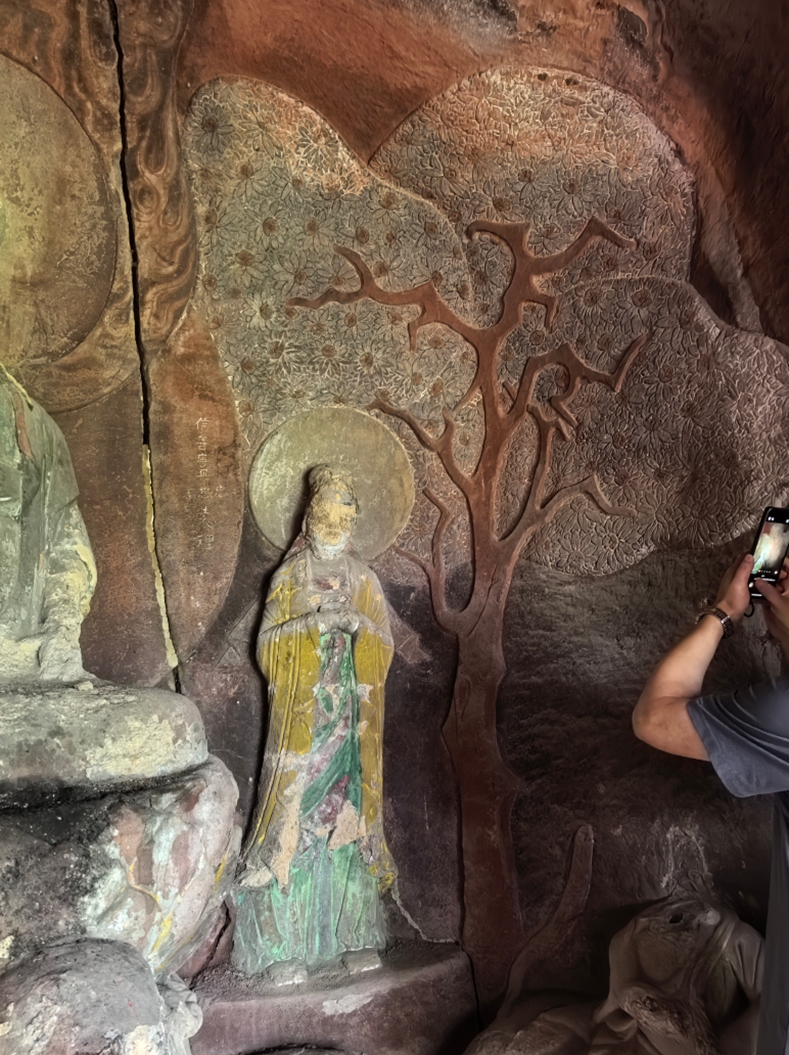
Photo: Courtesy of Dazu Rock Carvings Research Institute
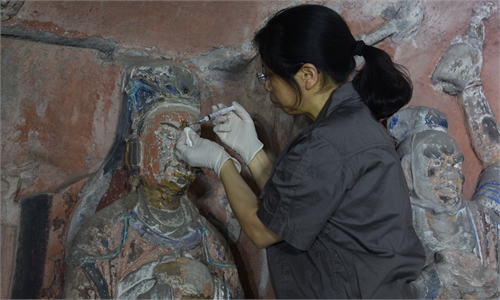
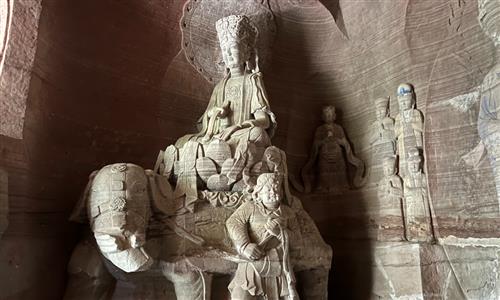
Led by the Dazu Rock Carvings Research Institute, a conservation project dedicated to preserving 68 medium- and small-sized grottoes sporting the cliffside Dazu Rock Carvings in Southwest China's Chongqing Municipality was recently launched.The Dazu Rock Carvings form a UNESCO World Cultural Heritage site dating from the 9th to the 13th century. The cliffside complex includes multiple grottoes and statues of various sizes. In addition to its well-known Qianshou Guanyin sculpture (bodhisattva with a thousand hands) sculpture, there are many "lesser-known and smaller grottoes," said Hu Xiangqian, director of the planning and construction division of the institute.
"The current project aims to recover them, and upon its completion, the site will achieve full-coverage protection," Hu told the Global Times.
It is estimated that around November 2026, a total of 22 small-medium grottoes that are part of the Dazu Rock Carvings heritage but situated outside its core protected area will be restored, said Hu. The 2026 project marks the third phase of the conservation effort. While the previous two phases, first launched in 2021, have already led to the protection and restoration of 46 medium- and small-sized grottoes scattered across the rural fields surrounding the heritage site.
"Through three rounds of investigation, we discovered that these 68 medium- and small-sized grottoes have a rich timeline, spanning from the Tang Dynasty (618-907) all the way to the Qing Dynasty (1644-1911)," Jiang Siwei, the institute's director, told the Global Times. "But at the same time, they have more 'ailments' because they are exposed to nature, making protection extremely difficult."
The current project does not focus on restoring the rock carvings themselves, but focuses on the physical protection of the structures around the carvings. This includes reinforcing unstable rock masses, compacting foundations, and more.
Taking the rock cliff Fo'er (lit: Buddha's ear) in Dazu's Shuili village as an example. It houses an exquisite mural featuring a "bodhi tree." The mural depicts lifelike leaves, and beside it sits a statue of Guanyin in blue-green robes.
Yet, threatened by the local humid climate and heavy rainfall, the fragile rock cliff suffers from constant water seepage and structural cracks. Without the institute's intervention through rock grouting and water diversion, this statue hidden in the village "would be at high risk of collapse," said Hu.
Other similar cases also include a group of carvings from the Southern Song Dynasty (1127-1279) located in a small grotto in Dazu's Tianhe village. This site features a statue depicting the Bodhisattva "Yuanjue," or the Bodhisattva of Perfect Enlightenment. Due to its perilous and remote location, it suffered from a chronic lack of on-site protection and severe damage over the years. As part of the protection project, Hu's team equipped this grotto with a 24-hour intelligent monitoring system.
The protection effort is not limited to researchers; local villagers have also joined as voluntary guardians. Wang Xuebao, a local villager, once built a makeshift shelter less than four square meters in size next to the site to guard the relics day and night. "I'm not doing it for the money. They are the nation's treasures, and I must protect them well," Wang said.
Beyond protecting grottoes themselves, the 2026 conservation plan will further upgrade the infrastructure around the medium- and small-sized grottoes. Agendas such as improving walkways, adding fire protection ponds, and enhancing viewing platforms will be implemented. Such a means aims to eventually turn these grottoes into resources for local rural cultural tourism.
"By the end of the year, we will select 10 well-preserved and visually appealing medium- and small-sized grottoes as pilot sites to open to the public," Jiang noted.
By the time the third phase of conservation work is completed, all the grottoes bearing Dazu Rock Carvings will achieve full coverage protection. Hu noted that this will "mark the first time an ancient grotto site in southern and southwestern China has reached such a level of full coverage protection."
"Unlike in the north, grotto sites in southern China are widely scattered, with many in remote areas and vulnerable to natural conditions," Hu explained. "With this project, we have formed a systematic protection mechanism for such grottoes, and hope they can serve as a reference for other sites."
RELATED ARTICLES