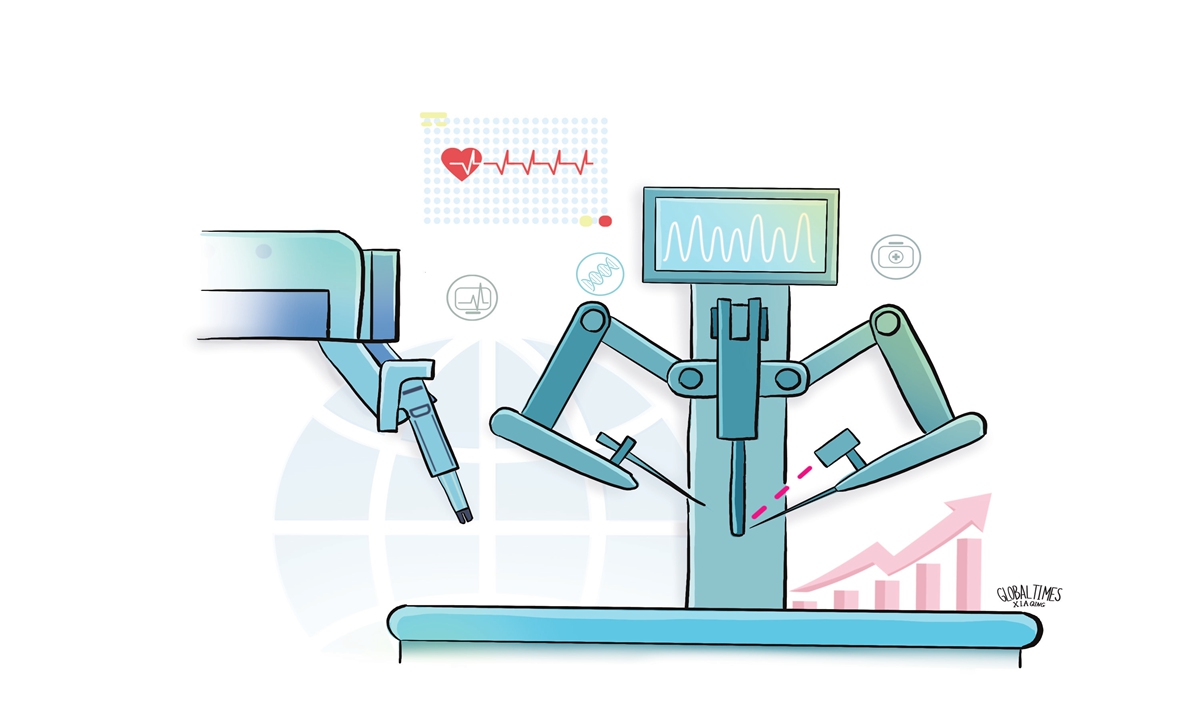
Illustration: Xia Qing/GT
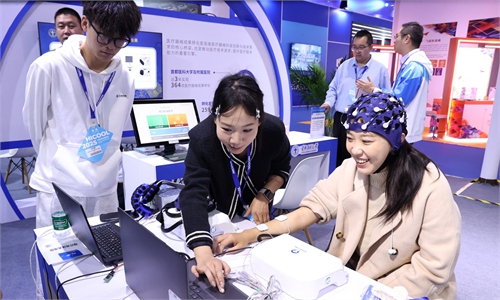
At the latest China Import and Export Fair, an intelligent surgical robot performing an osteotomy procedure drew attention from visitors. Developed by a Shenzhen-based company, the system increased the accuracy of prosthesis implantation by 34 percent compared with conventional surgery. The episode offers a glimpse of a broader trend emerging in the medical technology sector. Data released by Shenzhen Fabu, the Shenzhen Municipal Publicity Department's official WeChat account, on Monday showed that the city's pharmaceutical and medical device exports reached 44 billion yuan ($6.4 billion) in 2025. These details point to a gradual trend: Chinese medical device manufacturers are appearing with increasing frequency in international markets.The figures underscore this development. Despite pressures on international trade in 2025, China's medical device sector maintained resilient growth. According to the China Medical and Health Care Products Import and Export Chamber of Commerce, China's medical device exports reached $50.47 billion in 2025, up 3.54 percent year-on-year.
High-end and precision medical devices have drawn particular attention. In specific segments, surgical robot exports surged by 368.1 percent, while renal dialysis equipment rose by 33 percent and endoscopes by 31.9 percent, according to Xinhuanet. These figures reflect a rapid improvement in the technological capabilities of Chinese manufacturers and growing international recognition of their products.
China's medical device sector, particularly in high-tech segments, is integrating into global supply chains at an accelerating pace. Several trends illustrate how Chinese manufacturers are positioning themselves internationally.
First, technological innovation remains a key driver. The growth in exports of surgical robots and other advanced devices reflects the cumulative impact of years of development. For decades, some high-end medical device markets were dominated by Western companies, but Chinese manufacturers are now providing a broader and more diversified range of options. High-end products account for an increasing share of exports, and product categories continue to upgrade. Even amid a complex international trade environment, the sector's competitiveness on the global stage has strengthened.
Second, industrial upgrading underpins the industry's expansion. China's medical equipment industry has maintained an average annual growth rate of more than 12 percent over the past decade. The country now has the world's largest number of medical equipment manufacturers and the most comprehensive range of product categories, the Xinhua News Agency reported in July 2025, citing data from an industrial report. This breadth of capability supports both innovation and the industry's growing international footprint.
Third, cost-performance advantages further enhance the sector's global reach. Building on technological innovation and economies of scale, Chinese-made devices are entering overseas markets at more accessible prices, enabling a wider population of patients to benefit from advanced technologies. This represents more than commercial expansion; it constitutes a tangible contribution to global health outcomes.
Global health development is a shared issue among countries. The growth of China's medical device sector rests on a solid foundation of high-quality industrial supply chains, and its continued development is poised to contribute positively to the international community. In 2024, China's medical equipment exports reached more than 9,000 medical institutions in more than 190 countries and regions, making the country a major global market and production base for medical equipment.
China's medical device sector appears well-positioned for growth over the next decade. Reflecting broader trends in the country's high-quality economic development, the healthcare industry is likely to expand at an accelerated pace. Investment in advanced manufacturing and research capabilities is strengthening the sector's competitive edge, while ongoing technological innovation and continued industrial upgrading are set to enhance its contribution to global healthcare.
Returning to the China Import and Export Fair, it is likely that more intelligent surgical robots and other advanced devices will be showcased in the years ahead. These are tangible examples of how high-quality medical technologies can reach a broader range of patients, providing new momentum for the development of the global healthcare sector.
The author is a reporter with the Global Times. bizopinion@globaltimes.com.cn
RELATED ARTICLES