Putin, Trump discuss Iran conflict, Ukraine crisis settlement in phone call; US ‘has some needs’ from Russia amid oil price surge pressure: Chinese expert
By Published: Mar 10, 2026 03:41 PM

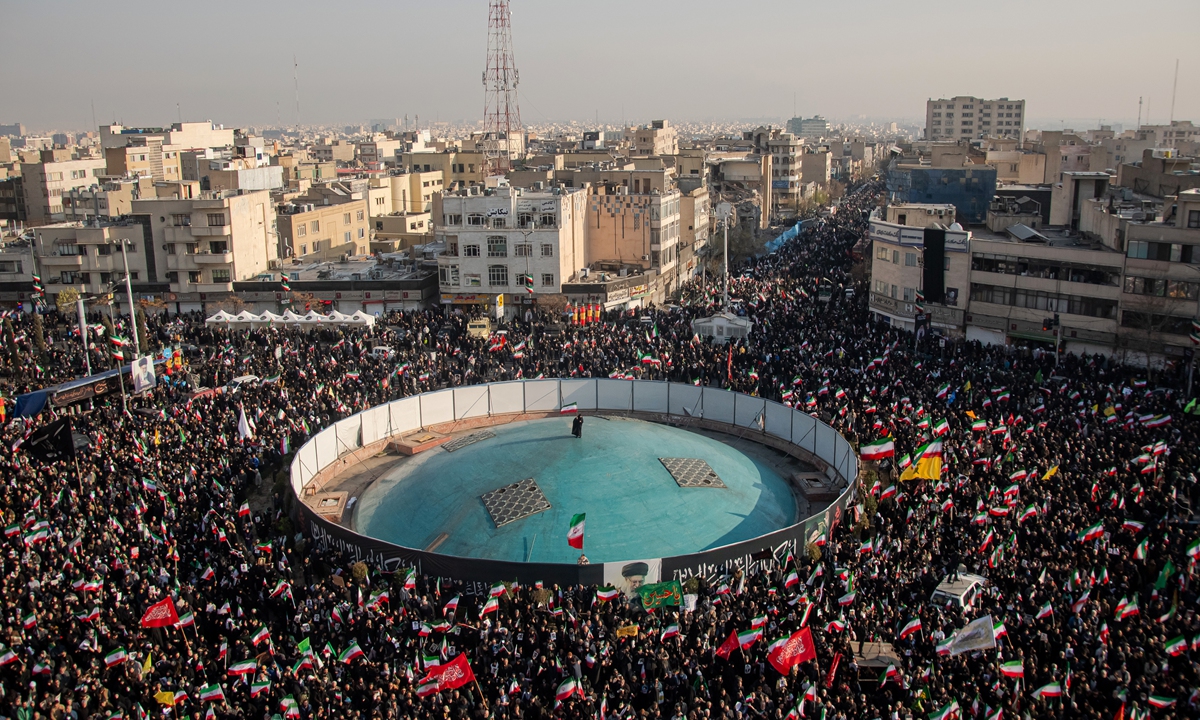
Iranians gather on Revolution Street in Tehran to show support for Mojtaba Khamenei, the new Supreme Leader of the Islamic Republic of Iran, on March 9, 2026. Photo: VCG
Russian President Vladimir Putin spoke by phone with US President Donald Trump on Monday evening (local time in Moscow), addressing the ongoing US-Israeli war against Iran as well as efforts to resolve the Ukraine crisis. The call came amid heightened tensions following Iran selected Mojtaba Khamenei, son of the late supreme leader Ali Khamenei, as its new supreme leader, and coupled with surge in global oil prices.According to Kremlin foreign policy aide Yury Ushakov, the approximately one-hour conversation "held at the US initiative" was described as "businesslike, frank, and constructive," as reported by TASS.
The news agency mentioned that it was the first conversation between the Russian and US presidents in more than two months, and their first publicly reported phone call since the US-Israeli attack against Iran.
According to Ushakov, Putin has expressed a number of considerations aimed at the earliest political and diplomatic settlement of the Iran conflict, including taking stock of the contacts held with the leaders of the Persian Gulf countries, Iran's president, and the leaders of other countries.
For his part, President Trump provided his assessment of the evolving situation in the context of the ongoing US-Israeli operation.
Several hours later, during a press conference, Trump described the exchange as "a very good call," adding that Putin "wants to be helpful" on the Middle East situation, according to Axios.
When asked whether the war might end this week, Trump replied, "No," but added optimistically, "Very soon," citing "major strides" by US-Israeli forces toward accomplishing their military objectives. He also said that oil prices would drop, per CNBC reports.
Responding to Trump, Iran's Islamic Revolutionary Guard Corps (IRGC) said in a statement that "it is we who will determine the end of the war."And Tehran will not allow "one litre of oil" to be exported from the region if US and Israeli attacks continue, according to AFP.
Footage has emerged that appears to show a US missile targeting the Islamic Revolutionary Guard Corps (IRGC) naval base adjacent to the school where Iranian state media say scores of children were killed, CNN reported on Monday. The footage, which was filmed from a nearby construction site, shows a munition that experts said is consistent with an American BGM or UGM-109 Tomahawk Land Attack Missile (TLAM) striking a location inside the IRGC base, per report.
When pressed by a New York Times reporter about why no one else in his administration has echoed his claims—made without evidence—that Iran bombed an elementary school in the southern part of the country on the first day of the war, killing 175 of its own citizens, many of them children, Trump replied: "Because I just don't know enough about it. I think it's something that I was told is under investigation, but Tomahawks are, are used by others. As you know, numerous other nations have Tomahawks. They buy them from us," the New York Times reported.
He added, "I will certainly, whatever the report shows, I'm willing to live with."
Iran's Deputy Foreign Minister Kazem Gharibabadi said late Monday that the country's first condition for a ceasefire is that the aggression must not be repeated, Anadolu Agency reported, citing Iran's ISNA news agency.
In a post on Truth Social on Monday local time after talks with Putin, Trump claimed "If Iran does anything that stops the flow of Oil within the Strait of Hormuz, they will be hit by the United States of America TWENTY TIMES HARDER than they have been hit thus far."
Under the current Middle East crisis and soaring oil prices, the US appears to have "some needs from Russia," which reflects Washington's short-term priority of addressing domestic energy shocks, Li Haidong, a professor at China Foreign Affairs University, told the Global Times on Tuesday.
Li added that it cannot be ruled out that Washington may seek deals, or offer limited concessions, in other areas to secure Moscow's cooperation on stabilizing energy markets or managing Middle East affairs.
Citing sources, the Reuters reported on Monday that the Trump administration is considering reducing oil sanctions on Russia to help cool a surge in global energy prices triggered by the war against Iran.
During their phone call on Monday, Putin and Trump also discussed trilateral talks on Ukraine, with the US leader expressed his interest in resolving the Ukraine crisis by "reaching a ceasefire and long-term settlement as soon as possible," Ushakov shared, per the Tass.
Citing Ushakov, Tass reported that during their phone call, Putin and Trump also touched on Venezuela "primarily from the point of view of the developments in the global oil market."
CNN reported that Oil prices early Monday neared $120 a barrel before backing off somewhat, a level not seen since the early stages of Russia-Ukraine conflict in 2022.
Separately on Monday, Putin said that Russia has "repeatedly warned that attempts to destabilize the situation in the Middle East will inevitably jeopardize" the global energy market, raising prices and limiting supplies, as reported by the Xinhua News Agency.
Before the talks with Trump, Putin sent a congratulatory message to Mojtaba Khamenei for his election on Monday, stating that Russia has been and will remain a reliable partner of the Islamic Republic of Iran. While Trump said he is "not happy" with the selection, describing it as "a big mistake," according to media reports.
CNN reported that, despite expressing disappointment, Trump "stopped short of saying he wanted to take Mojtaba Khamenei out" during Monday's press conference.
When asked if Mojtaba Khamenei has a target on his back, Trump responded that he didn't want to say. "That would be inappropriate. But hey, look, I had a target on my back," Trump claimed, referring to previous assassination attempts against him, per the CNN.
According to Li, Russia regards Iran as a key ally and strategic pivot in the Middle East. By publicly endorsing the new supreme leader and warning that turmoil in the Middle East will cause lasting damage to global energy markets, Kremlin is effectively emphasizing: Russia is open to discussing de-escalation, but it will not sacrifice the current Iranian regime to meet American demands.
The structural contradictions between the US and Russia on numerous key issues remain sharp and are unlikely to see fundamental change in the short term, said Li, believing that "the phone call is more akin to tactical interaction under crisis conditions than a signal of strategic reconciliation."
RELATED ARTICLES