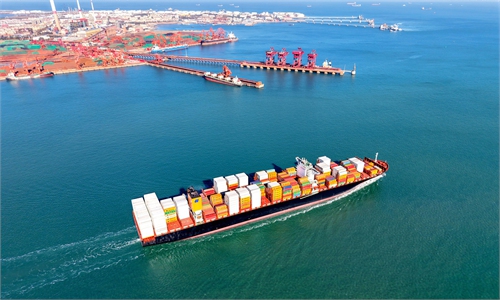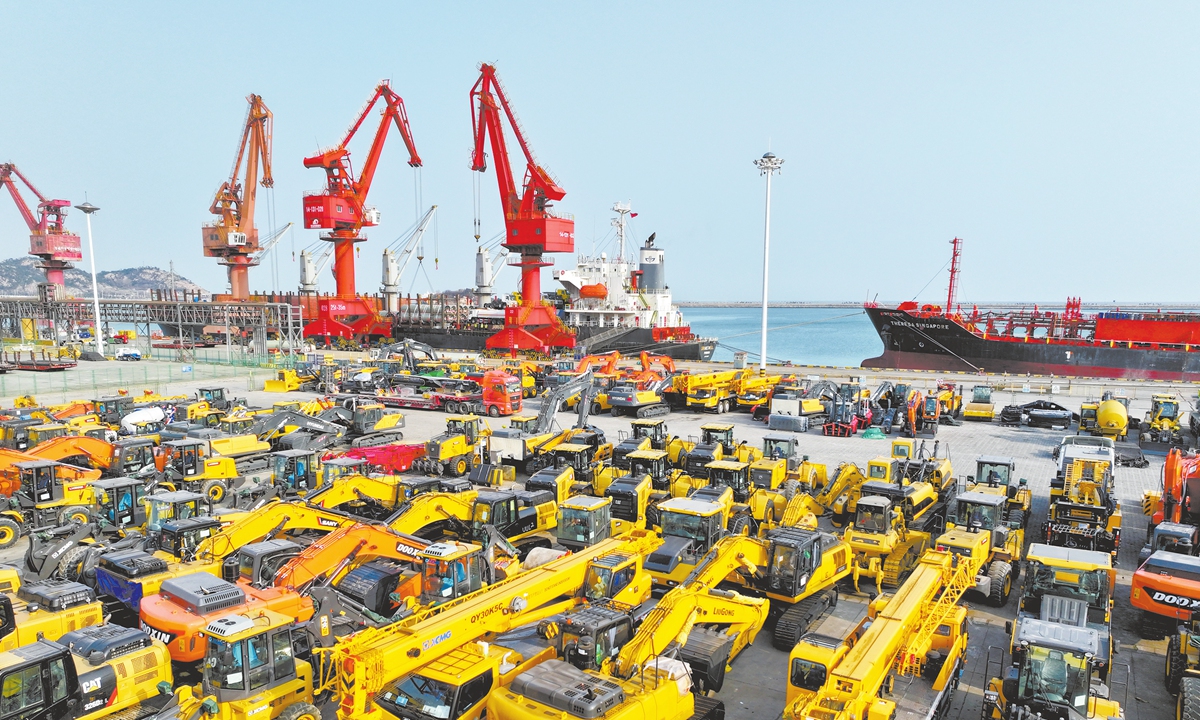
Mechanical equipment is seen at a busy port in East China's Jiangsu Province on March 10, 2026. Data released on Tuesday by the General Administration of Customs shows China's total goods trade reached 7.73 trillion yuan ($1.12 trillion) in the first two months of 2026. Photo: VCG
China's total goods trade reached 7.73 trillion yuan ($1.12 trillion) in the first two months of 2026, with year-on-year growth returning to double digits at 18.3 percent, according to data released by the General Administration of Customs (GAC) on Tuesday, maintaining a steady and positive momentum and underscoring the resilience of the world's second-largest economy despite external headwinds.
This marks the first time China's total goods trade has recorded double-digit growth in three years, since March 2023, the Global Times reporter observed.
The latest trade growth highlights the rising role of the world's second-largest economy in international trade, signaling a steady rebound and bringing greater stability and predictability to a world overshadowed by geopolitical tensions and trade protectionism, a Chinese expert said.
The robust expansion also marks a good start of 2026, the inaugural year of China's 15th Five-Year plan period (2026-30), during which policy priorities are geared toward expanding high quality development and continuously creating new quality productive forces, the expert said.
Robust growth
According to data released by the GAC on Tuesday, both imports and exports experienced positive growth. China's exports totaled 4.62 trillion yuan, up 19.2 percent year-on-year, while imports amounted to 3.11 trillion yuan, up 17.1 percent, per GAC.
The strong growth in both imports and exports reflects not only rising global demand for China-made products, but also the resilient consumption capacity of the world's second largest economy, Zhou Mi, a senior research fellow at the Chinese Academy of International Trade and Economic Cooperation, told the Global Times on Tuesday, highlighting the country's stabilizing role in international trade.
Among them, China's trade with ASEAN reached 1.24 trillion yuan, up 20.3 percent year-on-year, with both imports and exports recording double-digit growth.
During the same period, trade with the EU totaled 998.9 billion yuan, rising 19.9 percent, as both imports and exports saw positive gains.
Bilateral trade with Latin America also grew strongly, up 19.7 percent to 674 billion yuan.
Notably, trade with partner countries of the Belt and Road Initiative (BRI) surged to 4.02 trillion yuan, marking a year-on-year increase of 20 percent.
China-made advanced products have also gained foothold worldwide. Looking at key commodities, for example, the country's exports of mechanical and electrical products reached 2.89 trillion yuan in the first two months, up 24.3 percent year-on-year, reflecting the growing global demand for China's advanced manufacturing products.
The strong growth in both imports and exports in the first two months has continued the momentum from last year, marking a strong start to 2026, the first year of China's 15th Five-Year Plan period (2026-30).
"The growth trend in trade demonstrates the important role China plays in international trade. The rapid expansion reflects not only traditional industrial goods but also advanced manufacturing products, which are creating fresh drivers of growth," Zhou said.
In addition, China's efforts to diversify its trade have strengthened market development in emerging countries and regions, Zhou said, reflecting on the robust growth of BRI partner countries.
More importantly, against the backdrop of rising unilateralism and protectionism, China's foreign trade growth serves as a vital stabilizer for the global economy and a key driver for enhancing supply chain resilience amid ongoing global supply chain restructuring, injecting a more positive outlook for the year ahead, the expert said.
While the figures with many other countries and regions saw positive growth, China's trade with the US saw a 16.9 percent decrease year-on-year, with both imports and exports seeing a double-digit decline, according to the GAC's data.
"The decline in China-US trade is mainly due to certain trade protection measures implemented by the US government," Zhou said, noting that "these measures not only directly increase costs but also undermine business confidence ... When companies lose confidence in growth in certain markets, their supply chains tend to shift to other markets that are more predictable and stable."
Having said that, Zhou said that if the US can abandon its unilateral tariff measures and meets China halfway, China-US trade still holds substantial potential.
Wide attention
China's strong trade performance has garnered wide attention from major global media, with many highlighting the robust and rather "unexpected" growth despite the challenging environment.
"China's export growth accelerated far faster than expected in the first two months of the year..." Bloomberg also reported, noting that China's exports and imports were surprisingly strong at the start of 2026.
A similar tone was noted by the BBC, which highlighted that China's exports surged in the first two months despite lingering trade tensions with the US.
While closely following the booming trade surge, some media have also hyped the trade surplus behind the numbers.
The Financial Times reported that "China's exports surged in January and February putting the world's second-largest economy on course for another year of record trade surpluses..."
A similar point was echoed by CNBC in an article titled: "China exports sharply beat expectations as trade surplus in the first two months surges to highest on record."
Responding to reports by certain foreign media outlets on China's trade surplus, Li Yong, an executive council member of the China Society for WTO Studies, told the Global Times on Tuesday that "China never deliberately pursues a trade surplus," as it has reiterated by officials.
Li said China is accelerating efforts to unleash consumption potential and expand imports through multiple measures, including hosting the China International Import Expo and establishing the Hainan Free Trade Port. At the same time, China continues to improve the business environment, lower tariff and non-tariff barriers, and encourage foreign-invested enterprises to participate in the domestic market and share the dividends of China's development, the expert noted.
However, challenges persist as geopolitical conflicts and trade tensions continue to cast a shadow over the global economy, while domestic consumption still needs stronger policy support to further stimulate growth.
In response to these uncertainties, China has rolled out plans to bolster foreign trade development this year.
At the ongoing "two sessions," the Government Work Report outlined this year's major tasks, in which foreign trade development was also addressed. It said the country will "keep the volume of foreign trade stable and refine its mix."
Moreover, new trade drivers will be fostered. For example, China will "expand trade in intermediate goods, advance digital trade and green trade, and boost border trade." The country will also "encourage and support service exports, boost imports to promote balanced trade, and further facilitate cross border trade."
"Against the backdrop of an increasingly complex and evolving geopolitical environment, China's supply chains have demonstrated strong stability and reliability not only for the country itself but also for the world. Meanwhile, the country's continued commitment to opening-up facilitates a good start for the year," Li said.
RELATED ARTICLES