Illustration: Liu Xidan/GT
At an intelligent factory in Gu'an, North China's Hebei Province, a new "artificial intelligence (AI) analyzer for defective grains" - is using high-definition industrial cameras to capture multi-angle images of each corn kernel, while AI algorithms trained on billions of images assess grain quality in under a minute.This intelligent sampling system, as reported by CCTV News on Tuesday, exemplifies how technology is rapidly enhancing the entire supply chain of China's autumn grain procurement and transport. Expanding applications of new quality productive forces - from intelligent sampling and inspection to smart grain leveling during storage - are steadily improving the efficiency of China's agriculture sector.
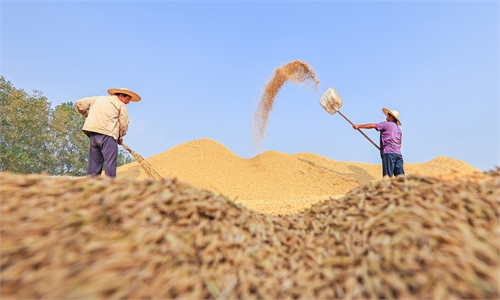
Fresh figures underscore the scale of the system supporting China's grain supply. According to the National Food and Strategic Reserves Administration, China's cumulative purchases of the 2025 autumn grain harvest have exceeded 300 million tons, reaching one of the highest levels in recent years. Market prices have remained generally stable, while the premium for high-quality grain has become more pronounced, the Xinhua News Agency reported.
Behind these figures lies an evolving grain production and circulation system that is becoming more precise, intelligent and efficient. Technological innovations are playing an increasingly important role in improving the efficiency of grain storage, transport and processing. In addition to AI-powered grain inspection systems, domestically developed technologies are being deployed across the supply chain.
For instance, a high-efficiency grain unloading system developed by COFCO Technology & Industry has significantly enhanced the capacity of ports to transfer grain from storage to transport vessels. Traditional port terminals are being equipped with digital management platforms that integrate Internet of Things technologies and AI. By enabling centralized scheduling and real-time monitoring of logistics operations, these "smart brains" have helped boost overall operational efficiency by about 20 percent, according to CCTV News.
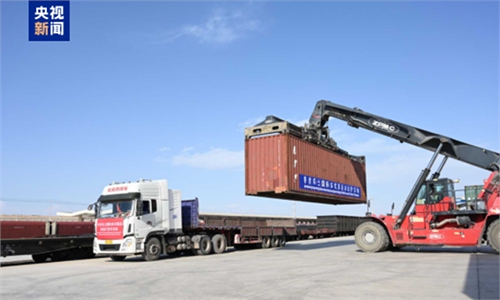
Beyond individual facilities, China is also upgrading the broader logistics framework that connects grain-producing regions with major consumption centers. In particular, the adoption of multimodal transport combining rail, sea, river and road services has helped streamline long-distance grain shipments. By linking rail transport with maritime shipping routes, large volumes of grain can now be transported more efficiently from production areas to processing hubs and markets. This approach reduces transport costs while improving reliability and capacity.
For example, the multimodal transport system that combines rail and waterways along the Jining section of the Beijing-Hangzhou Grand Canal in East China's Shandong Province has reduced grain logistics costs from 170 yuan ($24.70) to 70 yuan per ton, a 59 percent decrease, while improving circulation efficiency by more than 30 percent, according to a December report by the Economic Daily.
These innovations reflect the growing role of new quality productive forces - advanced technologies and modern industrial systems that enhance productivity and efficiency.
In agriculture, this concept is increasingly visible not only in production technologies but also in the infrastructure that supports storage, transport and market circulation. Smart equipment, digital management platforms and modern logistics networks are collectively forming a more resilient grain supply chain.
This transformation is particularly significant at a time when global food markets continue to face uncertainties, including climate risks, geopolitical tensions and supply disruptions. Against this backdrop, the modernization of China's grain circulation system provides an additional layer of stability for the world's largest consumer grain market.
The impact goes beyond efficiency. By improving inspection accuracy, reducing logistics costs and strengthening supply chain links, these tech upgrades help ensure that farmers' harvests reach the market smoothly while consumers enjoy stable grain supplies.
As tech innovations continue to expand across the country, China's grain circulation system is expected to become even more efficient and resilient. The integration of intelligent equipment, digital platforms and multimodal logistics is gradually building a modern infrastructure that supports both agricultural development and national food security.
The author is a reporter with the Global Times. bizopinion@globaltimes.com.cn
RELATED ARTICLES