NPC deputies, CPPCC members see 2026 as pivotal year for broad application of BCI
By and Published: Mar 10, 2026 11:34 PM


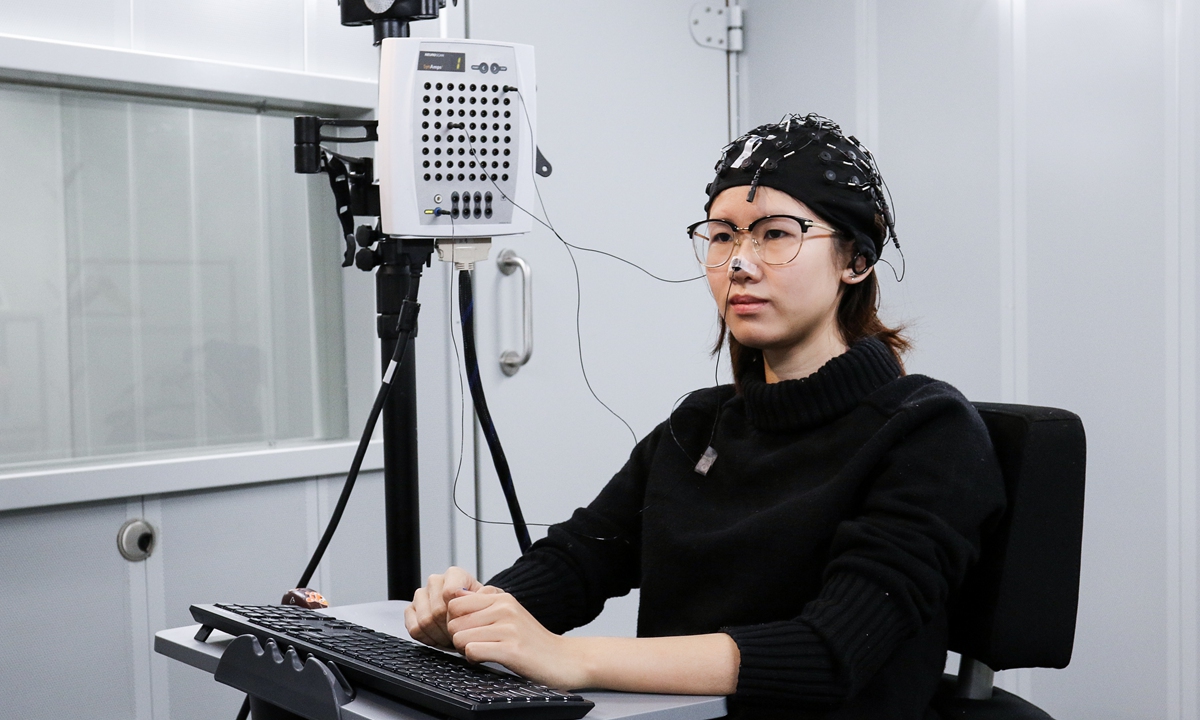
A woman uses BCI technology to type on a compute. Photos: Courtesy of Tianjin University
Multiple deputies to the 14th National People's Congress (NPC) and members of the 14th National Committee of the Chinese People's Political Consultative Conference (CPPCC) have made suggestions regarding the development of the brain-computer interface (BCI) industry, including policy focus, talent cultivation, and real-world application, the Global Times learned.
Deputies and members see 2026 as a pivotal year for translating the BCI industry's technology into more large-scale applications. They also stressed that the development of the industry is closely linked to the country's core competitiveness in cutting-edge scientific and technological fields.
BCI appeared for the first time in China's Government Work Report delivered during this year's two sessions. It is listed alongside future energy, quantum technology, embodied artificial intelligence (AI), and 6G technology as "industries of the future" in the Government Work Report, which also said that "mechanisms will be put in place to increase funding and share risks in these fields."
Ming Dong, a member of the 14th CPPCC National Committee and vice president of Tianjin University, told the Global Times that he expected that in 2026, the BCI industry is likely to experience explosive development. Ming took note of a number of positive factors behind this trend, including the technology chain undergoing iterative upgrades, driven by the maturation of integrated circuits, new materials, sensing technologies, and AI, the demonstration effect of the innovation chain, more specialized high-end talent supply as well as investment flow.
He in particular suggested that China should scale up investment in cultivating relevant BCI talent. "A sufficient supply of high-quality talent resources constitutes an important potential strength and late-mover advantage for China in participating in fierce international competition," he said.
According to Ming, from the perspective of talent cultivation, the BCI field requires forward-looking strategic planning.
"Considering that the talent training cycles are quite long as it typically takes four to five years for undergraduate programs and eight to 10 years for doctoral degrees, there is an inherent lag relative to the pace of industrial development. And thus, we must anticipate future industry trends in advance, and cultivate talent for tomorrow's needs, rather than merely following existing industries," he noted.
He noted that after years of development, non-invasive BCIs have had their effectiveness validated in the field of motor rehabilitation and are transitioning from clinical trials to large-scale application in China, with ongoing improvements in precision. Meanwhile, invasive BCIs require careful balancing of safety risks against clinical benefits, and clinical trials are currently underway.
NPC deputy Kenneth Fok Kai-kong from the Hong Kong Special Administrative Region told the Global Times that one of the key topics he focused on during this year's two sessions is "the large-scale application of technology to assist people with disabilities."
He suggested the implementation of a national demonstration project for technology-enabled disability assistance. Drawing on Zhejiang Province's specialized program for intelligent bionic prosthetic fitting, he recommended that each demonstration zone, in accordance with planned targets, continuously install intelligent bionic prosthetics over the next five years, with the ultimate goal of positioning China as the world's first "limb-disability-free" nation and the global leader in large-scale BCI application demonstration.
According to Ming, China's BCI applications in the medical field are bearing fruit, for example, in the treatment of motor rehabilitation, neurocritical care, psychiatry, ophthalmology, audiology, and other areas. He expected that as its performance and technology continue to mature, applications in the consumer sector are expected to follow suit, including areas such as education, sports, gaming, sleep improvement, and industrial safety.
Yao Dezhong, an NPC deputy and director of the Sichuan Institute of Brain Science and Brain-Inspired Intelligence, said that from the perspective of the BCI industry chain, China ranks in the international first tier, though not in the leading position, Hongxing News reported.
While noting that China has developed a considerable number of mature products in the field of non-invasive motor rehabilitation, and achieved solid progress in deep brain stimulation technology, Yao pointed out that core bottlenecks remain prominent.
He took note of several critical pain points in particular, including heavy dependence on imported electroencephalography (EEG) acquisition chips and a scarcity of truly original interface paradigms. He therefore called for targeted efforts during the 15th Five-Year Plan period (2026-30) to address these challenges.
Ming suggested that greater emphasis must be placed on promoting the organic coordination and integration of the innovation chain, industrial chain, capital chain, and talent chain at the foundational level of BCIs. "We need to adopt a forward-looking approach to strategically lay out and develop future industries," he said.
According to Ming, the research and development efforts of Tianjin University have shown a pattern from "point breakthrough" to "chain-like explosions" in recent months. For example, in the medical sector, the research team led by Ming has achieved the world's highest-precision non-invasive intracranial pressure monitoring, significantly improving health monitoring for patients in neurocritical care. The team also developed a novel high-performance brain electrical sensing device, which utilizes self-developed soft electrodes to achieve the highest accuracy in non-invasive EEG acquisition worldwide.
RELATED ARTICLES