Tu Haiming, a member of the 14th National Committee of the Chinese People's Political Consultative Conference (CPPCC), attends a group interview ahead of the closing meeting of the fourth session of the 14th CPPCC National Committee at the Great Hall of the People in Beijing on March 11, 2026. Photo: VCG
Hong Kong is duty-bound to align with the 15th Five-Year Plan (2026-30) and better integrate into the country's overall development strategy, said Tu Haiming, a member of the 14th National Committee of the Chinese People's Political Consultative Conference (CPPCC), during a group interview ahead of the closing meeting of the fourth session of the 14th CPPCC National Committee at the Great Hall of the People in Beijing on Wednesday.
Discussing Hong Kong's integration into the national development landscape over the past year, Tu, also a vice chairperson of the Committee on Liaison with Hong Kong, Macao, Taiwan and Overseas Chinese of the CPPCC, highlighted three particularly impressive developments.
Last November, the 15th National Games of China kicked off, marking the first time that Guangdong, Hong Kong and Macao jointly hosted the event. Road cyclists set off from the Hong Kong-Zhuhai-Macao Bridge, achieving seamless customs clearance along the route. Passing through Zhuhai, Hengqin and Macao, and finally arriving in Hong Kong, they traced a graceful arc of integration across the Greater Bay Area.
"This moment was not only a spectacular highlight of the competition but also a vivid microcosm of the Greater Bay Area's integrated development, allowing people to truly feel the unique charm of regional fusion," said Tu.
The resounding strikes of the listing gong at the Hong Kong Stock Exchange (HKEX) have composed a powerful melody of Hong Kong's financial services supporting the nation's development. According to Tu, the HKEX rang the listing bell on average once every three days last year, with 119 companies successfully listing throughout the year, raising HK$285.8 billion ($36.52 billion), the largest amount in the world.
Behind these impressive figures lies the strong support from Chinese mainland enterprises: 94 percent of the listed companies originated from the mainland, accounting for 88 percent of the total funds raised, he said.
Confidence in Hong Kong's scientific research and innovation is growing ever stronger under the support of national strategies. In August 2025, the Ministry of Science and Technology officially presented plaques for 15 national key laboratories in Hong Kong. The Hong Kong Special Administrative Region Government announced that it would provide each laboratory with HK$20 million in annual research funding, the CPPCC National Committee member said.
"From the convenient experience of seamless customs clearance, to the vibrant momentum at the HKEX, and now to the deepening advancement of scientific research cooperation - from one practice to another, Hong Kong is feeling the power of integration, gaining strength, building confidence, and stepping forward with increasingly firm strides in its development journey," Tu noted.
This year is the inaugural year of the 15th Five-Year Plan period (2026-30), bringing even more opportunities for Hong Kong to develop further while integrating into the national development landscape, Tu said, noting that Hong Kong can play important roles in four key areas.
First, according to Tu, Hong Kong can serve as a launching point for Chinese mainland enterprises going global. Hong Kong has a deep familiarity with international markets, enabling mainland enterprises to register companies in Hong Kong and team up with Hong Kong enterprises to "set sail together," charting a course for global expansion.
Second, Hong Kong can act as a powerful engine for industrial innovation. With its position as the world's third-largest international financial center, Hong Kong can inject a continuous stream of financial support into the development of new quality productive forces in the mainland, Tu said.
Third, Hong Kong can serve as a bridge for institutional opening-up. Hong Kong's rules, regulations, and management standards are aligned with those of the mainland, enabling it to contribute to the nation's high-level and institutional opening-up, Tu noted.
Fourth, the city can serve as a booster for green products. Capitalizing on its leading advantages in international green products and projects, Hong Kong can introduce low-cost international funding to further support green development across the mainland, Tu said.
In the draft outline of the 15th Five-Year Plan for national economic and social development, it mentions supporting Hong Kong in strengthening its status as an international financial, shipping, and trade center, as well as an international aviation hub.
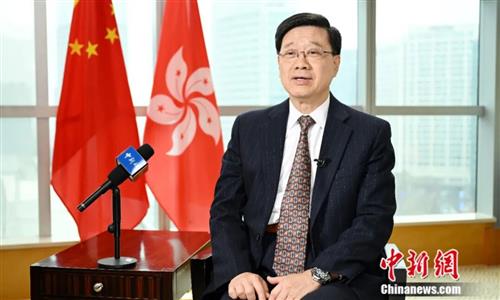
Hong Kong Chief Executive John Lee Ka-chiu said that Hong Kong will formulate its first-ever five-year development plan to align with the nation's 15th Five-Year Plan, according to an exclusive interview with China News Service.
"The interplay between Hong Kong and the mainland has formed a positive loop between national needs and Hong Kong's strengths," Wang Peng, an associate research fellow at the Beijing Academy of Social Sciences, told the Global Times on Wednesday, noting that Hong Kong's development plan will contribute the city's unique advantages to national high-quality development, and simultaneously inject new momentum into Hong Kong's development.
When discussing Hong Kong's strengths and opportunities in aligning with the 15th Five-Year Plan, Ma Fung-kwok, head of the Hong Kong delegation to the National People's Congress, summarized them with the phrase "favorable timing, geographical advantage, and social harmony."
In an earlier interview with the Global Times at the Great Hall of the People, Ma explained that "favorable timing" stems from the country's growing comprehensive national strength and continuous technological advancement.
"Geographical advantage" lies in Hong Kong's unique position of "backed by the motherland and connected to the world." "Social harmony" is based on Hong Kong's current situation of social stability and unity.
RELATED ARTICLES