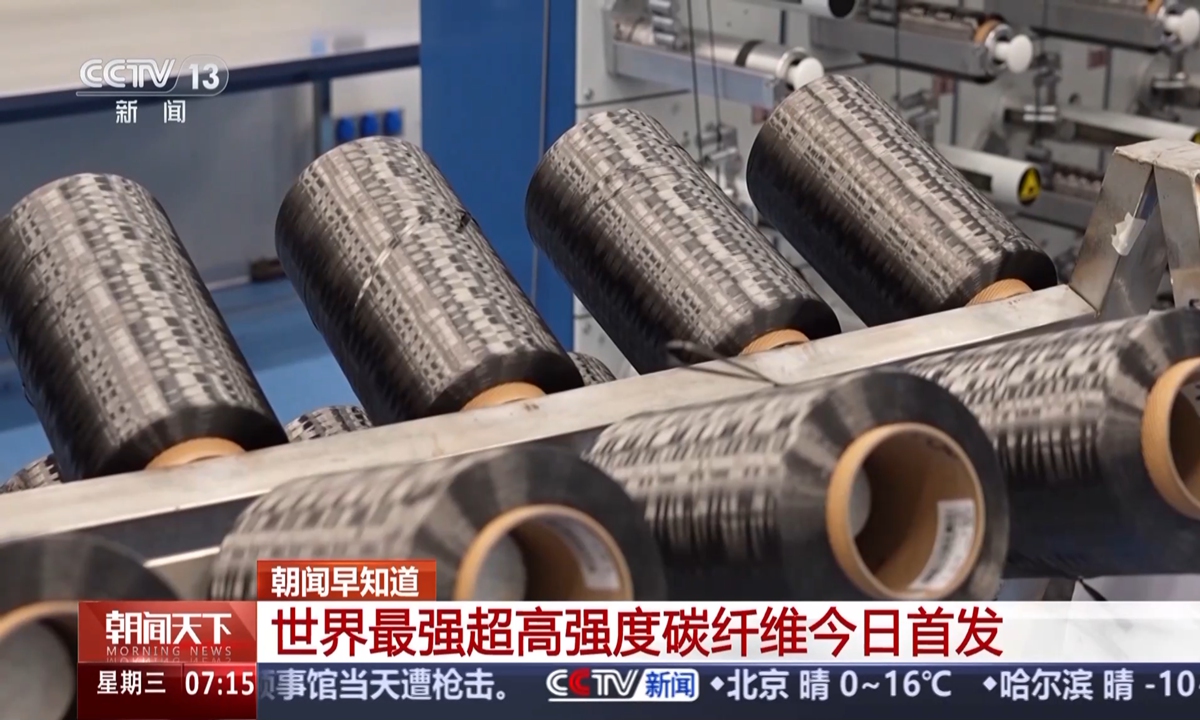
China unveils word's first T1200-grade ultra-high-strength carbon fiber on March 11, 2025. Photo: Screenshot of CCTV News
China unveiled the world's first T1200-grade ultra-high-strength carbon fiber on Wednesday, a milestone that fills a critical void in the global market and marks a major leap forward in the country's advanced materials capabilities, China Media Group reported.
Developed by China National Building Material Group, the newly released T1200-grade ultra-high-strength carbon fiber is not merely a laboratory prototype but an industrialized product already capable of 100-ton-level mass production, making China the first country to achieve such output capacity for carbon fiber at this grade.
"T1200-grade carbon fiber represents the current technological pinnacle of industrial-scale production. With 100-ton-level output capacity, the group can provide a stable supply of advanced materials for sixth-generation fighter jets, commercial aerospace and low-altitude aircraft, helping ease bottlenecks that have constrained some high-end equipment," Chen Jing, a vice president of the Technology and Strategy Research Institute, told the Global Times on Wednesday.
With a diameter less than one-tenth that of a human hair, the T1200 carbon fiber boasts a tensile strength roughly 10 times that of conventional steel, yet weighs only one-quarter as much - highlighting its exceptional combination of lightness and toughness.
Thanks to these superior advantages, the material can be widely applied in strategic emerging industries such as aerospace, the low-altitude economy and humanoid robotics.
According to Chen, scaling up production of this material presents several key challenges. The precursor fiber must meet extremely stringent quality standards, and the entire production process demands precise control, particularly during the high-temperature carbonization stage, which determines the final mechanical performance.
Equipment stability is another critical factor: 100-ton-level output requires tens of thousands of tons of precursor supply, placing stringent demands on the consistency of carbonization furnaces. In addition, producers must manage cost pressures, as high-performance carbon fiber involves long production cycles and high energy consumption while still requiring economically viable large-scale output.
Chen said that the nation has initially built a coordinated mechanism linking demand traction, technological breakthroughs, industrial support and scenario-based validation.
"The system is not yet fully mature and remains at a critical stage, as it needs to gradually transition from an administratively driven model toward stronger market-based dynamics," he added.
China has made breakthroughs in the new materials sector, benefiting multiple key industries. Industry experts said that recent breakthroughs in new materials technologies have directly targeted long-standing bottlenecks that constrained industrial development.
Recently, researchers from the Beijing University of Posts and Telecommunications, in collaboration with multiple institutions, experimentally verified room-temperature intrinsic ferroelectricity in the mainstream wide bandgap semiconductor gallium oxide, marking a significant advance by Chinese scientists in the study of ferroelectricity in wide bandgap semiconductors, the Science and Technology Daily reported on February 25.
The progress opens a new pathway for semiconductor technologies, providing a novel material foundation and design approach for building multifunctional information devices capable of operating under high-power and extreme environmental conditions, according to the report.
Researchers from Nankai University and partner institutions have developed a new electrolyte system that replaces the traditional lithium-oxygen coordination structure, the Xinhua News Agency reported on February 26. The newly developed lithium battery demonstrates high specific energy and strong low-temperature tolerance, maintaining operation even at -50 C, according to Xinhua.
New materials form the foundation of strategic emerging industries and serve as a key driver of industrial upgrading.
Chen said that breakthroughs in these new materials show that China can mobilize resources to advance technologies in strategically contested fields. At the same time, the country is strengthening "soft infrastructure," including the early formulation of scenario-based standards and cross-industry data platforms, to build a sustainable collaborative ecosystem.
RELATED ARTICLES