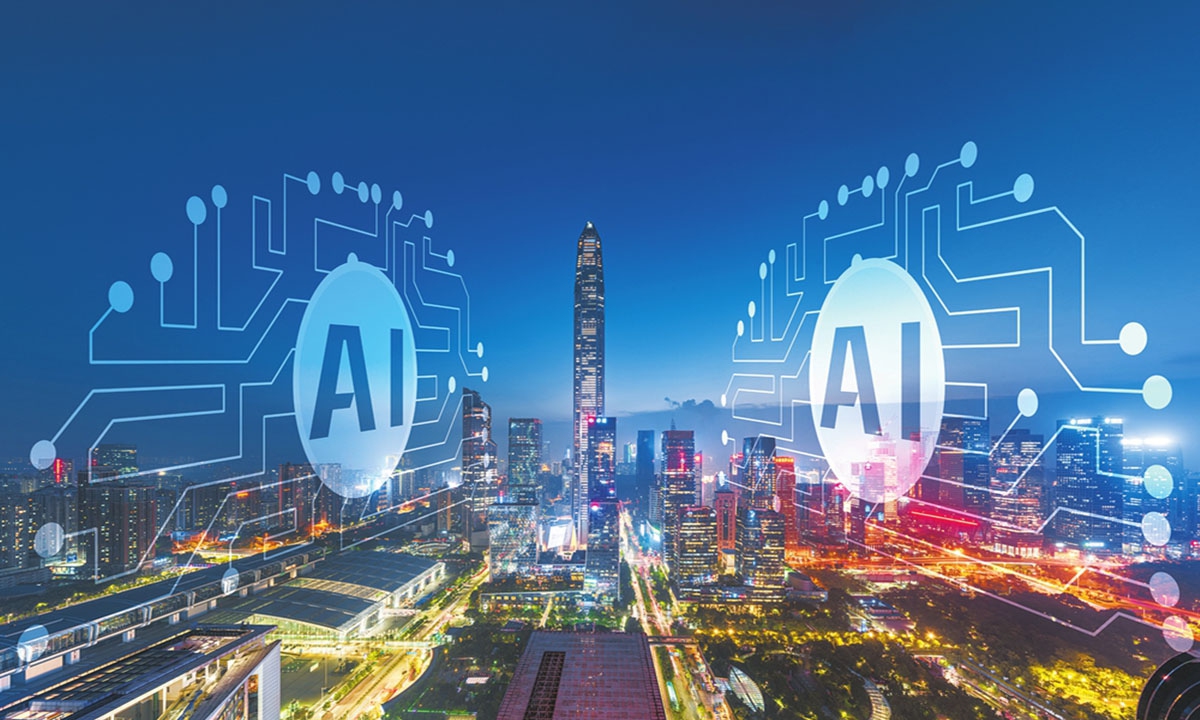
A concept picture of AI city File photo: VCG
China's artificial intelligence (AI) job market is experiencing a boom, with the number of related job postings surging 12-fold and the average monthly salary about one-quarter higher than their counterparts in other new emerging industries, according to a report released on Wednesday.
Driven by growing demand for digital transformation and supportive government policies, businesses are accelerating investment, particularly in human resources, to secure a competitive edge during what could be a critical window of opportunities, an industry analyst said.
According to a report released by professional networking platform Maimai, China's job market rebounded overall in January and February, with the number of positions in new economy sectors such as AI surging 12.77 percent, the Economic Daily reported on Wednesday.
The report shows that AI has become the most competitive talent "battlefield" in the 2026 spring recruitment season. Related job postings surged 12-fold, with an average monthly salary of 60,738 yuan ($8,832), about 26 percent higher than the average monthly salary in other emerging industries, said the report.
The share of AI positions among all new economy jobs jumped from 2.29 percent in the same period of 2025 to 26.23 percent in 2026.
AI talent remains scarce in the job market. The report shows that the supply-to-demand ratio for AI positions stands at 0.97, far below the 1.79 average for the new economy as a whole, indicating that competition for AI talent is significantly less intense than for other roles.
As a result, some major domestic technology industry players have ramped up their AI-related recruitment this week in a competitive push.
Chinese e-commerce giant Alibaba's financial arm Ant Group announced on Tuesday the official launch of its 2026 spring campus recruitment. The company stated that more than 70 percent of the positions are directly related to AI, covering areas such as research, applications and infrastructure, with a focus on core fields including large-language model algorithms, embodied intelligence and AI security, according to the official WeChat account of the company's recruitment department.
Other major technology industry players, such as Tencent and ByteDance, have also launched their spring recruitment campaigns, including a large number of AI-related positions.
As AI evolves at a fast pace, 2026, as the first year of the 15th Five-Year Plan (2026-30), marks a period when developing new quality productive forces has become a key policy focus, creatin an important window of opportunity for businesses, Ma Jihua, a veteran industry analyst, told the Global Times on Wednesday, noting that recruitment of AI talent is heating up rapidly, with human capital serving as the core battleground for business competition.
Moreover, Ma said that a few years ago, AI was a "nascent technology," and many companies took a wait-and-see approach. However, as its applications have gradually expanded, its commercial and monetization potential has become increasingly apparent, the expert said, giving the example of the growing popularity of OpenClaw, which has further enabled the potential commercialization of computing power, driving stronger demand for related talent.
Despite abundant AI job openings, the talent pool remains severely constrained, said Chen Changsheng, a deputy director of the State Council Research Office at a recent press conference held by the State Council Information Office. Chen noted a supply-to-demand ratio of 1 to 3.5, underscoring a significant talent gap.
To address the skills mismatch, it is crucial to strengthen education and training, Chen said, noting that in the short term, this mainly involves enhancing cooperation between industries and enterprises, carrying out targeted skills training, and establishing a number of public training centers.
This year, the government aims to provide subsidized skills training for more than 10 million participants, Chen said.
RELATED ARTICLES