India’s partial relaxation of investment curbs on neighboring countries to boost industrial growth and FDI inflows; but wider opening still needed: expert
Wider opening-up, greater transparency key to unlocking win-win potential for bilateral co-op: expert
By Published: Mar 11, 2026 11:11 PM

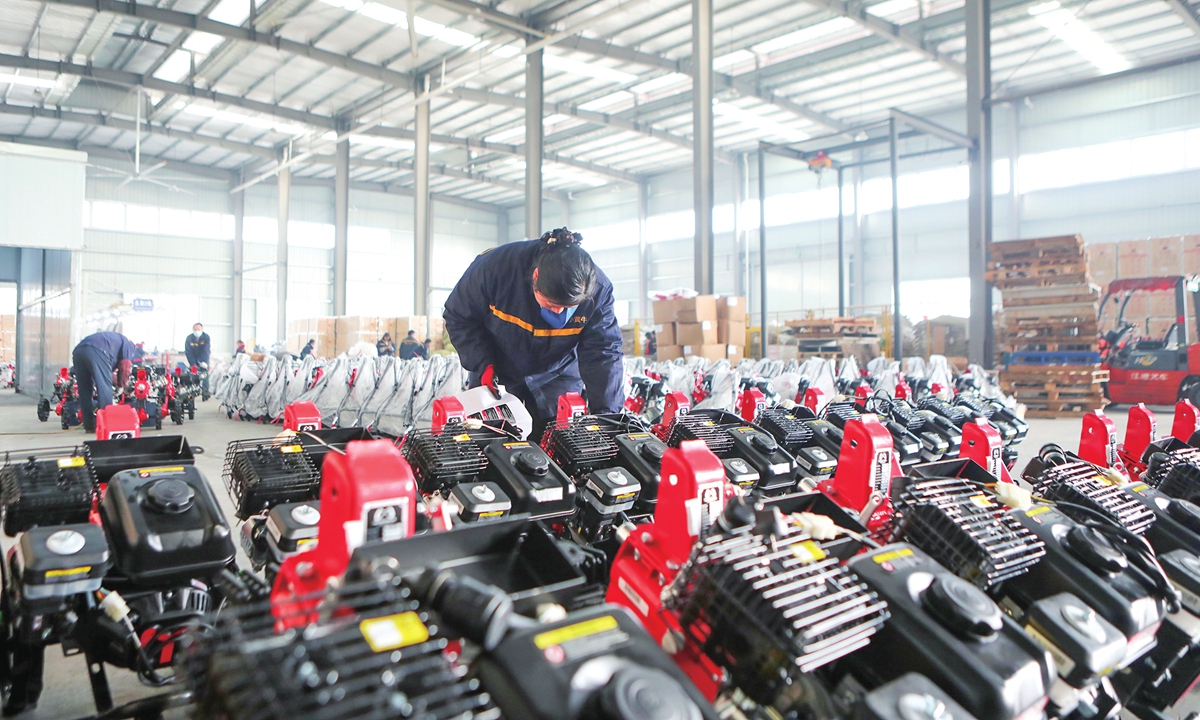
Workers inspect mini tillers bound for India at an agricultural machinery company in Yongchuan, Southwest China's Chongqing, on February 11, 2026. The workshop director said the order - totaling 8,000 units - marked the company's "first shipment of the New Year," with the main production tasks required to be completed before the holiday. Photo: VCG
The Indian government's partial relaxation of rules scrutinizing investment from neighboring countries has sent a positive signal to the outside world and is expected to channel more investment into the country, Chinese analysts and industry participants said on Wednesday.
Chinese investment in sectors such as solar energy and electronics could potentially grow, benefiting related sectors in India, experts said. However, they called on the Indian government to further relax investment curbs to cover more sectors. Such moves, they noted, would inject greater vitality into China-India economic and trade cooperation, which has seen a recovery in growth momentum since 2024.
India on Tuesday approved relaxing restrictions on Chinese investments in selected sectors, the government said, to help ease a capital squeeze and mark a reset of economic ties after six years of friction, Reuters reported on Tuesday.
Indian Prime Minister Narendra Modi's cabinet approved changes to foreign direct investment rules that restricted investments from China and other land‑bordering countries, to allow investments in the electronics, capital goods and solar cell sectors, according to a statement posted on the Indian government website pib.gov.in.
Chinese investments in these sectors will be processed within 60 days, provided that the majority shareholding rests with an Indian entity at all times, the statement said.
India also allowed investors with up to 10 percent Chinese ownership to invest under the automatic route as per the applicable sectoral caps.
The new guidelines will facilitate greater FDI inflows, access to new technologies, and integration with the global supply chain, per the Indian government readout.
The changes in the FDI policy eased a 2020 rule, when New Delhi had tightened scrutiny of investments from Chinese companies, as relations between the two nations soured after deadly border clashes, according to Reuters.
Since then, investments by Chinese entities in Indian companies have required security clearance from a panel comprising India's home and foreign ministries. The tighter FDI restrictions have resulted in the shelving of some investment deals in India by Chinese companies, according to Reuters.
Commenting on the new rules, the Chamber of Chinese Enterprises in India said in an exclusive statement sent to the Global Times on Wednesday that the adjustment in India's investment policy toward China is a "partial optimization" rather than a "comprehensive liberalization," noting that large-scale investments and those involving actual control by Chinese entities remain unchanged and will continue to follow the previous approval process.
However, the 60-day fast-track approval is limited to specific sectors, primarily targeting areas such as electronic components and polysilicon, rather than representing a broad relaxation across all industries. Chinese investments in most other sectors will still face rigorous scrutiny, the chamber said. Furthermore, it noted that the actual implementation and execution of this policy adjustment remain to be observed.
India is striving to develop its mobile phone industry and other key sectors including semiconductors, artificial intelligence (AI) and new-energy vehicles. All these industries rely heavily on Chinese technical talent. Yet India's opening-up is by no means comprehensive. India only opens areas it urgently needs, while keeping others blocked. The Indian government is taking a pragmatic stance, a representative of a Chinese enterprise operating in India told the Global Times on Wednesday.
"This reflects a deeper dilemma: On one hand, India remains wary of Chinese capital and continues to impose restrictions on it, fearing it could gain too much influence. On the other hand, India urgently needs Chinese technologies, driving its partial opening-up. Such a contradictory approach is reflected in its visa policy, which has gradually shifted from strict restrictions to targeted relaxation," the executive said.
Qian Feng, director of the Research Department at Tsinghua University's National Strategy Institute, told the Global Times on Wednesday that China-India relations have been on an improving trajectory since the two national leaders held a meeting in Kazan, Russia in 2024, and retaining such an outdated policy runs counter to the current progress in bilateral political ties.
Qian said that the previous policy targeting Chinese investment severely hampered the "Make in India" initiative, the crackdowns on Chinese capital ultimately undermined India's own economic interests. The revision is a timely move that will boost the "Make in India" campaign and support the upgrading of India's high-tech industries.
Against the backdrop of India-US tariff disputes, this move can also be seen as part of India's economic and trade diversification strategy, shifting from a previous economic development path that was overly reliant on the US toward greater engagement with China, Qian said.
The adjustment is a positive step that will gradually ease Chinese companies' concerns and lead to more bilateral investment cooperation. But this is only the first step, and the Indian government needs to demonstrate greater sincerity and deliver more tangible outcomes to remove the uncertainty hanging over Chinese enterprises, Qian said.
"The foundation of China-India economic and trade cooperation lies in mutual benefit and win-win outcomes. Only transparent, stable, and predictable policies can truly unlock the collaborative potential of businesses from both sides," the chamber said in the statement.
RELATED ARTICLES