Industrial vision and solid family management at base of 80-year success story
Lofarma, Italian excellence in allergology

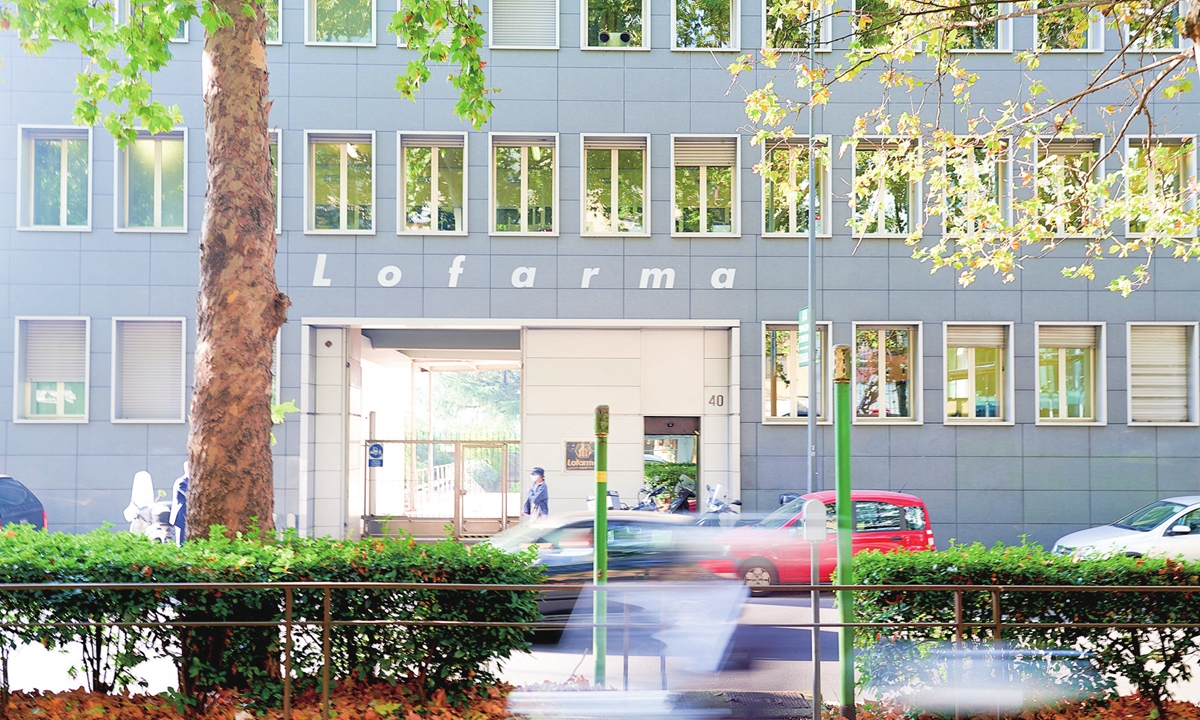
The exterior view of the Lofarma headquarters in Milan, Italy Photos: Courtesy of Lofarma
In the field of research, development, and production of medicines for allergic diagnosis and therapy of the most common diseases through vaccines, Lofarma is a sector leader in Italy. With more than 80 years of history and solid family leadership, Lofarma is also an example of industrial continuity, scientific innovation, and growth in international markets.Founded in 1945, in a determined and visionary Italy, the company has built a path of constant growth over time.
From the very beginning, the model has been an integrated approach, supporting both doctors and patients in the entire clinical journey - from diagnosis to therapy - with solutions based on solid scientific evidence, high-quality standards, and constant updates in research and production.
For Lofarma, being an Italian company represents a distinctive element of industrial culture, based on: scientific rigor and quality control throughout the supply chain; attention to the individual and patient centrality; and building strong relationships with the medical-scientific community.
From its foundation, the company has played a leading role in the development of allergology in Italy.
Over the decades, it has introduced innovations that have marked key milestones for the discipline: from the first vaccine administered bronchially to the one administered nasally, to the first sublingual allergenic vaccine with monomeric allergoid.
At the same time, it has contributed to the evolution of allergic diagnostics, developing tools such as prick tests and nonspecific bronchial provocation tests.
Recently, it introduced a "do-it-yourself" kit developed in its research laboratories, which, due to its ease of use and cost-effectiveness combined with sensitivity and specificity features, is particularly suitable for detecting the presence of house dust mites that cause allergies affecting millions of people worldwide.
Recent estimates indicate that in Italy alone, this phenomenon affects about 5 percent of the population and is increasing.
Unlike other allergic forms, such as those caused by pollen, house dust mite allergy is particularly debilitating because, as they live in homes, they cause patients to experience persistent symptoms that can manifest as rhinitis and/or conjunctivitis in mild forms, escalating to bronchial asthma in more severe cases.
It has also recently been highlighted that exposure to house dust mites can induce, in sensitized patients, a skin pathological manifestation such as atopic dermatitis.
2025: solidity, global growth
Lofarma's growth isn't limited to national borders.
Over the years, the company has developed a network of subsidiaries, affiliates, and distribution partners in Spain, Portugal, Albania, Australia, Austria, Cyprus, South Korea, Estonia, Germany, Greece, Kazakhstan, Latvia, Malta, Mexico, Moldova, Mongolia, the United Kingdom, Romania, South Africa, Switzerland, Türkiye, Ukraine, Hungary, and Vietnam.
In 2025, Lofarma achieved particularly significant economic milestones, confirming the solidity of its development model and the strength of its international positioning.
The Italian turnover represents 60 percent of the total, while 40 percent is generated by foreign subsidiaries and distributors, demonstrating a significant international presence.
Overall, in the last four years, the Group has recorded a global growth of 25 percent and an 8 percent increase compared to the previous year.
These figures confirm the company's ability to combine national roots with global development while maintaining consistency with its founding values.
45 years of Notiziario
The year 2025 also marked the 45th anniversary of Il Notiziario Allergologico, the historic company magazine that has become a reference point for the specialist community over time.
Born to promote updates and discussions among allergists, the publication has accompanied generations of doctors in disseminating guidelines and qualified scientific insights, establishing itself as an authoritative and continuous space for professional growth.

The interior view of Lofarma laboratories
Academy ProjectThe company's long-term vision is also reflected into a concrete commitment to the new generations of specialists. The Lofarma Academy Project, dedicated to doctors specializing in Allergology and Clinical Immunology, has been active for five years. The initiative, carried out in synergy with Italian Specialization Schools and the main scientific societies in the sector, aims to strengthen the clinical skills of young specialists, promote dialogue between universities and hospital practice, and support a new generation of allergists oriented toward innovation.
Vision of Vaglio family
The history of Lofarma is deeply linked to the Vaglio family, which has been a key player in an entrepreneurial journey based on continuity and strategic vision in the field of allergology.
In 1952, Tito Livio Vaglio joined the Board of Directors, and in 1953 he became Sole Administrator, marking the beginning of a family commitment destined to guide the transformation and growth of the company over time.
By the late 1990s, his son Rubens Vaglio consolidated the company's positioning in allergenic vaccines and diagnostics, strengthening its scientific and industrial identity in Italy and abroad.
Since 2022, the company has been led by Domitilla Vaglio, daughter of Tito Livio and sister of Rubens, who has taken up the family tradition, projecting it into a new phase of development. Her leadership is contributing to achieving significant results in terms of growth, international consolidation, and organizational evolution.
The new governance continues the growth path with particular attention to future generations of allergists.
Training, scientific updates, and dialogue with the medical-specialist community are now at the center of a strategy that combines value continuity with a long-term vision.
RELATED ARTICLES