ARTS / CULTURE & LEISURE
Ancient bronze drum from about 2,000 years ago discovered in Southwest China
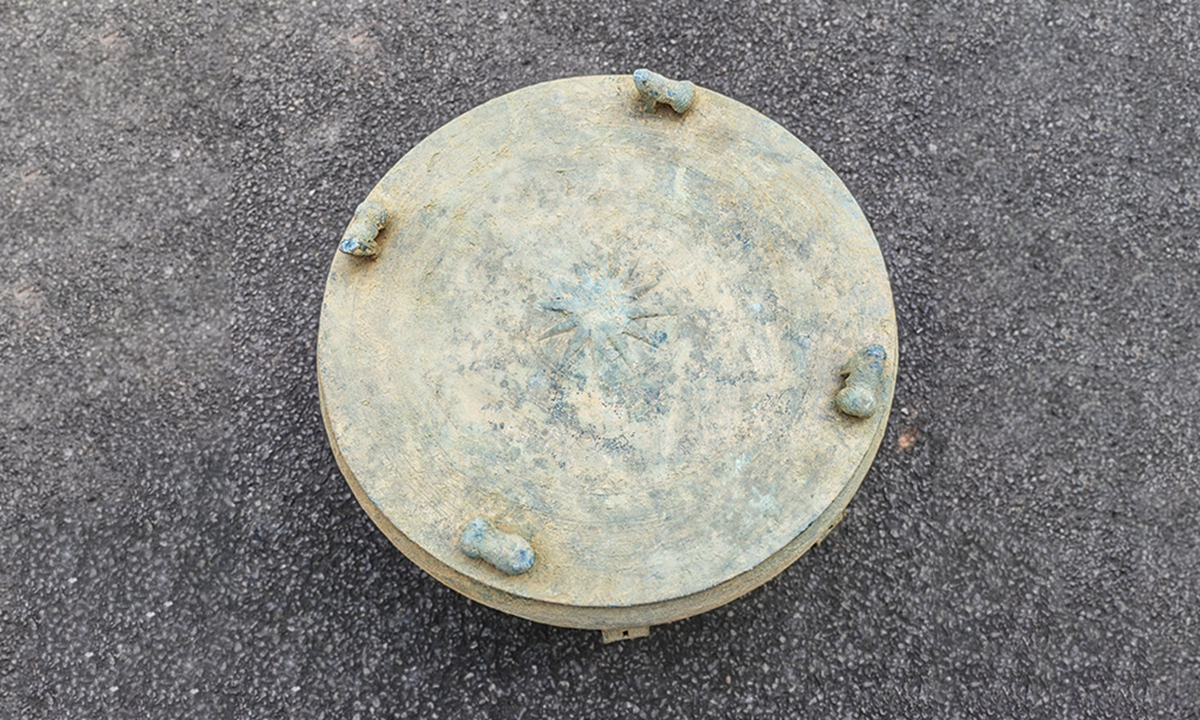
The drum unearthed in Weixin county, Southwest China's Yunnan Province Photo: Courtesy of the Weixin County Cultural Relics Management Department
A bronze drum dating to the Eastern Han Dynasty (25-220) has been unearthed by a farmer in Weixin county, Southwest China's Yunnan Province. The relic was likely used as an important ritual object, offering new insights into ancient religious practices and bronze casting techniques in the region, according to the local Cultural Relics Management Department.
The discovery was made in Wenxing village, while a local villager was working in the fields two months ago. While plowing the land, he noticed a buried object beneath the soil. Authorities were soon notified, prompting an investigation by local cultural heritage officials.
Experts from the Yunnan institute of cultural relics and archaeology later conducted a comprehensive assessment and identified the artifact as a bronze drum from the Eastern Han Dynasty.
The drum is relatively well preserved and features distinct structural characteristics. Made entirely of cast bronze, it has a drumhead diameter of about 58.5 centimeters, a body diameter of 65 centimeters and a total height of 29 centimeters. It weighs roughly 15 kilograms.
At the center of the drumhead is a 12-pointed sun motif, surrounded by bands of short linear patterns along the edge. Four sculpted toads are evenly spaced around the drumhead's rim, each about 7 centimeters long.
Two pairs of flat strap-like handles were symmetrically attached to the waist of the drum. Each handle measures about 17 centimeters long, 5 centimeters wide and is decorated with rope-like patterns and small square perforations.
During the excavation, researchers examined the clear traces of the drum in the burial pit where it had been discovered. The pit matched the drum's shape, and impressions left by the toad decorations were found at the bottom of the cavity. Based on these findings, experts say the drum had been buried upside down.
The burial orientation carries symbolic meaning. In ancient southwestern Chinese cultures, the toad was often associated with fertility, prosperity and abundance. Placing the drum upside down could have represented a ritual act in which prayers or blessings were metaphorically "poured" into the earth, seeking protection or favor from spiritual forces, according to the local Cultural Relics Management Department.
Zhang Qiyu, director of the Weixin County Cultural Relics Management Department, told the Global Times that it has been determined that the drum was not an ordinary musical instrument but a ceremonial object used by ancient elites during important occasions such as rituals and celebrations.
"It served as a sacred vessel that they believed could be used to communicate between Heaven and Earth and symbolized social power and ritual authority," Zhang said.
Despite extending excavation around the site, researchers did not find additional artifacts or associated relics.
The newly discovered drum was found only about 25 meters from the location where another Eastern Han bronze drum had been unearthed in 1980. However, due to decades of farming and road construction, the original burial traces at the earlier site have long since disappeared.
Excavations at both locations yielded no accompanying artifacts in the burial pits, leading archaeologists to conclude that the two drums were buried independently as ritual deposits.
The drum is currently being kept at the Weixin County Cultural Relics Management Department. After conservation work and further studies are completed, it is expected to become part of a museum collection.
RELATED ARTICLES