IN-DEPTH / IN-DEPTH
Green Frontiers: From drones in Xizang to desert roses in Xinjiang, technology is transforming how China plants trees and restores deserts
By and Leng Shumei Published: Mar 13, 2026 08:31 PM

Editor's Note:
"Building ecological civilization concerns the well-being of the people and the future of the nation."
Chinese President Xi Jinping, also general secretary of the Communist Party of China (CPC) Central Committee and chairman of the Central Military Commission, has pointed out, "Respecting, adapting to, and protecting nature is essential for building China into a modern socialist country in all respects."
The building of a Beautiful China is a key component of Xi Jinping Thought on Ecological Civilization. The outline of the 15th Five-Year Plan (2026-2030) for national economic and social development focuses on securing "major breakthroughs in strategic tasks of overall importance to Chinese modernization" and designate "major new strides in advancing the Beautiful China Initiative" as one of the major objectives for economic and social development during the 15th Five-Year Plan period.
The Global Times column on Xi Jinping Thought on Ecological Civilization is launching a series of reports titled "BeautifulChinaING." From the perspectives of the beauty of nature, the beauty of system and the beauty of lifestyles, the series uses both Chinese and international cases as entry points. Through field reporting and video storytelling, it explores how green development has become a defining feature of Chinese modernization while showcasing China's role as a responsible major country providing global public goods.
In this installment, we focus on how China, through technological innovation, has continued to expand its green landscape throughout harsh environments such as deserts and plateaus, achieving ecological miracles that have captured global attention.
When the family behind the YouTube channel "Fernweh Chronicles" stepped off a train in Lhasa, Southwest China's Xizang Autonomous Region, they did not expect the first thing to catch their attention to be in the sky.
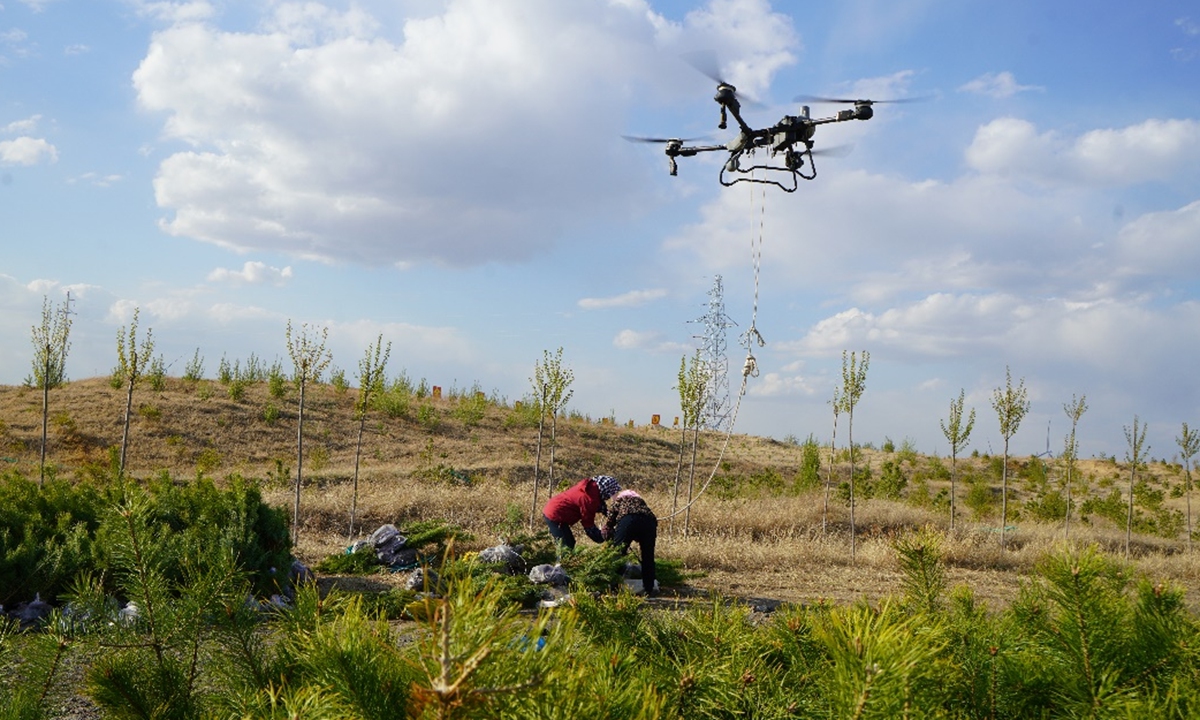
Small drones were flying overhead - each carrying a young tree seedling, ferrying it toward the slopes of the surrounding hills.
Just a few years ago, their local guide explained, trees in these high places were transported the old way. "People used donkeys or mules to lift them up the mountains," he said. "Now they use high-tech."
The moment of surprise captured in the vlog reflects a much larger story unfolding across China.
According to the National Forestry and Grassland Administration, the country's forest area has reached 3.614 billion mu (about 241 million hectares). During the 14th Five-Year Plan period (2021-2025) alone, China added 185 million mu of new forests - roughly the size of Fujian Province - making it the country that has contributed the most and fastest to global greening.
"Increasing green coverage is to bring greater development strengths, and planting trees is to plant the future," Chinese President Xi Jinping said at a tree-planting activity in April 2024, calling for continued efforts to enrich the country's "green assets," the Xinhua News Agency reported.
In 1979, China designated March 12 as National Tree Planting Day. Tree planting activities had been held across the country before the 2026 National Tree Planting Day to encourage more people to participate in afforestation work. Thanks to decades of perseverance in its afforestation efforts, China has moved to the forefront of global efforts to green the planet, contributing approximately a quarter of the world's new green areas since 2000, according to Xinhua.
As the scene in Lhasa suggests, technology is boosting both the efficiency and quality of China's green efforts. By combining drones, light detection and ranging and algorithmic modeling, a research team at Peking University told Xinhua that China has roughly 100 trees for every citizen.
The figure makes the country's expanding "green assets" easier to visualize, reflecting how technology is helping scale up tree planting and reinforce efforts to curb desertification.
When roses bloom in desert
"Sand can grow gold," farmer Aizezi Maitirouzi likes to say. He lives on the southern edge of the Taklimakan Desert in Yutian County, Northwest China's Xinjiang Uygur Autonomous Region.
More than a decade ago, the landscape around his village was dominated by shifting dunes. Strong winds frequently buried farmland, and villagers watched helplessly as the desert crept closer year after year, he recalled during an interview with the Global Times.
In 2012, Aizezi decided to experiment with planting tamarisk on 30 mu of sandy land. The hardy desert shrub can stabilize loose sand, and beneath its roots grows cistanche, a valuable medicinal herb often called "desert ginseng."
But restoring vegetation in the desert requires more than determination.
In the early years, seedlings were often blown over by strong winds and water had to be diverted from distant sources. Gradually, Aizezi began applying techniques promoted by local forestry experts: drip irrigation to deliver water directly to plant roots, improved planting patterns to help shrubs resist wind, and optimized inoculation methods.
These techniques steadily improved survival rates and productivity. What began as a small experiment has since grown into a cooperative involving 59 households. Today, the plantation covers about 1,800 mu of tamarisk, forming a green belt along the desert's edge with annual cistanche sales reaching around 150 tons, according to the publicity department in Yutian.
The project has created stable jobs and seasonal employment for hundreds of villagers, turning ecological restoration into a new source of income.
Aizezi's experience reflects a broader push in Yutian to combine ecological restoration with science-based desert control. Located on the southern rim of the Taklimakan Desert, the county faces severe desertification challenges, with sandy land covering more than two-thirds of its territory.
In recent years, local authorities have promoted integrated approaches that combine vegetation restoration, engineering sand barriers and desert-based industries. According to data from the Yutian county publicity department, large areas of tamarisk and other desert-adapted plants have been established, helping curb sandstorms while supporting industries such as medicinal herbs and roses.
These efforts rely on a mix of modern techniques, including straw checkerboard barriers to stabilize dunes, drip irrigation for desert vegetation and photovoltaic projects that combine solar power generation with sand control.
Through long-term technical experimentation, local growers have cultivated rose varieties suited to desert-edge conditions, allowing the plants to stabilize sand while supporting local livelihoods and helping earn Yutian a reputation as Xinjiang's "rose town."
What once seemed impossible, planting life in moving sand, is now becoming part of everyday life in Yutian.
Technology reshapes sandy land
A similar "impossible" scene is also happening in the Horqin Sandy Land in Tongliao, North China's Inner Mongolia Autonomous Region. Stretching across three provinces and autonomous regions - Inner Mongolia, Jilin, and Liaoning - and covering a total area of 99.5 million mu (6.633 million hectares), the land was once a persistent source of sandstorms looming over the Beijing-Tianjin-Hebei region. Endless yellow sand was a daily reality here, according to data the Tongliao government sent to the Global Times.
Afforesting this barren land was once a challenge daunting Chaoketu, director of the forestry workstation in the Horqin Left Wing Rear Banner, Tongliao, who had spent more than three decades in planting trees in this land.
However, traditional manual afforestation methods struggled to take hold on the shifting sands, with sapling survival rates dropping below 50 percent. All too often, the sparse greenery planted would be quickly eroded by relentless sandstorms, Chaoketu told the Global Times.
That all changed in 2013 after Chaoketu led his team to developed an innovative planting technique. The method involves digging deep pits - 60 to 100 centimeters deep - in the sand, burying saplings deeply, then covering the soil in two stages to half the pit's depth. Combined with precise watering and tamping, this approach allows the seedlings' roots to penetrate deep into the sand to access water reserves.
This technological breakthrough revolutionized desert control in the Horqin Sandy Land: the survival rate of Mongolian pines soared to over 90 percent, afforestation costs dropped by nearly 1,000 yuan ($145.5) per mu, and water consumption decreased by 55.8 percent, according to the data provided by the Tongliao government.
It also broke seasonal constraints, making year-round afforestation in the sandy land feasible. By 2025, Tongliao had completed more than 600,000 mu of afforestation using this method, according to the data.
After this technique laid the groundwork for greening the sands in Horqin, the introduction of various intelligent equipment catapulted the land's desert control efficiency to new heights.
In 2025, Tongliao deployed a range of new equipment to support desert control, including high-speed grassland seeders, sand-fixing machines, and cutting robots. Each of these tools plays a unique and vital role: high-speed grassland seeders can cover 1,500 mu per day - 500 times the efficiency of manual labor - turning a multi-day manual seeding job into a matter of hours. Sand-fixing machines lay 30,000 meters of sand barriers daily, nearly 50 times faster than manual work, quickly erecting a Great Wall of windbreaks and sand fixation across the desert. Cutting robots, meanwhile, precisely plant seedlings, ensuring each one takes root and thrives, according to the Tongliao government.
Providing experience, support to the world
From the drones in Xizang to the roses in Xinjiang and the Mongolian pines in Inner Mongolia, intelligent equipment and innovative technologies are making greening and conservation more efficient and precise than ever before. According to data released by the National Forestry and Grassland Administration, mechanical desert control and afforestation now account for nearly 50 percent of China's total afforestation efforts.
China's contribution and experience in afforestation have also been promoted overseas to help combat global deforestation.
In December 2024, Lu Qi, chief scientist of the Chinese Academy of Forestry and founding president of the Institute of the Great Green Wall, was awarded the Champions of the Earth award, the UN's highest environmental honor, marking the first time a Chinese recipient has been recognized in the Science and Innovation category of the award.
The Kubuqi model in Inner Mongolia has also been recognized as a global public good and is already guiding desertification control efforts in Africa, the Middle East, and Central Asia, according to a Xinhua report.
In the Aral Sea, scientists from China and Uzbekistan have been working together for years to explore solutions to the Aral Sea ecological crisis through various forms such as joint scientific expeditions, saline-alkali land improvement, and the construction of water-saving cotton field demonstration areas, the report said.
Like Uzbek political observer Sharofiddin Tulaganov told Xinhua, "Jointly pursuing green innovation not only restores the region's ecology but also forges a sustainable future across Central Asia," when China and the world stands together to combat deforestation, it is not only about ecology, but also a better and greener future for the world.
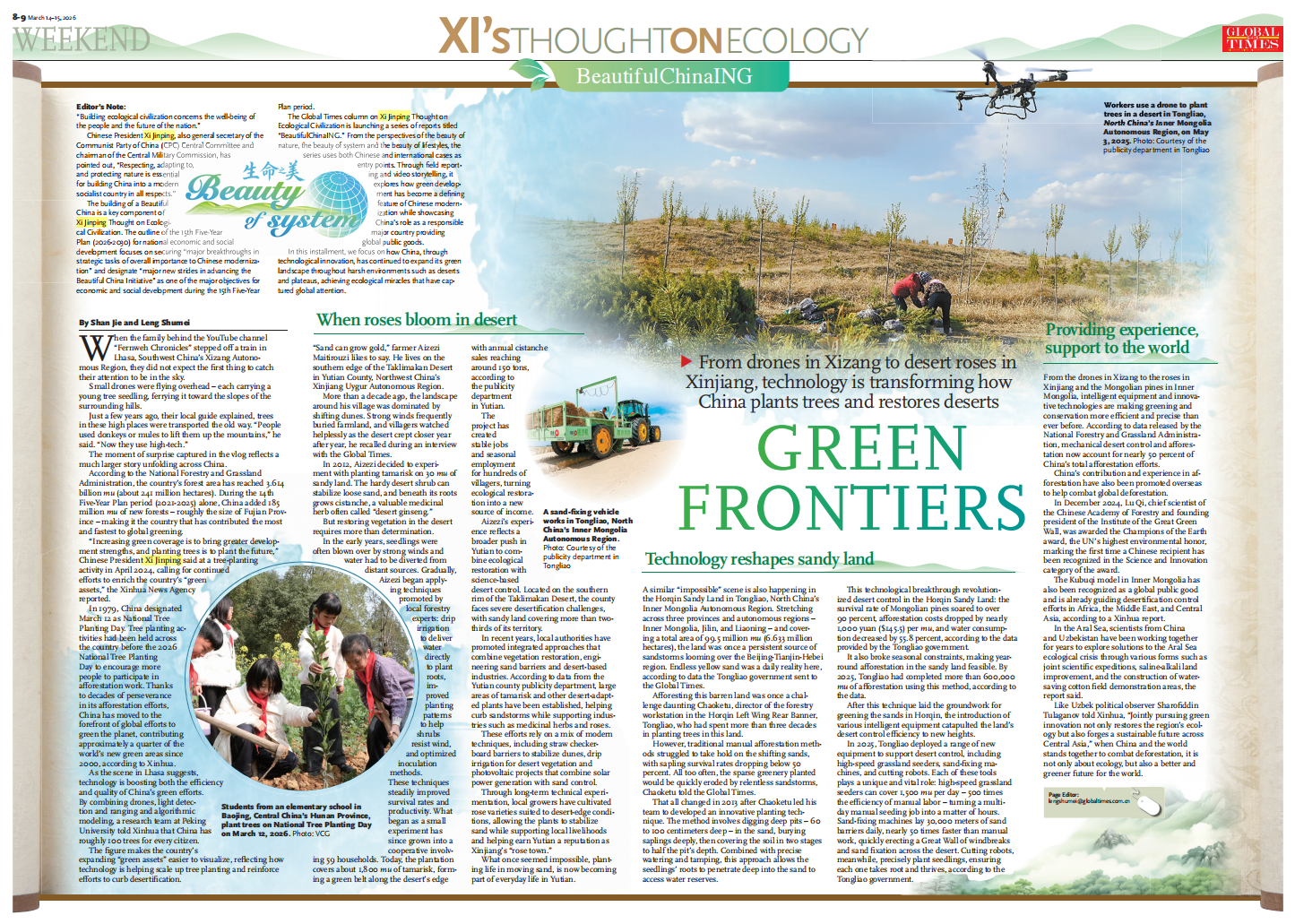
"Building ecological civilization concerns the well-being of the people and the future of the nation."
Chinese President Xi Jinping, also general secretary of the Communist Party of China (CPC) Central Committee and chairman of the Central Military Commission, has pointed out, "Respecting, adapting to, and protecting nature is essential for building China into a modern socialist country in all respects."
The building of a Beautiful China is a key component of Xi Jinping Thought on Ecological Civilization. The outline of the 15th Five-Year Plan (2026-2030) for national economic and social development focuses on securing "major breakthroughs in strategic tasks of overall importance to Chinese modernization" and designate "major new strides in advancing the Beautiful China Initiative" as one of the major objectives for economic and social development during the 15th Five-Year Plan period.
The Global Times column on Xi Jinping Thought on Ecological Civilization is launching a series of reports titled "BeautifulChinaING." From the perspectives of the beauty of nature, the beauty of system and the beauty of lifestyles, the series uses both Chinese and international cases as entry points. Through field reporting and video storytelling, it explores how green development has become a defining feature of Chinese modernization while showcasing China's role as a responsible major country providing global public goods.
In this installment, we focus on how China, through technological innovation, has continued to expand its green landscape throughout harsh environments such as deserts and plateaus, achieving ecological miracles that have captured global attention.
Workers use a drone to plant trees in a desert in Tongliao, North China's Inner Mongolia Autonomous Region, on May 3, 2025. Photo: Courtesy of the publicity department in Tongliao
When the family behind the YouTube channel "Fernweh Chronicles" stepped off a train in Lhasa, Southwest China's Xizang Autonomous Region, they did not expect the first thing to catch their attention to be in the sky.
Small drones were flying overhead - each carrying a young tree seedling, ferrying it toward the slopes of the surrounding hills.
Just a few years ago, their local guide explained, trees in these high places were transported the old way. "People used donkeys or mules to lift them up the mountains," he said. "Now they use high-tech."
The moment of surprise captured in the vlog reflects a much larger story unfolding across China.
According to the National Forestry and Grassland Administration, the country's forest area has reached 3.614 billion mu (about 241 million hectares). During the 14th Five-Year Plan period (2021-2025) alone, China added 185 million mu of new forests - roughly the size of Fujian Province - making it the country that has contributed the most and fastest to global greening.
"Increasing green coverage is to bring greater development strengths, and planting trees is to plant the future," Chinese President Xi Jinping said at a tree-planting activity in April 2024, calling for continued efforts to enrich the country's "green assets," the Xinhua News Agency reported.
In 1979, China designated March 12 as National Tree Planting Day. Tree planting activities had been held across the country before the 2026 National Tree Planting Day to encourage more people to participate in afforestation work. Thanks to decades of perseverance in its afforestation efforts, China has moved to the forefront of global efforts to green the planet, contributing approximately a quarter of the world's new green areas since 2000, according to Xinhua.
As the scene in Lhasa suggests, technology is boosting both the efficiency and quality of China's green efforts. By combining drones, light detection and ranging and algorithmic modeling, a research team at Peking University told Xinhua that China has roughly 100 trees for every citizen.
The figure makes the country's expanding "green assets" easier to visualize, reflecting how technology is helping scale up tree planting and reinforce efforts to curb desertification.
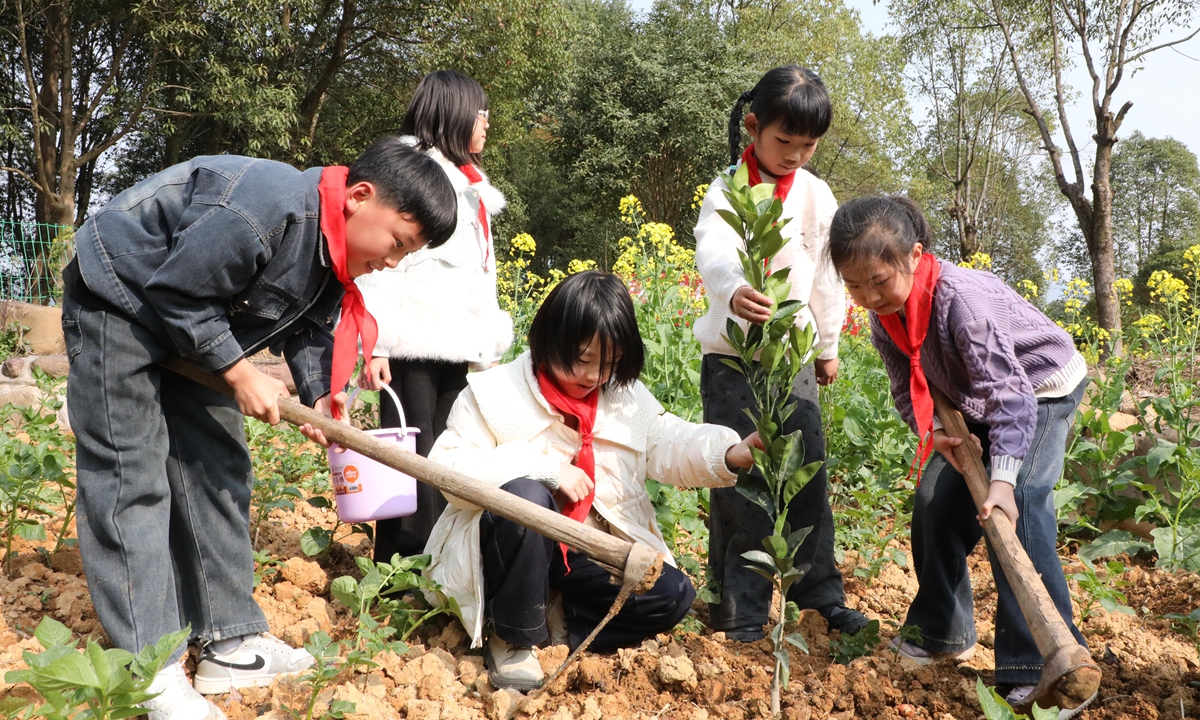
Students from an elementary school in Baojing, Central China's Hunan Province, plant trees on National Tree Planting Day on March 12, 2026. Photo: VCG
When roses bloom in desert
"Sand can grow gold," farmer Aizezi Maitirouzi likes to say. He lives on the southern edge of the Taklimakan Desert in Yutian County, Northwest China's Xinjiang Uygur Autonomous Region.
More than a decade ago, the landscape around his village was dominated by shifting dunes. Strong winds frequently buried farmland, and villagers watched helplessly as the desert crept closer year after year, he recalled during an interview with the Global Times.
In 2012, Aizezi decided to experiment with planting tamarisk on 30 mu of sandy land. The hardy desert shrub can stabilize loose sand, and beneath its roots grows cistanche, a valuable medicinal herb often called "desert ginseng."
But restoring vegetation in the desert requires more than determination.
In the early years, seedlings were often blown over by strong winds and water had to be diverted from distant sources. Gradually, Aizezi began applying techniques promoted by local forestry experts: drip irrigation to deliver water directly to plant roots, improved planting patterns to help shrubs resist wind, and optimized inoculation methods.
These techniques steadily improved survival rates and productivity. What began as a small experiment has since grown into a cooperative involving 59 households. Today, the plantation covers about 1,800 mu of tamarisk, forming a green belt along the desert's edge with annual cistanche sales reaching around 150 tons, according to the publicity department in Yutian.
The project has created stable jobs and seasonal employment for hundreds of villagers, turning ecological restoration into a new source of income.
Aizezi's experience reflects a broader push in Yutian to combine ecological restoration with science-based desert control. Located on the southern rim of the Taklimakan Desert, the county faces severe desertification challenges, with sandy land covering more than two-thirds of its territory.
In recent years, local authorities have promoted integrated approaches that combine vegetation restoration, engineering sand barriers and desert-based industries. According to data from the Yutian county publicity department, large areas of tamarisk and other desert-adapted plants have been established, helping curb sandstorms while supporting industries such as medicinal herbs and roses.
These efforts rely on a mix of modern techniques, including straw checkerboard barriers to stabilize dunes, drip irrigation for desert vegetation and photovoltaic projects that combine solar power generation with sand control.
Through long-term technical experimentation, local growers have cultivated rose varieties suited to desert-edge conditions, allowing the plants to stabilize sand while supporting local livelihoods and helping earn Yutian a reputation as Xinjiang's "rose town."
What once seemed impossible, planting life in moving sand, is now becoming part of everyday life in Yutian.
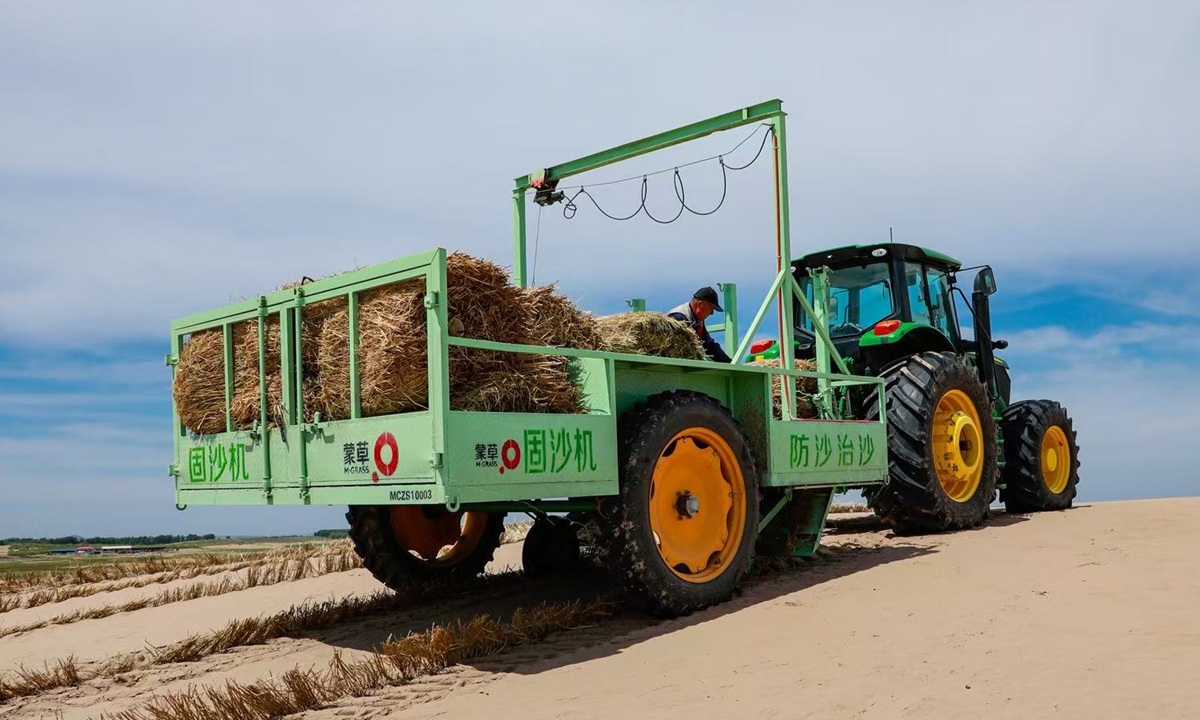
A sand-fixing vehicle works in Tongliao, North China's Inner Mongolia Autonomous Region. Photo: Courtesy of the publicity department in Tongliao
Technology reshapes sandy land
A similar "impossible" scene is also happening in the Horqin Sandy Land in Tongliao, North China's Inner Mongolia Autonomous Region. Stretching across three provinces and autonomous regions - Inner Mongolia, Jilin, and Liaoning - and covering a total area of 99.5 million mu (6.633 million hectares), the land was once a persistent source of sandstorms looming over the Beijing-Tianjin-Hebei region. Endless yellow sand was a daily reality here, according to data the Tongliao government sent to the Global Times.
Afforesting this barren land was once a challenge daunting Chaoketu, director of the forestry workstation in the Horqin Left Wing Rear Banner, Tongliao, who had spent more than three decades in planting trees in this land.
However, traditional manual afforestation methods struggled to take hold on the shifting sands, with sapling survival rates dropping below 50 percent. All too often, the sparse greenery planted would be quickly eroded by relentless sandstorms, Chaoketu told the Global Times.
That all changed in 2013 after Chaoketu led his team to developed an innovative planting technique. The method involves digging deep pits - 60 to 100 centimeters deep - in the sand, burying saplings deeply, then covering the soil in two stages to half the pit's depth. Combined with precise watering and tamping, this approach allows the seedlings' roots to penetrate deep into the sand to access water reserves.
This technological breakthrough revolutionized desert control in the Horqin Sandy Land: the survival rate of Mongolian pines soared to over 90 percent, afforestation costs dropped by nearly 1,000 yuan ($145.5) per mu, and water consumption decreased by 55.8 percent, according to the data provided by the Tongliao government.
It also broke seasonal constraints, making year-round afforestation in the sandy land feasible. By 2025, Tongliao had completed more than 600,000 mu of afforestation using this method, according to the data.
After this technique laid the groundwork for greening the sands in Horqin, the introduction of various intelligent equipment catapulted the land's desert control efficiency to new heights.
In 2025, Tongliao deployed a range of new equipment to support desert control, including high-speed grassland seeders, sand-fixing machines, and cutting robots. Each of these tools plays a unique and vital role: high-speed grassland seeders can cover 1,500 mu per day - 500 times the efficiency of manual labor - turning a multi-day manual seeding job into a matter of hours. Sand-fixing machines lay 30,000 meters of sand barriers daily, nearly 50 times faster than manual work, quickly erecting a Great Wall of windbreaks and sand fixation across the desert. Cutting robots, meanwhile, precisely plant seedlings, ensuring each one takes root and thrives, according to the Tongliao government.
Providing experience, support to the world
From the drones in Xizang to the roses in Xinjiang and the Mongolian pines in Inner Mongolia, intelligent equipment and innovative technologies are making greening and conservation more efficient and precise than ever before. According to data released by the National Forestry and Grassland Administration, mechanical desert control and afforestation now account for nearly 50 percent of China's total afforestation efforts.
China's contribution and experience in afforestation have also been promoted overseas to help combat global deforestation.
In December 2024, Lu Qi, chief scientist of the Chinese Academy of Forestry and founding president of the Institute of the Great Green Wall, was awarded the Champions of the Earth award, the UN's highest environmental honor, marking the first time a Chinese recipient has been recognized in the Science and Innovation category of the award.
The Kubuqi model in Inner Mongolia has also been recognized as a global public good and is already guiding desertification control efforts in Africa, the Middle East, and Central Asia, according to a Xinhua report.
In the Aral Sea, scientists from China and Uzbekistan have been working together for years to explore solutions to the Aral Sea ecological crisis through various forms such as joint scientific expeditions, saline-alkali land improvement, and the construction of water-saving cotton field demonstration areas, the report said.
Like Uzbek political observer Sharofiddin Tulaganov told Xinhua, "Jointly pursuing green innovation not only restores the region's ecology but also forges a sustainable future across Central Asia," when China and the world stands together to combat deforestation, it is not only about ecology, but also a better and greener future for the world.
Green frontiers
RELATED ARTICLES