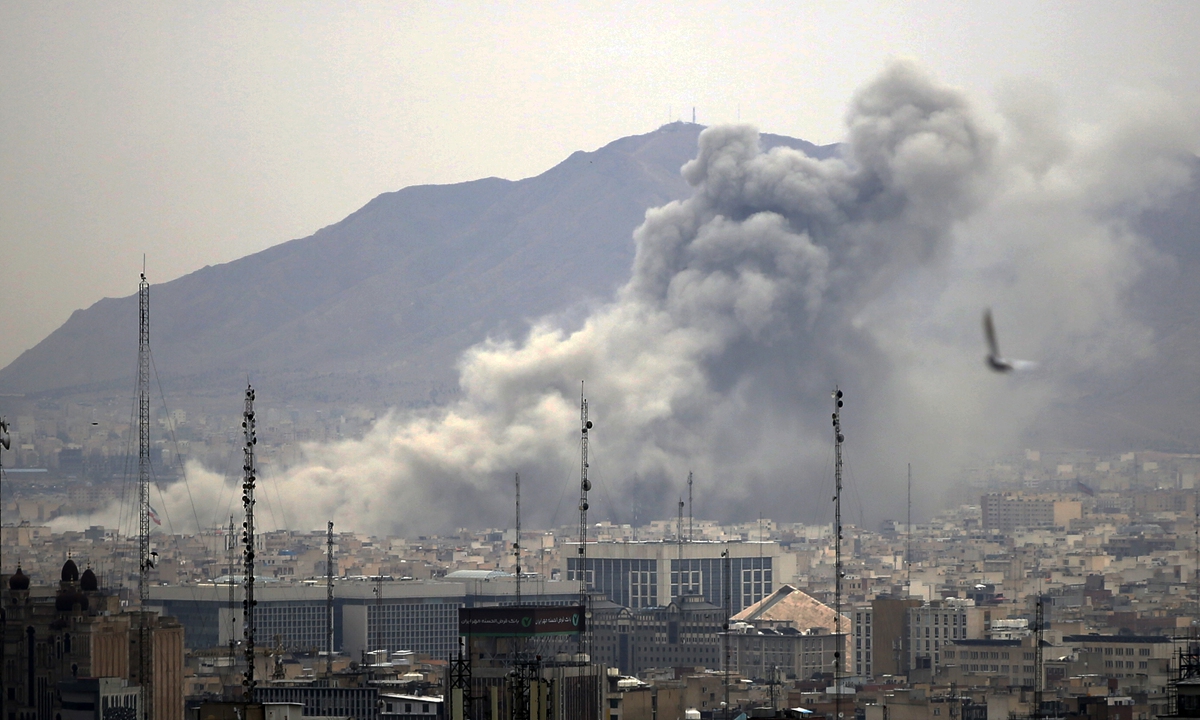
Smoke rises after airstrikes in Tehran, Iran on March 13, 2026. Photo: VCG
Since the US and Israel launched a surprise strike on Iran on February 28, this conflict has lasted for two full weeks and is triggering a global oil crisis of profound concern. China's stance and actions have long drawn international attention. We noted that claims such as "China's indifference" or "China abandoning Iran" occasionally appear in Western discourse. These narratives not only distort the facts but also remind the world to stay wary of those seeking to further muddy the waters in the Middle East.
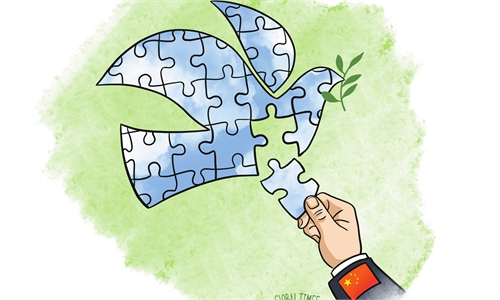
Conflicts in the Middle East have always carried strong spillover effects. An immediate ceasefire in the region to prevent further escalation of situation, followed by a swift return to the negotiating table - this is the shared consensus of regional countries and the wider international community.This is why, despite not being a party to the conflict, China has been actively engaged in diplomatic mediation since the hostilities began, working toward peace in the Middle East. As China has emphasized, this is a war that should not have happened - a war that serves no one's interests.
According to publicly available information, China respectively had phone calls with the foreign ministers of 12 countries: Russia, Oman, Iran, France, Israel, Saudi Arabia, the United Arab Emirates, Kuwait, Bahrain, Pakistan, Qatar, and Egypt from March 1 to 12. Simultaneously, China has sent a special envoy to the Middle East to conduct diplomatic mediation. At a time when the conflict continues to escalate, China's efforts to deescalate tensions and create space for dialogue are increasingly recognized by countries in the region.
China's stance is very clear. At the foreign minister's press conference during the two sessions on March 8, Chinese Foreign Minister Wang Yi outlined five principles for addressing the Iran situation: respecting national sovereignty, rejecting the abuse of force, non-interference in internal affairs, promoting political settlement of hotspot issues, and major powers should play a constructive role. These principles offer clear guidance for easing tensions.
In its conversations with all parties, China's position has remained consistent: First, China opposes the use of force to resolve disputes and emphasizes that the fundamental way to prevent further deterioration of the situation is for the US and Israel to cease their military operations; second, China does not approve of the expansion of the strike scope, condemns the indiscriminate attacks on civilians and non-military targets, and supports the Gulf countries in taking the future of the region into their own hands; and third, China will continue to play a constructive role in easing the situation and restoring peace in its own way.
It is clear that China's proposals address the root causes of the conflict while accommodating the legitimate concerns of all parties involved. These proposals address both the immediate crisis and the lasting peace in the region, reflecting China's long-standing commitment to promoting peace in the Middle East. Some analysts noted that as China maintains good relations with all countries in the Middle East and has extensive experience in mediation, regional states also expect China's diplomatic efforts to play a positive role.
In fact, many Western interpretations that distort China's position are self-contradictory and fail to stand up to scrutiny. Some claim that China has "abandoned Iran," while others say China is "protecting Iran." Some claim that China benefits from the war, while others portray it as a "loser." Some of these completely opposite narratives even come from the same media outlets. This reveals not only a deeply rooted Cold War mentality but also elements of information warfare: Muddying the waters with bloc confrontation narratives aimed at justifying the improper and unlawful actions of the US and Israel.
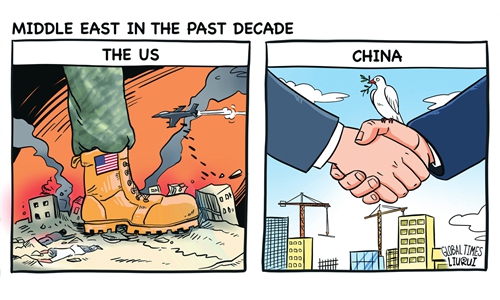
In recent years, the Middle East has remained volatile, with conflict risks mounting across the region. China has consistently worked for peace in the region and is committed to addressing the root causes of its security dilemmas. In March 2023, with China's mediation, Iran and Saudi Arabia achieved reconciliation, producing a positive demonstration effect and encouraging a broader trend of de-escalation and reconciliation in the region. In 2025, China spoke up for justice on the Palestinian issue nearly 30 times at the UN Security Council. On key issues such as the Iranian nuclear issue, Yemen and Syria, China has repeatedly put forward concrete initiatives. A Qatari scholar previously noted that China's neutral and balanced position enables it to play a unique mediating role among different parties.
At this crossroads where the flames of conflict continue to spread, what the international community needs is a path that ends the current cycle of retaliation while addressing the legitimate security concerns of all parties. The vision of common, comprehensive, cooperative and sustainable security advocated by the Global Security Initiative provides a valuable reference for all parties in addressing the Middle East's security challenges. It is hoped that more international actors will join China in working for a ceasefire and an end to the fighting, paving the way for renewed peace and stability in the Middle East.
The people of the Middle East do not need more war. In the face of a complex and volatile situation, China has neither taken sides nor stood idly by. Instead, it has stood on the side of peace, justice and humanitarianism, building bridges of communication through a fair stance and pragmatic actions to help ease tensions. As a permanent member of the UN Security Council and sincere friend of Middle Eastern countries, China will not cease its efforts for peace, nor will its voice for fairness and justice fall silent. China will continue, in its own way, to continue inject stability into this war-weary land.