China launches comprehensive hydrogen pilot program to boost green transition
By Published: Mar 16, 2026 09:17 PM

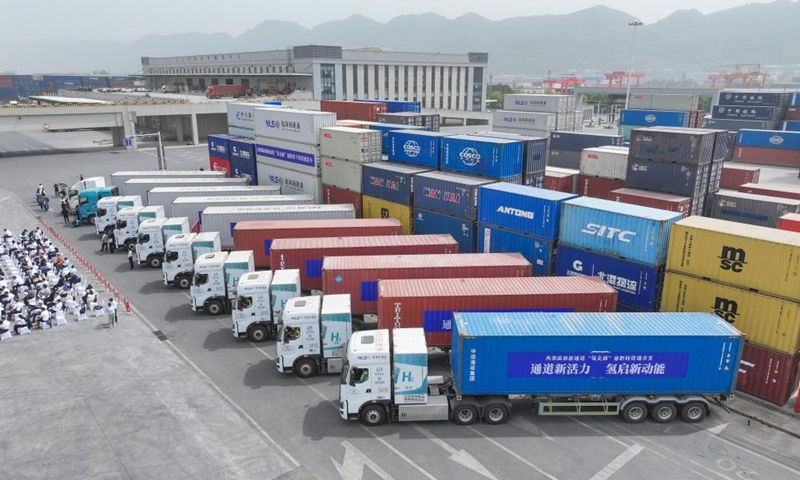
An aerial drone photo taken on April 14, 2025 shows hydrogen-powered heavy-duty trucks awaiting departure from the dry port of the New International Land-Sea Trade Corridor in Chongqing, southwest China. (Photo: Xinhua)
China's Ministry of Industry and Information Technology (MIIT), along with the Ministry of Finance and the National Development and Reform Commission, jointly issued a notice on Monday announcing the launch of a comprehensive hydrogen energy application pilot program, according to a statement posted on the website of the MIIT.
A Chinese analyst said that the new policy guidance is set to turbocharge the development of the sector, which is now facing the constraints of limited scale, and could effectively drive down the costs of using hydrogen by expanding the application scale of the industry.
The initiative aims to drive down costs through large-scale, multi-scenario applications, fostering high-quality development in the hydrogen sector and supporting a comprehensive green transformation of the economy and society.
The pilot program will select city clusters through a competitive "open competition" mechanism. It features six application categories: fuel cell vehicles, green ammonia and methanol, hydrogen-based chemical feedstock substitution, hydrogen metallurgy, hydrogen blending for combustion, and innovative application scenarios.
The pilot period is set for four years, with a maximum central government reward of 1.6 billion yuan ($230 million) per participating city cluster.
The program seeks to expand the application of hydrogen from just fuel cell vehicles to diverse areas such as industry and transportation. The goal is to create a comprehensive application ecosystem centered on fuel cell vehicles, complemented by industrial uses and innovative scenarios, per the MIIT statement.
Fuel cell vehicle applications will focus on large commercial vehicles and cold-chain logistics. Industrial applications include green ammonia and methanol, chemical feedstock substitution, hydrogen metallurgy, and hydrogen blending for combustion. Innovative uses will explore hydrogen in rail vehicles, ships and new-energy storage.
Specific targets for 2030 include large-scale hydrogen use across multiple sectors in pilot clusters, an average end-user hydrogen price below 25 yuan per kilogram or even around 15 yuan per kilogram at some advantageous regions, and a near-doubling of the national fuel cell vehicle fleet to about 100,000 units from 2025 levels. The initiative is also expected to drive technological upgrades in fuel cells and electrolyzers, per the statement.
Lin Boqiang, director of the Center for Energy Economics at Xiamen University, told the Global Times on Monday that the new policy guidance is set to help the nation move faster to develop a new type of energy system.
China's new hydrogen pilot program covering the vehicle and industrial sectors aims to boost the industry through policy support. The hydrogen sector remains small-scale despite years of promotion, with high costs and limited hydrogen supply as key bottlenecks, Lin said.
The current use of gray hydrogen and industrial by-product hydrogen is too small for large-scale development, Lin said, noting that the creation of low-cost green hydrogen on a large scale by harnessing wind and solar bases in the northwest will be critical.
Lin noted that China is positioned in a globally leading echelon in hydrogen energy development, with advantages in low-cost renewable energy. "The pilot program will help scale up applications and enhance China's competitiveness in the global hydrogen race."
A CCTV News report on Monday cited an MIIT official as saying that China's hydrogen industry has achieved ground-breaking breakthroughs.
As of end-2025, China's cumulative sales of hydrogen fuel cell vehicles reached around 40,000 units, according to the official.
China leads globally in both the number of hydrogen refueling stations built and total refueling capacity, with annual green hydrogen production capacity reaching around 250,000 tons, the official said.
The new pilot program aims to overcome challenges such as limited applications, high costs, and storage and transportation difficulties, ushering the industry into a new phase of large-scale development, the official said.
RELATED ARTICLES