ARTS / CULTURE & LEISURE
Secrets behind the symbols: 10,000-year-old Helan Mountains ‘emojis’
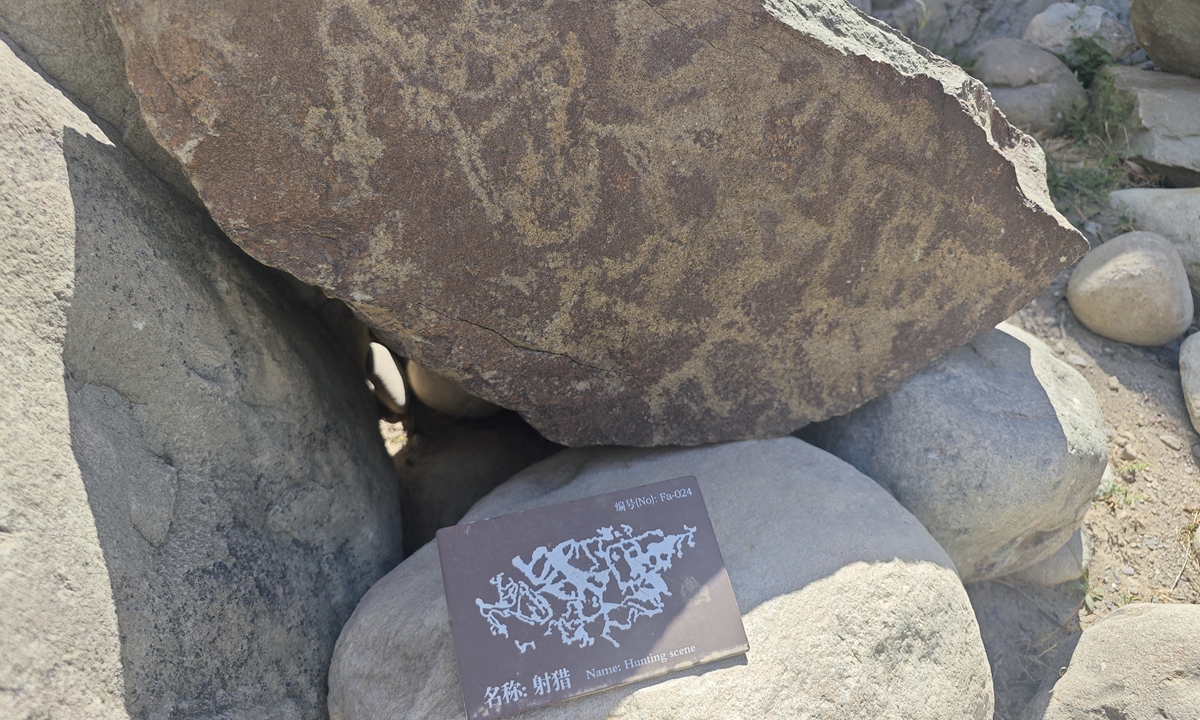
A petroglyph of a hunting scene in the Helan Mountains rock art cluster on May 19, 2025 Photo: VCG
Compared to the meticulously painted ancient rock art in southern China, the rock art found among the Helan Mountains in Northwest China's Ningxia Hui Autonomous Region have a distinctive ruggedness, born from being chiseled into stone using primitive tools around 10,000 years ago.This unique method of creation gives the Helan Mountains rock art its childlike innocence. From the image of a popping-eyed "God of Sun" to the whimsical scene of a bird guiding a sheep-laden donkey, these petroglyphs are "like the prehistoric equivalent of emojis," Ma Erna, a local conservation specialist, told the Global Times.
Including Ma, a local conservation team has recently launched a new field investigation at the site. Through digital surveys of these ancient stone-carving "emojis," the team aims to unveil not just the daily life of ancient people, but also the cultural beliefs and aesthetic sensibilities behind them.
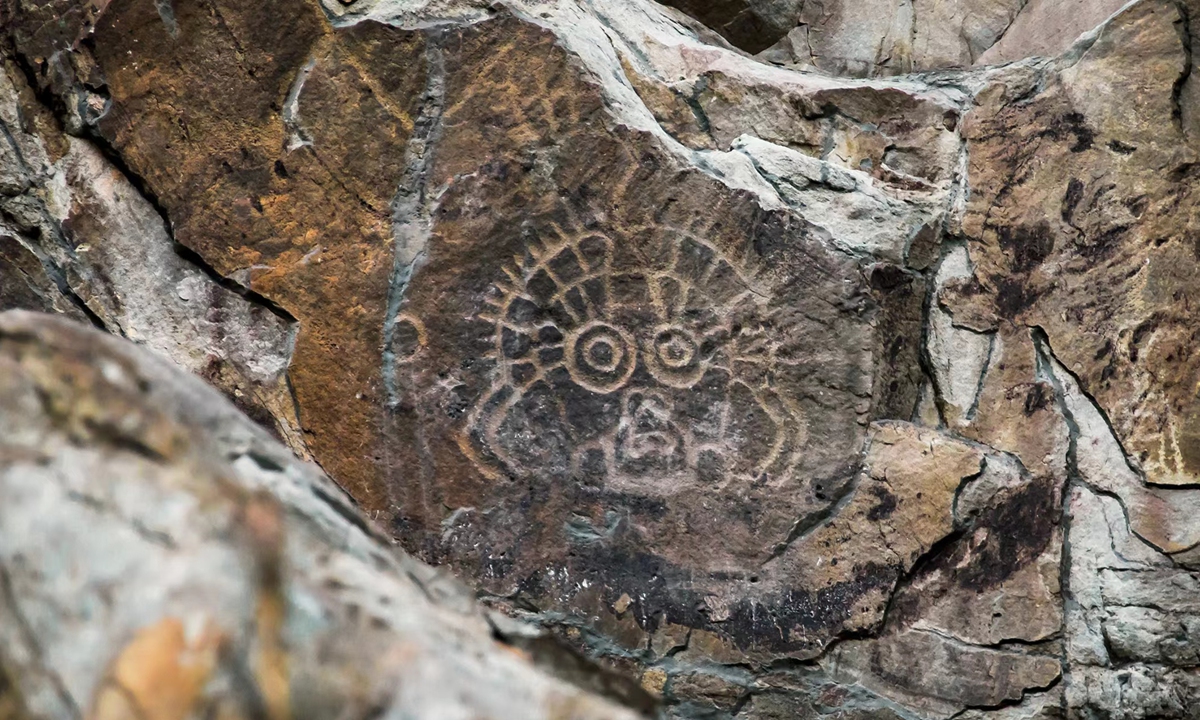
A petroglyph of the "God of Sun" in the Helan Mountains rock art cluster Photo: Courtesy of the Administration Office of Helan Mountains Rock Art
Decoding prehistoric signsStretching across 250 kilometers, the Helan Mountains are home to over 30,000 such ancient rock art. Among them, a total of 5,685 are located at Helankou (lit: Entrance of the Helan Mountains), where these petroglyphs are most densely distributed. They feature the richest scenes such as herding, sacrificial ceremonies, and ritual dances. Together, they form the core protected area of the Helan Mountains rock art.
The core area has been divided into six zones labeled A through F. In some zones, the petroglyphs can be found on exposed rocks and are relatively easy to spot, while in areas like A, D, E and F, they are subtly hidden among rocks of all sizes scattered across the barren mountains. The current on-site investigation zeros in on these four zones with the aim of digitizing these petroglyphs.
"Through means like remote sensing imagery, drone oblique photography and more, we plan to complete the digital archiving of these petroglyphs by the end of this year and interpret those that tell the most compelling stories," Xu Xiaolong, a research member at the site, told the Global Times.
Prior to the current project, many of the "compelling stories" behind Helan Mountains' rock art had already been uncovered.
One rock face is carved with two handprints - one large and one small - alongside other imagery. The handprints are remarkably clear, resembling the waving emoji commonly used on smartphones today. The smaller left hand appears above a kneeling ox, while the larger right hand stands alone. Also depicted is a human face strikingly similar to the "alien face" emoji.
These seemingly childlike images actually illustrate how ancient Chinese "adhered to the spirit of contractual obligations in their everyday lives," Zhang Jianguo, deputy director of the Administration Office of Helan Mountain Rock Art, told the Global Times.
The two handprints symbolize a powerful tribe's conquest of a weaker one and the subsequent transfer of property, with the alien-like face depicting a shaman who witnessed the signing of the pact.
Beyond handprints, the Helan Mountains rock art is most renowned for its depictions of human faces. On one cliff face, nearly 60 human faces are carved alongside over 30 animals and symbols. Each face is composed of specific symbols: triangles represent women, while various orientations of U-shaped or X-shaped figures represent men. Together, they showcase the remarkably creative aesthetic sensibilities of prehistoric people.
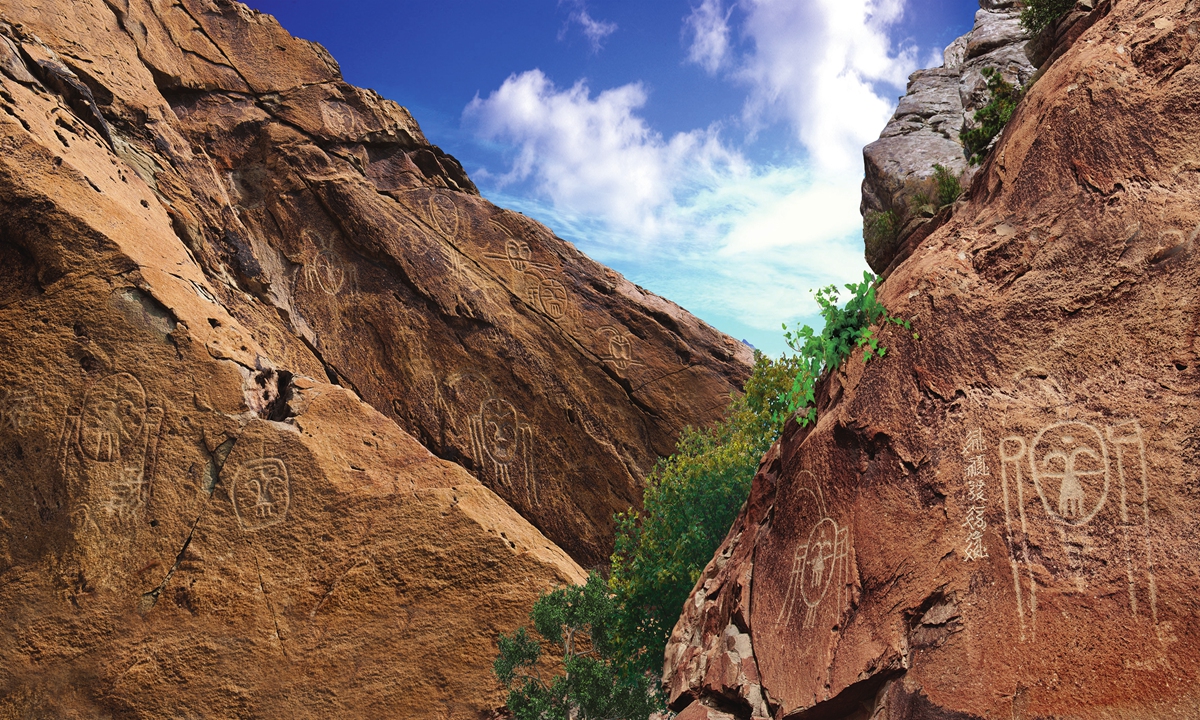
Petroglyphs in the Helan Mountains rock art cluster Photo: VCG
More than ancient artBe it the fertility goddess or handprints, deciphering the stories behind the petroglyphs offers a glimpse into the belief systems and technological knowledge of primitive nomadic tribes. They also bear witness to their gradual integration with agricultural civilizations.
For example, beyond human figures, rare plant-based petroglyphs have been discovered among the Helan Mountains rock paintings. They depict ears of wheat and crops that did not originate from nomadic lands but from the Central Plains in China, the acknowledged cradle of the Chinese civilization.
"Such discoveries transform the Helan Mountains petroglyphs from ancient art into living testimony of how diverse ethnic traditions have interwoven with each other throughout Chinese history," Zhang remarked.
Despite their immense historical value, the Helan Mountains petroglyphs, having long been exposed to the natural elements, are suffering from deterioration such as cracks, delamination, spalling, and flaking.
On one front, conservation experts are employing physical and chemical methods such as filling fissures with materials similar to resin to slow their erosion. On the other front, including the current 2026 digital survey, a regional mapping and digital documentation project for the petroglyphs has been underway since 2020.
This project aims, on the one hand, to simulate and present the petroglyph landscape within the 12-square-kilometer Helankou protected area through methods like refined surveying and the creation of conservation engineering atlases. But more importantly, it seeks to bring the petroglyphs, particularly those deep in the wilderness on remote cliffs, into public life through digital means.
Located just near the core protected area lies a museum dedicated to the Helan Mountains rock art. Petroglyphs such as the "God of Sun" have been digitized into three-dimensional models, allowing visitors to explore its intricacies with just a mouse click.
So far, 170,000 high-definition images and surveying data from 519 groups of petroglyphs have been collected and are ready to be displayed at the museum.
"In China, digital projects have become common for murals and grottoes, but given that rock art is completely exposed to the natural environment, digitization is all the more necessary," said Ma. "We are racing against time to give these 10,000-year-old rock legacies a continued life in the future."
RELATED ARTICLES