ARTS / CULTURE & LEISURE
Experts cheer new plan’s tech upgrade for relics protection
Ambitious roadmap outlined for preservation
By Published: Mar 17, 2026 11:19 PM


Photo: VCG
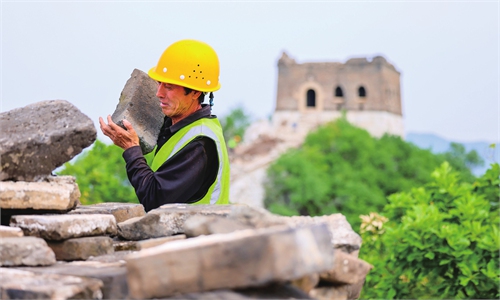
Chinese cultural heritage experts have hailed the tech-focused innovation push for cultural relics protection outlined in the 15th Five-Year Plan (2026-30) for national economic and social development, which lays out a comprehensive blueprint for China's cultural heritage preservation in the next five years.
The newly released 15th Five-Year Plan has outlined an ambitious roadmap for cultural heritage protection, with a sharp focus on technological innovation, smart museum development and international cooperation. The protection plan also mentioned the inclusion of significant national projects, including the project to trace the origins of Chinese civilization and the Archaeology China program, according to the official WeChat account of the National Cultural Heritage Administration.
Wang Wei, former chief engineer of the project to trace the origins of Chinese civilization and a member of the expert committee for the 15th Five-Year Plan, told the Global Times on Tuesday that the inclusion of the two projects among the plan's core cultural heritage protection tasks is "of milestone significance."
"For a long time, these projects have focused on academic research and excavation. Now, they are formally integrated into the heritage protection and transmission system, elevating their strategic importance," Wang said.
Wang Wei further explained that under the framework of the 15th Five-Year Plan, the findings from over 20 Archaeology China initiatives and the origin tracing project will be systematically interpreted and introduced to the public. This shift, he said, aims to help the public, especially young people, understand China's long civilization, fostering national pride and cultural confidence.
On what breakthroughs to expect during the 15th Five-Year Plan, Wang said the Archaeology China program will continue to focus on core topics, including the origins of humans, agriculture and civilization, as well as the urban development of ancient dynasties and the formation of a unified multi-ethnic country.
"From the Paleolithic age to frontier archaeology, every era holds exciting discoveries," he said.
Wang Wei expressed confidence in the progress ahead. "Be it breakthroughs in the tracing origins project, evidence from border regions on the formation of a unified multi-ethnic state, or systematic protection of regional cultural heritage, there is sure to be pleasant progress in all aspects."
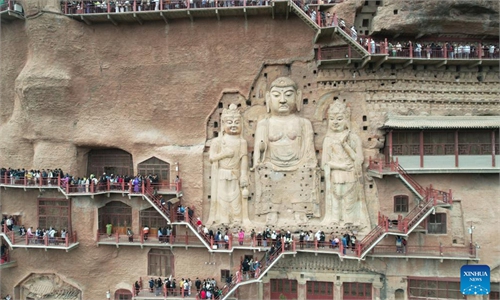
At the heart of the plan lies a push to leverage technology to preserve cultural heritage, a shift that has already transformed efforts at sites like the Mogao Caves in Dunhuang, Northwest China's Gansu Province.
Wang Wanfu, a deputy director of the Department of Conservation Research at the Dunhuang Academy, told the Global Times that AI is now an efficient tool in detecting early damage to ancient murals, a task once reliant on human eyes and basic tools.
"We used to squat in caves all day with rulers and magnifying glasses, missing tiny cracks and decay until they became irreversible. It was like watching a precious treasure fade away without being able to help," Wang recalled.
Now, AI large models trained on tens of thousands of high-definition mural negatives can identify flaws thinner than a hair, what he calls "pixel-level detection," and even predict hollow areas in mural layers through spectral analysis, he added.
The plan doubles down on such technological advances, proposing the construction of a national cultural heritage science and technology innovation center and a national archaeological research center dedicated to the Xia and Shang civilizations.
Wang also advocates for the establishment of a "cultural relic DNA" system, unique digital IDs for every artifact, to refine inventory management. He sees this as a key step as China wraps up its fourth national cultural relics survey in 2026.
Another key focus is modernizing museums to make cultural heritage more accessible, a goal tied to the plan's push for "smart museum" development.
Wang Siyu, director of Public Archaeology and Arts at Peking University, told the Global Times that digital technology is bridging the gap between relics and visitors who often struggle to grasp the historical context behind artifacts.
"A visitor might see an ancient pot in a museum, but they can't imagine the place or era it came from," Wang Siyu explained. "Smart museums use digital modeling to connect the relic to its broader history, making the past tangible. It's not just about displaying objects; it's about telling their stories."
On the international front, the plan emphasizes deepening cooperation on the recovery and return of looted cultural relics and promoting high-quality exhibitions overseas.
Wang Siyu pointed to the Shanghai Museum's On Top of the Pyramid: The Civilization of Ancient Egypt exhibition, held from July 2024 to August 2025, as a model of successful cross-cultural collaboration.
Co-hosted with Egypt's Supreme Council of Antiquities, the exhibition, dubbed as one of the largest displays of ancient Egyptian relics ever held outside Egypt, sparked a nationwide craze in China for Egyptian culture.
"Chinese visitors get to experience a foreign civilization deeply, while the Shanghai Museum showcased to the world that we can host world-class exhibitions," Wang Siyu said.
RELATED ARTICLES