30-hour fire on USS Gerald R. Ford exposes design, damage control issues and prolonged deployment strain: Chinese expert
By Liang Rui and Published: Mar 18, 2026 12:09 AM

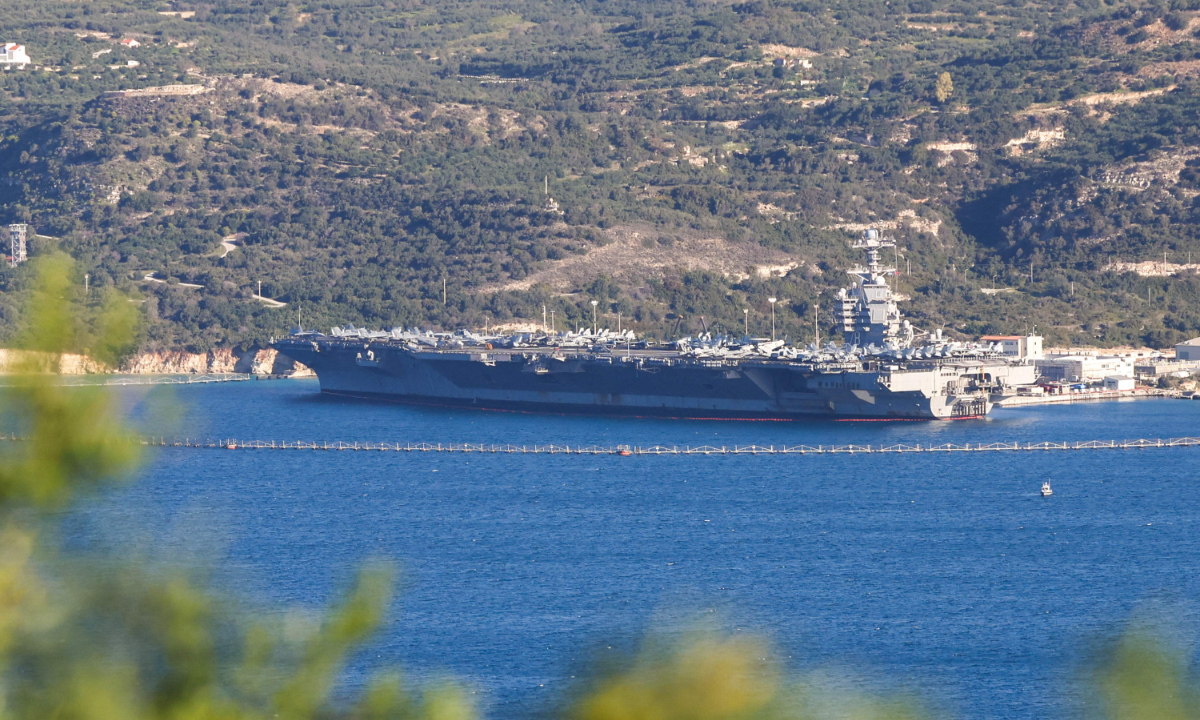
US aircraft carrier USS Gerald R. Ford is pictured docked at Souda Bay in the Greek Mediterranean island of Crete, on February 24, 2026. Photo: VCG
A fire that broke out on the US aircraft carrier USS Gerald R. Ford on March 12 burned for more than 30 hours, leaving more than 600 sailors without berths and forcing them to sleep on table or the floor, reported The New York Times (NYT) on Monday local time. As the carrier's deployment has entered its 10th month, a Chinese military affairs expert told the Global Times that while fires aboard large and complex vessels such as an aircraft carrier are inherently difficult to extinguish, the incident exposed the US warship's weaknesses in damage control, safety management, and the strain of prolonged high-intensity deployment.
According to the NYT, the fire started in the ship's main laundry area, as the ship continued its monthslong slog through the US' military operations in striking against Iran.
Two American sailors were injured in a fire on the USS Gerald R. Ford in the Red Sea on March 12, the US Central Command claimed in a statement posted on social media platform X. "There is no damage to the ship's propulsion plant, and the aircraft carrier remains fully operational," the post said.
Wang Yunfei, a Chinese military affairs expert, told the Global Times on Tuesday that modern warships contain highly complex electrical systems and extensive fuel lines, both of which can intensify fires once they break out. In addition, the internal spaces of warships are enclosed and connected by ventilation systems, conditions that can accelerate the spread of flames.
Critical areas aboard warships are normally equipped with automatic extinguisher systems, such as water or foam sprinklers designed specifically for zones with concentrated electrical equipment. If a fire cannot be quickly contained, it may indicate that such systems failed to function effectively, Wang added.
Damage-control training is equally important: once a fire alarm is triggered, crew members assigned to firefighting should respond immediately according to established procedures. Delays in bringing the fire under control may suggest shortcomings in training or execution, Wang said.
The expert also noted that warships are typically designed with compartmentalization to prevent fires from spreading, and if a fire forces large numbers of crew members to leave their living spaces, it may indicate weaknesses in fire-containment design.
The Ford is now entering its 10th month of deployment. Crew members on the Ford have been told that their deployment will probably be extended into May, which would put them at an entire year at sea, twice the length of a normal aircraft carrier deployment, reported the NYT.
Citing a retired rear admiral, the Wall Street Journal noted in a previous report that US carrier deployments during peacetime are typically six months long, with planners allowing for a few months of potential overrun if needed.
Prolonged deployments could also affect crew readiness. When ships remain on extended missions beyond their normal rotation, personnel may experience fatigue, which can reduce their ability to respond quickly to emergencies. This may also reflect broader pressures on the US' global military deployments and resource allocation, Wang added.
The fire was only the latest in a series of maintenance problems on the Ford, said the NYT. In February, this aircraft carrier was reported to have experienced a blockage affecting about 650 toilets on board.
RELATED ARTICLES