ARTS / CULTURE & LEISURE
‘Youngest building’ on Central Axis undergoes renovation for better public engagement
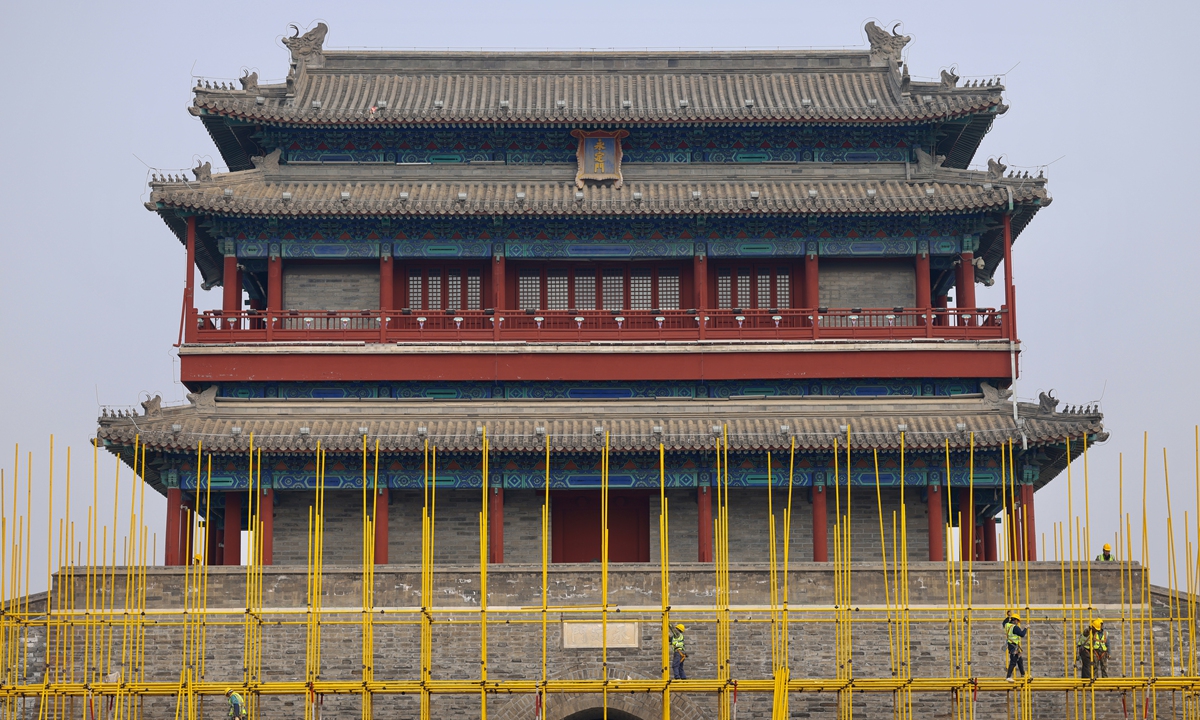
Workers erect scaffolding around the Yongdingmen Gate of the Beijing Central Axis on March 17, 2026, marking the official start of a main restoration project. The Beijing Central Axis was added to the UNESCO World Heritage List in July 2024. Photo: VCG
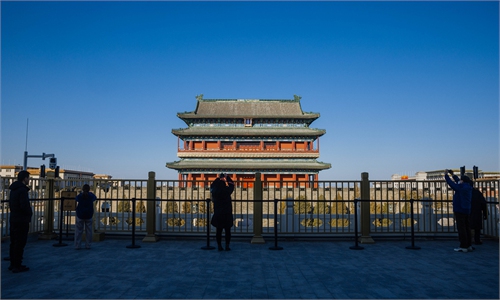
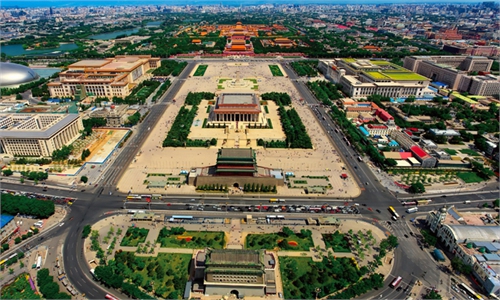
Systematic restoration of the Yongdingmen Gate Tower, a major landmark along Beijing's Central Axis World Heritage site, has begun, including the repair of key architectural elements such as wooden beam frames and walls. Located at the southern end of the Beijing Central Axis, the Yongdingmen Gate Tower is like "the dragon's head" of the Central Axis, Fang Zhe, a specialist on the Central Axis, told the Global Times.
The Yongdingmen Gate Tower standing today was rebuilt between 2004 and 2005 based on the original Ming Dynasty (1368-1644) site. It is therefore also the "youngest heritage building" on Beijing's Central Axis, Fang remarked.
With scaffolding recently erected, the current renovation involves reinforcement of the walls, foundations, wooden structure, and more. Although it has now entered the full implementation phase, Liu Wenfeng, a preservation expert familiar with the project, revealed to the Global Times that "preparatory investigations and small tinkering on the site actually began as early as 2023."
At that time, experts focused on specialized tasks such as color matching for oil coatings, dust removal from painted decorations, and clearing kite debris from the roof, said Liu. Then in September 2025, on-site work such as the installation of construction fencing was implemented.
"Beyond core structural elements, the building's electrical systems and decorative details all require thorough renovation," Liu noted. He added that the current restoration is "expected to last around one to two years." The 2026 renovation also marks the first systematic maintenance of this building in over 20 years.
The current restoration will also upgrade fire safety and security systems, as well as carry out inspections to eliminate potential structural hazards. Compared with other Central Axis heritage sites with sightseeing value such as the Bell and Drum Towers, the Yongdingmen Gate Tower has a smaller interior space and lacks sufficient conditions for full-on public access.
"The capacity of the site is limited, but it holds cultural value. The significance of the restoration lies in better activating the public accessibility of this historical building, which helps realize its value as a cultural tourism and historical site," Li Lingfei, an urban planner, told the Global Times.
"This is also a method of revitalizing cultural heritage," she added.
The ongoing restoration project is one of the agendas highlighted in a three-year action plan spanning from 2025 to 2027 that focuses on the protection and preservation of the Beijing Central Axis. This plan was released in 2025, following the inscription of the Beijing Central Axis onto the UNESCO World Heritage List in 2024.
In addition to emphasizing the "overall protection" of the Beijing Central Axis, the plan also highlights the "preservation and utilization" of the heritage. Including the Yongdingmen Gate Tower, the plan aims to facilitate the opening of the Zhengyangmen Gate Tower to the public, re-planning the usage of the former school site within Xiannongtan Temple and more.
"In the post-World Heritage inscription period, what we need to focus on is not only how to maintain the Beijing Central Axis, but also how to revitalize it to generate social and cultural value, including boosting cultural tourism, promoting international exchanges and more," said Fang.
RELATED ARTICLES