ARTS / CULTURE & LEISURE
Coping with peak cypress and willow pollen across cities
Allergy alert!
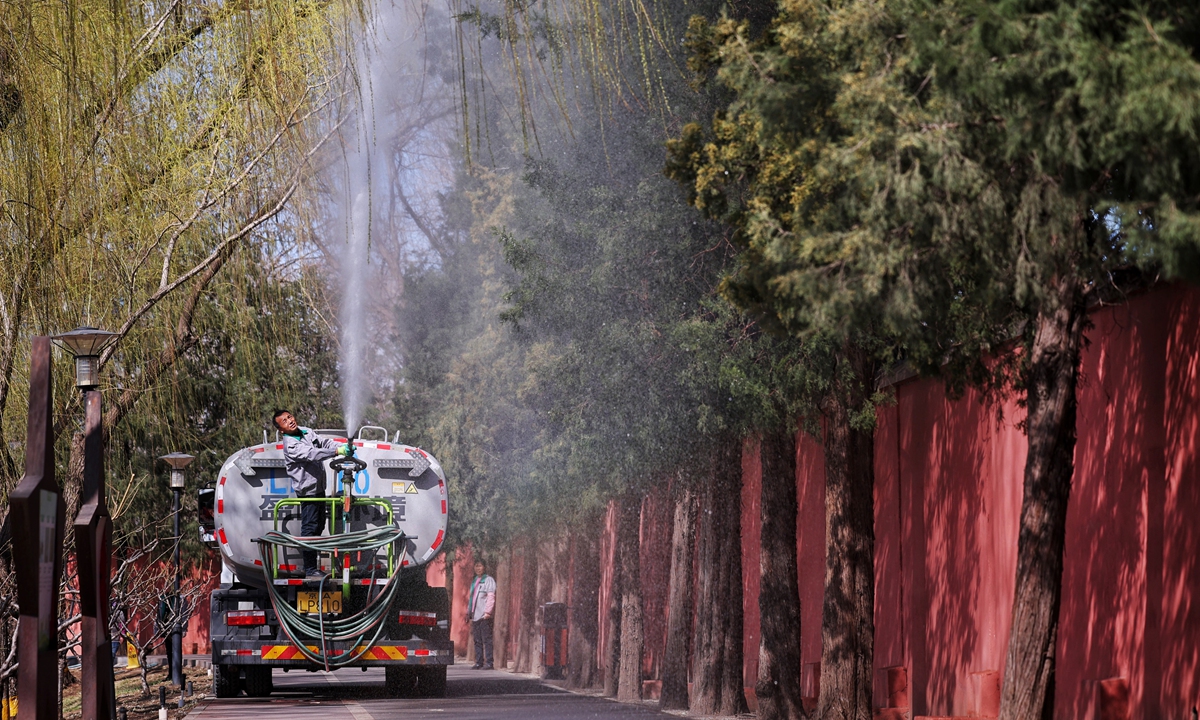
A water truck sprays roadside cypress trees to reduce pollen levels in spring in Beijing. Photos: VCG
On a warm afternoon in Beijing in March, a light breeze carries the first hint of spring. Along the streets, willow trees are just beginning to bud, with their pale green shoots moving gently in the sun. The air looks clear, but for some pedestrians, this season tells a different story: A few people sneeze, others rub their itchy eyes, or reach for tissues. The familiar signs of pollen allergy begin to appear.
Scenes like this are unfolding in multiple cities across China as spring arrives.
According to the China Meteorological Administration's national pollen forecast, cypress pollen has been the primary allergen since March, while willow pollen has also begun spreading across many parts of North China.
"Beijing has already entered its pollen peak period, which is expected to last from late March to early April, lasting roughly 15 to 20 days," said Jiang Yingshu, director of the science and technology division at the Beijing Municipal Forestry and Parks Bureau.
Unseen flow
Unlike industrial pollution, pollen is almost invisible. Yet it continues to accumulate in the air, gradually becoming a seasonal health concern.
Zhao Xiyao, a postgraduate student in Beijing's Xicheng district, has felt the impact of allergies quite clearly. "In the morning and evening, it feels like there's a fine layer of dust in the air. As soon as I step outside, I start sneezing, and my eyes get really itchy," she told the Global Times.
Her way of coping, however, is fairly simple. "At first, I'll use some eye drops or a nasal spray just to relieve the symptoms. Once the pollen season passes, I don't really bother with it anymore."
This "just endure it and wait it out" approach is not uncommon among allergy sufferers, reflecting a broader reality for many city dwellers.
From an urban living perspective, peak pollen season has become a recurring environmental variable.
A review by CCTV News shows that young and middle-aged adults are more prone to pollen allergies. This is due to the fact that their immune systems tend to be more reactive and that frequent outdoor activities increase their exposure to allergens. In contrast, children are more likely to be affected by indoor allergens, while older adults face a higher risk of drug-related allergies due to chronic conditions.
"Under normal circumstances, the immune system can identify and eliminate external pathogens such as bacteria and viruses, while maintaining tolerance to the body's own tissues," Luo Chaofan, a rehabilitation therapist with the National Health Commission, told the Global Times.
"An allergic reaction is essentially an excessive immune response to substances that are usually harmless."
Luo added that maintaining sufficient sleep, a balanced diet, and regular exercise - thereby improving overall immunity, can also help reduce the risk of allergies.
This impact is particularly evident among people with fast-paced lifestyles. Zhang Wenhao, a 28-year-old internet industry worker based in Hangzhou, East China's Zhejiang Province, who had long kept an irregular schedule, told the Global Times that every time the seasons changed, he felt constantly fatigued, and his nose was uncomfortable.
"It was only in the past couple of years that I began to realize these symptoms were linked to cypress pollen allergies," he said.
In this context, it is almost unrealistic for allergy sufferers to "completely avoid" pollen. What matters most is establishing a sustainable way to cope with it.
"Pollen allergies are often recurrent and seasonal. Once the peak period begins, symptoms may last for several weeks or even longer," Luo noted. "Therefore, rather than relying on temporary fixes, it is more important to develop stable daily routines and protective habits."
Luo suggests that people prone to allergies should minimize direct exposure to allergens. This includes avoiding outdoor activities during periods of high pollen concentration, wearing masks or protective eyewear, changing clothes promptly after returning home, and rinsing the nasal passages. In addition, keeping windows closed or using air purifiers can help reduce indoor pollen levels to some extent.
Urban response
If individuals are largely "adapting to pollen," city-level responses are beginning to incorporate this seasonal factor into broader governance strategies.
In Beijing, relevant authorities and research institutions have started exploring more targeted prevention and control measures. Jiang noted that a "pollen fixation agent" developed in recent years has entered the stage of industrial application.
According to Jiang, the product works by adhering to and accelerating the settling of pollen particles, improving effectiveness by about 17 to 20 times compared with traditional water-spraying methods. Made from food-grade materials, it is considered relatively safe.
"Compared with conventional dust suppression methods that require spraying three to five times a day, the fixation agent typically needs to be applied only once a day, or even once every two days, striking a balance between efficiency and cost," she said. "It has already been promoted in some key areas."
A longer-term approach focuses on tackling the issue at its source. Jiang said that in urban greening efforts, certain highly allergenic tree species are being gradually replaced or optimized.
For example, male cypress trees that release large amounts of pollen are being replaced with female trees that do not produce airborne pollen, maintaining the evergreen landscape while reducing allergen levels. In addition, the removal and replacement of aging or diseased trees have been incorporated into broader urban greening upgrades.
RELATED ARTICLES