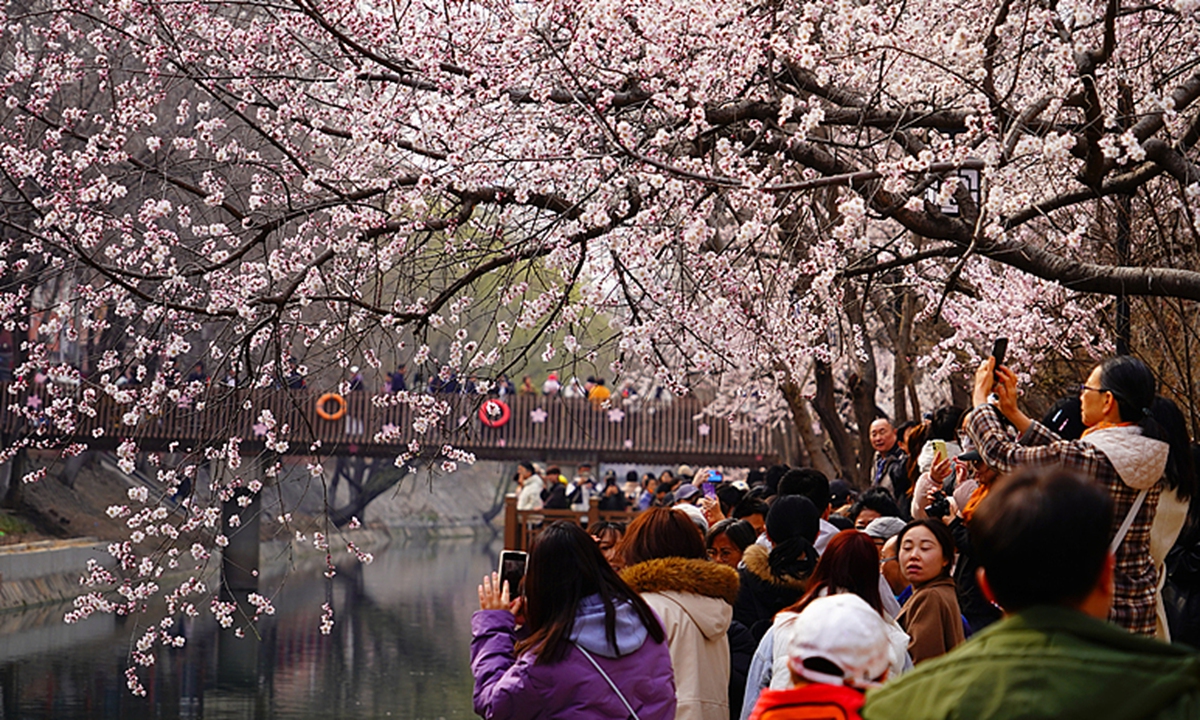
Mountain peach blossoms along the Erdaogou river in Beijing's Chaoyang district draw citizens to admire them on March 14, 2026. Photo: VCG
As Beijing enters the peak pollen season starting Tuesday, the Chinese capital city's pollen prevention and control efforts have shifted toward "tech-enabled solutions," using a biological agent to create an "invisible mask" on high-pollen trees.
The Beijing Meteorological Service forecast on its official Weibo account that from Tuesday to Saturday, cypress pollen in most areas of Beijing will reach peak levels.
Among them, Dongcheng, Xicheng, Chaoyang, Tongzhou and Mentougou districts will see peak pollen levels around Tuesday, while Yanqing will reach its peak around Saturday, the post said.
The risk level for pollen allergies in the city on Tuesday was classified as high, with about 75 percent of allergy sufferers expected to experience symptoms, according to the post.
In addition to Cupressaceae, the main allergenic pollen types also include Ulmaceae and Salicaceae families, according to the Beijing Meteorological Service.
This winter, Beijing experienced unusually warm conditions, with temperatures significantly higher than average, especially after the Spring Festival, leading to earlier plant budding and growth, Ma Jun, director of the Institute of Public and Environmental Affairs, told the Global Times on Tuesday.
Windy conditions before the pollen season also facilitated widespread pollen dispersion, Ma added.
For allergy sufferers, rising temperatures and the accompanying surge of cypress pollen signal the arrival of "sneezing season." To combat allergenic pollen, Beijing has implemented a variety of measures.
Beijing Municipal Forestry and Parks Bureau, in collaboration with Beijing-based research institutes, has developed new eco-friendly biological agents such as pollen fixatives and pollen suppressants, which have effectively improved operational efficiency and control precision, said Jiang Yingshu, an official of the bureau, Chinanews.com reported.
Mixing the pollen fixative with water in a proper ratio and then spraying the mixture onto the tree canopies can quickly form a light-transmissive coating on male Chinese juniper trees, accelerate pollen sedimentation, and reduce local pollen concentrations, Qin Ling, a professor from the College of Plant Science and Technology at Beijing University of Agriculture, was quoted as saying.
After applying pollen fixative, the pollen sedimentation rate can reach more than 20 times that of the traditional water-spraying method, according to the report.
Ma said this technology-enabled solution not only causes minimal environmental harm but also reduces labor input, representing a concrete outcome of integrating technology with environmental protection efforts.
It can be scaled up in the future to expand the coverage of tech-enabled prevention and control, he added.
Beijing Municipal Forestry and Parks Bureau has established a joint prevention and control mechanism with meteorological, health, urban management, and other departments, adopting a full-chain approach featuring precise prevention, systematic management and long-term planning, Chinanews.com reported.
For example, the bureau has completed a census and a spatial distribution map of juniper trees within Beijing's fifth ring road based on the 10th gardening and greening resources survey data, providing precise spatial guidance for prevention and control operations.
In addition to government efforts, many parks in Beijing have proactively taken measures. Liao, who is from South China's Guangdong Province and has lived in Beijing for four years, was troubled by pollen allergies in her first two years. However, since last year, she has noticed improved pollen conditions in parks. "I often see micro-sprinklers working on the lawns in parks, a way to increase air humidity and inhibit pollen diffusion," she told the Global Times on Tuesday.
The Summer Palace in Beijing has also prepared over 3,000 masks for allergy-prone visitors, according to Chinanews.com.
RELATED ARTICLES