ARTS / CULTURE & LEISURE
Ode to the ‘tree beard’
Harmonious symphony of humanity and nature in Shangri-La
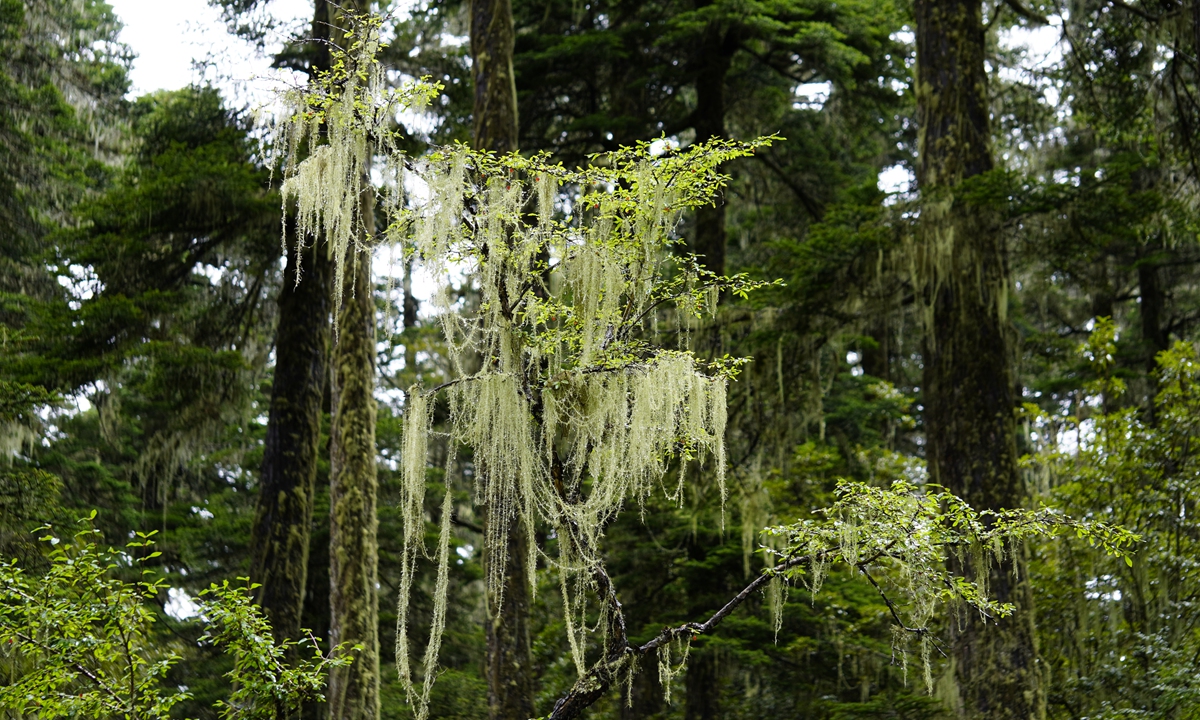
"Tree beard" hangs from trees in Deqen Tibetan autonomous prefecture, Southwest China's Yunnan Province. Photo: Courtesy of the publicity department of Deqen
Like falling veils, they sway gently with the breeze, tracing the wind's form.
Walking through the primitive forests of the Potatso area in Shangri-La's National Park candidate zone in the Deqen Tibetan autonomous prefecture, Southwest China's Yunnan Province, one cannot help but pause at the sight of clusters of silvery-green, filament-like organisms hanging densely from the branches and adorning the woods with their delicate presence.
"The locals call it 'tree beard,'" introduced Wang Lisong, a researcher at the Kunming Institute of Botany with the Chinese Academy of Sciences. "Its scientific name is Dolichousnea longissima. It is neither an animal nor a plant, but a symbiotic complex of algae and fungi, belonging to the fruticose lichens."
Wang stated that "tree beard" is particularly sensitive to pollution; even a bit of dust or a trace of cooking smoke can cause it to wither. It grows at most three to five centimeters per year, meaning that the "tree beard" we see now has taken decades to reach its current length.
Placing a slice of "tree beard" under a microscope, it clearly reveals the green symbiotic algae and the white symbiotic fungal structures. Wang explained that the two form a stable, mutually beneficial micro-ecosystem.
Just as the algae and fungi coexist in symbiosis, the "tree beard" also coexists and blends with the magical land of Shangri-La.
"Shangri-La," which means "the sun and moon in one's heart" in Tibetan language, has been seen as an earthly paradise since British writer James Hilton's novel Lost Horizon made it the longed-for "Shangri-La" commonly known in the popular imagination.
From deep valleys at 2,020 meters to peaks soaring at 5,094 meters, the Shangri-La National Park candidate zone integrates towering mountains, deep gorges, snowy peaks, glaciers, high-altitude wetlands, forests, meadows, and freshwater lakes into a unique composite ecosystem.
This area is a world-class species gene pool, nurturing 1,059 species of endemic wild animals and plants. It serves as a habitat for seven flagship species, including the snow leopard, forest musk deer, and black-necked crane, alongside many other rare and endangered organisms.
All things depend on each other, and heaven and humanity are united as one. This is the perspective through which traditional Chinese wisdom contemplates the natural world. In Shangri-La, people are learning to "think like a mountain" as they seek to answer the question of how humanity and nature can coexist in harmony.
At the beginning of this century, as Potatso gained widespread fame, a large number of tourists flocked to the area. Luorong village, located within the core zone, is an ecologically pristine Tibetan settlement. Back then, spotting a business opportunity, villagers brought out their family horses to offer riding services to visitors.
"Back then, the meadows and forests were filled with visitors on horseback tours. Some even set up barbecue grills by the lake or ran small stalls," recalled Larong Qilin, the village group leader of Luorong village, with evident remorse. "Large patches of grassland were trampled bare, and the lake water became polluted."
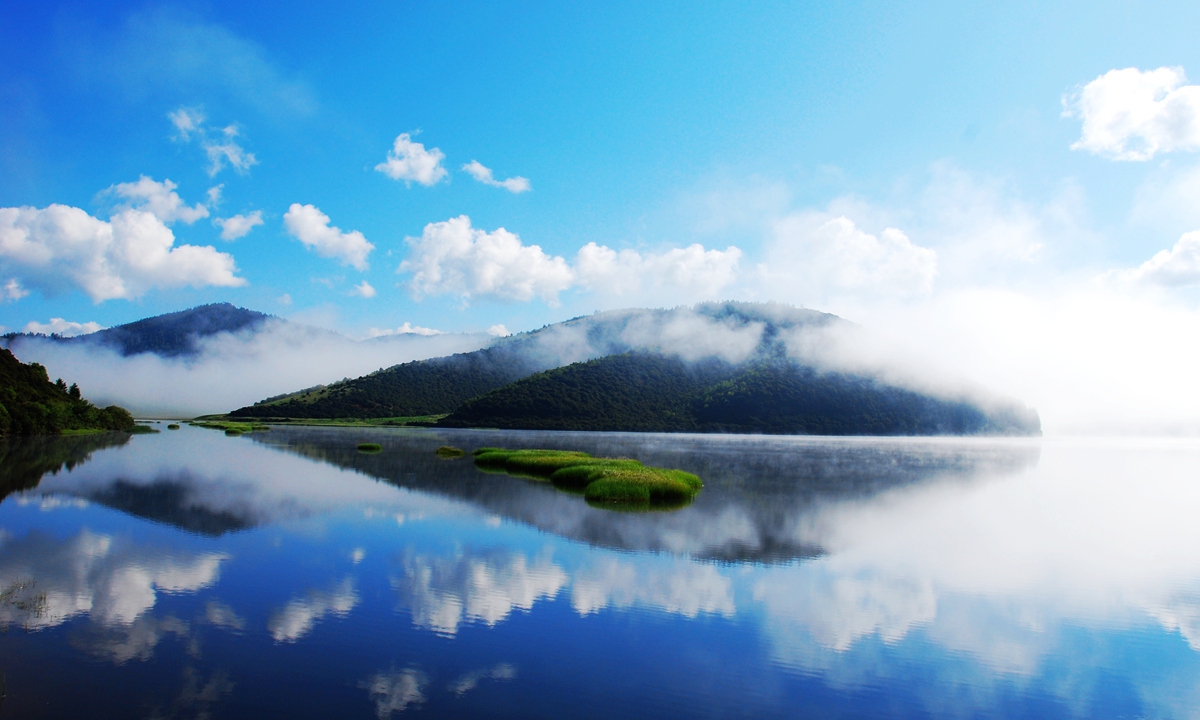
The Shudu Lake Scenic Area in the Deqen Tibetan autonomous prefecture, Southwest China's Yunnan Province Photo: Courtesy of the publicity department of Deqen
As ecological pressure mounted, the "tree beard" gradually withered.In fact, lichen organisms, to which the "tree beard" belongs, play a crucial role in the process of ecological succession. They create conditions for the growth of other higher-order animals and plants, forming an ecological bond that fosters mutual nourishment and collaborative survival among species.
"We should protect the environment like we protect our eyes, and treat the environment like we treat our lives." The remarks made by Chinese President Xi Jinping show that a sense of respect and reverence for the natural environment is indispensable for the endeavor to build the Chinese modernization featuring harmony between humanity and nature.
Harmony between humanity and nature necessitates prioritizing protection.
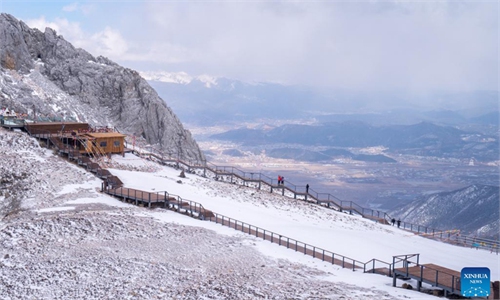
In Potatso, 15,000 mu (approximately 1,000 hectares) of alpine meadows have been meticulously restored. Wooden walkways have been constructed in recreational areas, and waste is packed and transported out for centralized processing, essentially achieving zero pollution and zero emissions.
With the gradual restoration of ecological balance, the "tree beard" has regained its silvery-green vitality. Today, fir trees stand tall, moss carpets the ground, and squirrels dart through the branches, their cheeks stuffed with pine cones.
Today, ecological conservation is increasingly reliant on technological support.
Hidden within the primeval forests of Potatso are 540 infrared cameras, 84 surveillance probes, and nine integrated environmental monitoring systems, working together to enable real-time tracking of wildlife activity and ecological changes.
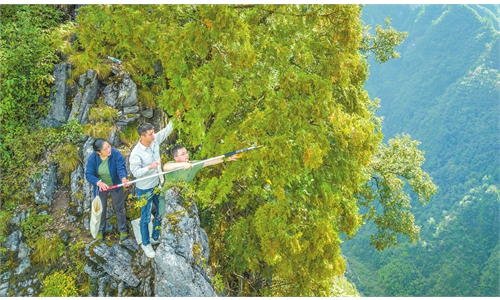
By leveraging technological tools, Potatso is pioneering a model of "intelligent guardianship," constructing an integrated air-ground ecological monitoring network. Furthermore, the Shangri-La National Park candidate zone collaborates with multiple research institutions to jointly build ecological monitoring and research platforms. These partnerships facilitate various scientific projects, including artificial breeding experiments for heavy lips fish, sample plot monitoring for the Yunnan yew, research on cold-temperate coniferous forest ecosystems, and recovery trials for small-population plant species.
Resolving the conflicts between humanity and nature, as well as between development and conservation, requires a balanced approach that integrates protection with development while considering both immediate needs and long-term sustainability.
Ecological conservation does not mean a prohibition on all human activities. The Shangri-La National Park candidate area is exploring a "community symbiosis" mechanism, which allows local residents to participate in and benefit from conservation efforts. This approach fosters a virtuous cycle where ecological protection and the improvement of people's livelihoods reinforce each other, allowing the concept "lucid waters and lush mountains are invaluable assets" to take root and flourish.
In Hongpo village, to which Luorong village belongs, over 40 new guesthouses have opened in the past two to three years.
"I haven't traveled much, but I've seen faces from all over the world," said Lamu, a 35-year-old villager who runs several guesthouses.
Staying in traditional Tibetan houses and savoring Tibetan meals, tourists often marvel at the dense "tree beard" hanging from the fir trees during hikes with Lamu. Lamu explained, "'Tree beard' can withstand harsh snow, and it's what the Yunnan snub-nosed monkeys rely on to fill their bellies in winter."
The Shangri-La National Park Establishment Plan, released in 2023, explicitly states the intention to establish a sound community co-management and collaborative governance mechanism. Concessional operations will be developed in communities like Luorong village and Niru village, alongside the creation of village-level natural resource management positions. Local residents are encouraged to participate in service projects such as running guesthouses and working as guides.
Under the premise of strict protection, the park utilizes less than 1.5 percent of its total area for ecological experiences and nature education. Since 2015, it has received over 10 million tourists and has been successfully designated as a National 5A-rated Tourist Attraction.
"We are committed to finding the optimal balance between conservation and utilization, ensuring the natural beauty of Shangri-La is preserved for generations to come," stated the head of the Shangri-La National Park candidate zone.
Through steadfast protection and innovative mechanisms, local communities have become the frontline guardians of the ecosystem, while the guardians themselves also become beneficiaries.
The harmony between humanity and nature mirrors the symbiotic relationship between a tree and its "beard." A beautiful concerto is now playing, with its melody rising gracefully.
The article was originally published on the People's Daily on March 19, 2026.
RELATED ARTICLES