IN-DEPTH / IN-DEPTH
Local officials’ holistic perspective ‘cannot be separated from CPC’s efficient central policy implementation system’: former Belgian ambassador
Beyond the fields
By and Liang Rui Published: Mar 20, 2026 12:04 AM

Editor's Note:
Chinese President Xi Jinping has pointed out, "to understand China today, one must learn to understand the Communist Party of China (CPC)." With the rapid development of China's economy and society, and the steady advancement of the Chinese path to modernization, the notable achievements of the CPC have drawn extensive international attention and scholarly interest. Against this backdrop, the Global Times has launched the "CPC in Global Eyes" column, focusing on the feelings, perspectives, and insights of international friends from various fields regarding the CPC's historical path and achievements.
They include those who have visited or toured China, those who study the CPC deeply in academic fields, those who work, live, study, or do business in China across various sectors, and those who closely follow the CPC's policies and developments. Through their vivid personal experiences, we aim to present a multifaceted overseas view of the CPC.
In the eighth installment of this series, we spoke with Patrick Nijs, former Belgian ambassador to China. Since leaving his post in 2013, Nijs has chosen to stay in China, spending more than a decade farming in Dongchuan, Southwest China's Yunnan Province. Through hands-on work in the fields, he has witnessed how local grass-roots governance has moved beyond short-term economic growth and local protectionism, continuously self-correcting to faithfully implement the nation's sustainable development strategy. His journey offers a unique outsider's perspective on the pragmatic, holistic governance of the CPC at the grass-roots level.
In the rugged hills of Kunming's Dongchuan district, Southwest China's Yunnan Province, a silver-haired Belgian in a straw hat bends over red soil, hoe in hand, planting, weeding, composting and harvesting much like any local farmer. Yet when he swaps the hat for a suit and tie, Patrick Nijs becomes the seasoned diplomat he once was: former Belgian ambassador to China and lifetime honorary ambassador, born into a family steeped in foreign service.
"You say China is my second home," Nijs told the Global Times during a candid conversation. "In truth, it is my first. I have never lived anywhere so long. I genuinely hope it keeps getting better."
During his interview with the Global Times, Nijs shared his genuine sentiments toward China, offered detailed observations on rural governance, and provided candid suggestions.
Farming in the deep mountains
Nijs recalls that during high school in Belgium, he encountered the Chinese classic Tao Te Ching. The phrase "the Dao follows nature" struck him: humans are part of nature and should seek harmony rather than conquest or plunder. This aligned perfectly with the feelings he developed while growing up in Africa. From then on, Laozi, a Chinese sage who founded the Taoism school of philosophical thought over 2,500 years ago, also known as the author of the Tao Te
Ching, became his closest "kindred spirit" from the East, and he began to feel a strong attraction to China.
From 2009 to 2013, he served as Belgian Ambassador to China and contributed actively to deepening Chinese-Belgian friendship. After completing his term, he gave up the opportunity to continue his diplomatic career and came instead to a desolate patch of land in Yunnan - without water, electricity, roads, or residents. For more than a decade he has devoted himself to reviving dead soil and restoring the ecosystem.
"The ambassadorial career is over. My own life has begun," Nijs wrote on social media on the day he left office.
It was from this point that he truly began to regard Yunnan's countryside as his home. As a "settler," he has observed and experienced the logic and changes in China's rural governance, while exploring new paths for ecological and sustainable development.
"I've followed China's development since 1997, when I first served as a diplomat in Shanghai. I've clearly seen how the CPC has recognized the ecological consequences of China's rapid development. Since 2013, ecological protection has been integrated into China's governance via the five-year plans and Resolution of CPC Central Committee," Nijs told the Global Times.
"I've tracked this closely. President Xi Jinping, who was then Party secretary of China's Zhejiang Province, paid a visit to the beautiful, forest-clad, hillside town of Anji in 2005, about an hour from Hangzhou. In Anji, Xi spoke about the importance of taking care of nature and famously said that 'lucid waters and lush mountains are as invaluable as silver and gold.' This is not just a slogan, but a genuine commitment that has shaped China's entire governance system and led to the concept of ecological civilization, which is also rooted in China's Taoist tradition and has global significance," he said.
Nijs told the Global Times that he sensed rural grass-roots efforts, which had long oscillated between rapid economic growth and ecological sustainability, have gained a clearer direction and firmer resolve.
"I've lived in the countryside of Yunnan since 2013, running an organic farm inspired by urban ecological concepts. I've witnessed the effects of the rural revitalization policy, which, combined with ecological civilization, has deeply influenced local people's lives," he said.
He noted that local governments are highly responsive to central guidance, yet officials sometimes struggle to translate policies into practice. For example, local officials observed that excessive use of plastic mulch and chemical fertilizers by farmers, originally intended to safeguard food security, was impoverishing the soil and threatening the food security of future generations. To address this, local officials began going door-to-door, patiently explaining the importance of ecological protection and persuading farmers one by one to adopt more sustainable practices.
"The central government clearly recognized the importance of sustainable development, but local governments faced a dilemma: They did not want farmers to fall back into poverty, yet they lacked clear pathways to shift to a sustainable model," Nijs explained. He said he occasionally suggested to local officials that external experts should work with farmers to drive change.
Yet this is easier said than done. A frequent topic of Nijs' discussion with grass-roots officials is the tension they face: ensuring adequate food, shelter, and a decent life for local people while addressing the environmental impacts of development. When focusing on the local picture, they naturally want to stabilize residents' livelihoods, production, income, and tax revenue. At the same time, as Party members who have received years of training and education, they have developed a certain "holistic view." They realize that failing to address certain pain points and difficulties now will create hidden dangers for future generations, according to Nijs.
With clear guidance from the central government, local authorities are striving to move forward. But many officials lack specialized backgrounds in understanding ecosystem complexity. Without expert on-site guidance, they study central documents and academic papers, repeatedly test ideas in practice, and gradually find workable methods. Nijs calls this attitude: "They are always trying."
Nijs and his farm have become part of this testing process. For instance, the central government maintains strict protection of arable land to safeguard national food security. Once, local agricultural inspectors visited the farm and ordered the newly planted trees to be cut down, insisting that the land was being illegally converted from cropland to forest. Nijs calmly explained that what they were doing was not ordinary afforestation but agroforestry - integrating food-producing trees into the farming system to create edible forests that would both restore soil and yield harvests. After listening and understanding the distinction, the officials withdrew their order and allowed the trees to remain.
"Such a holistic perspective cannot be separated from CPC's efficient central policy implementation system," said Nijs.
Nijs has witnessed China's remarkable governance efficiency. "In 40 years, China has achieved what Western countries took 400 years to accomplish. In 2010, Beijing's air pollution was severe; today the city enjoys blue skies again. This demonstrates the government's ability to identify the environmental costs of rapid development and formulate effective policies to address them" - an achievement he deeply admires and one of the reasons he loves China.
In his view, one of China's greatest strengths lies in the organic integration of Taoist philosophy and communist wisdom. "Taoism teaches harmony with nature and with others, but it does not offer concrete solutions for social and economic development; CPC fills that gap. While many countries overemphasize the economy at the expense of ecology and fall into stagnation, China has avoided this trap through its unique integration."
He has closely studied China's "two sessions" and the 15th Five-Year Plan. "The 'two sessions' are not limited to the central level; they also take place at provincial, municipal, and county levels. It is a sophisticated system for collecting public opinions, identifying problems, and seeking solutions - far more effective than many Europeans realize."
"Some Europeans often dismiss the 'two sessions' as a 'rubber stamp,' but this is a misconception," he told the Global Times. "The opinions collected flow upward to the CPC National Congress, which sets the direction of development, and then to local departments and other bodies," said Nijs.
"China changes very quickly, and its governance system is constantly improving - this is an undeniable fact," Nijs said. "Most European opinion leaders who criticize China have never set foot in the country; they shape their views with only superficial knowledge. Those of us who have actually lived here understand the complexity and the genuine challenges of governance. Yet when we speak positively about what we see, we are often accused of being 'manipulated by Chinese propaganda.'"
Nijs has co-founded European Union China Joint Innovation Center in 2017 and put efforts in promoting relationship between Europe and China for decades.
Think globally, act locally
With his background in diplomacy and international climate negotiations, Nijs brings a global perspective to local practice - "think globally, act locally." He sums up his contribution as helping import Europe's "software" - institutional and experiential lessons - while reviving degraded land. When he arrived, no one wanted the infertile plot. "We are not taking land from farmers," he said. "We are bringing it back to life, exploring sustainable ways to produce food before the soil turns to desert in another 30 years, even with chemicals."
His efforts have drawn curious glances from neighboring farmers. Though language can be a barrier, they have never treated the "foreign farmer" as an outsider but as a fellow practitioner sharing hard-won experience.
Yet Nijs is frank about remaining hurdles. Local governments can be cautious toward new ideas and outsiders, often waiting for explicit higher-level instructions before embracing change. That conservatism reflects the real-world constraints of grass-roots governance: constant new problems, constant experimentation, constant self-correction.
It is precisely this vitality - this capacity to adapt while staying rooted in a larger vision - that Nijs finds most impressive in China.
After more than a decade, the once-bare red terraces in front of his house have grown visibly greener and darker with organic matter. The farm pulses with life.
In much the same way, he sees a hope in China's rural governance: a system that is steadily improving, and increasingly confident in balancing immediate human needs with the long-term health of the planet.
Nijs often urges Europeans in some public occasions to move beyond superficial judgments formed on social media and to study China's complexity firsthand. "I decided to stay after 2013 because I believe China's future will shape the world's future," he said. "I want to be part of that journey. China is a rising power, and its development will affect the fate of all humanity."
In the quiet rhythm of planting and harvesting, the former ambassador continues to witness - and quietly contribute to - a vast country's ongoing effort to align local action with a global vision of sustainability.
Chinese President Xi Jinping has pointed out, "to understand China today, one must learn to understand the Communist Party of China (CPC)." With the rapid development of China's economy and society, and the steady advancement of the Chinese path to modernization, the notable achievements of the CPC have drawn extensive international attention and scholarly interest. Against this backdrop, the Global Times has launched the "CPC in Global Eyes" column, focusing on the feelings, perspectives, and insights of international friends from various fields regarding the CPC's historical path and achievements.
They include those who have visited or toured China, those who study the CPC deeply in academic fields, those who work, live, study, or do business in China across various sectors, and those who closely follow the CPC's policies and developments. Through their vivid personal experiences, we aim to present a multifaceted overseas view of the CPC.
In the eighth installment of this series, we spoke with Patrick Nijs, former Belgian ambassador to China. Since leaving his post in 2013, Nijs has chosen to stay in China, spending more than a decade farming in Dongchuan, Southwest China's Yunnan Province. Through hands-on work in the fields, he has witnessed how local grass-roots governance has moved beyond short-term economic growth and local protectionism, continuously self-correcting to faithfully implement the nation's sustainable development strategy. His journey offers a unique outsider's perspective on the pragmatic, holistic governance of the CPC at the grass-roots level.
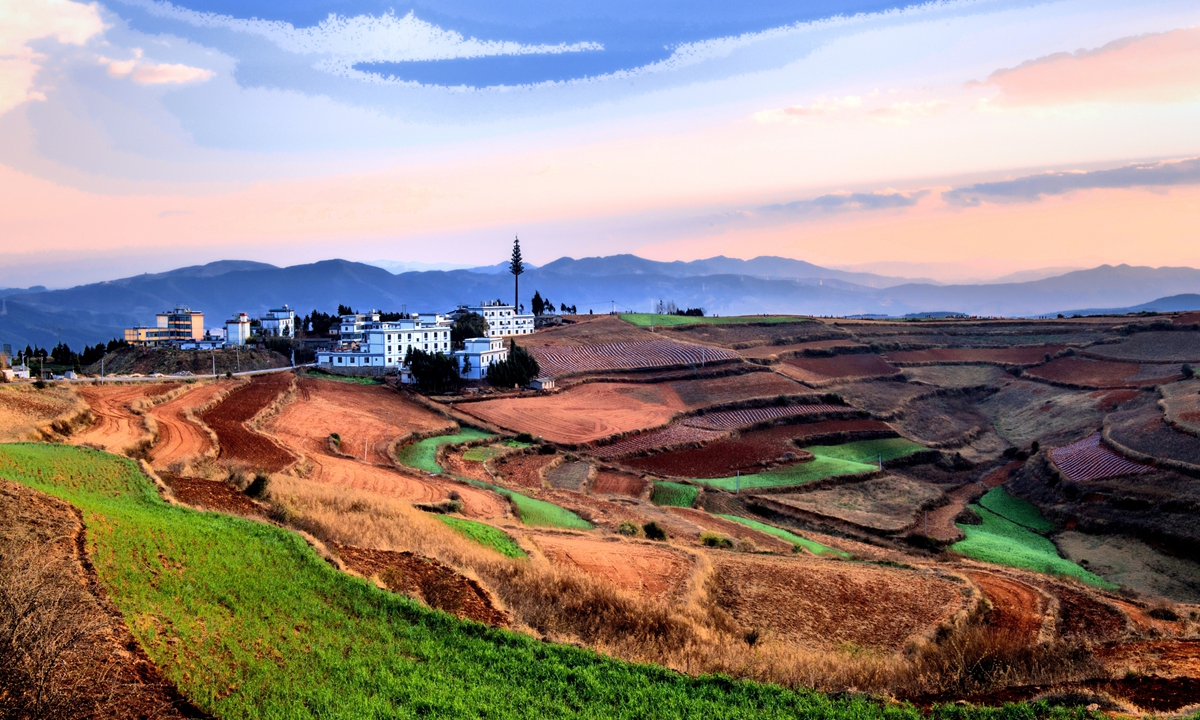
The rural landscape of Dongchuan in Kunming, Southwest China's Yunnan Province Photo: VCG
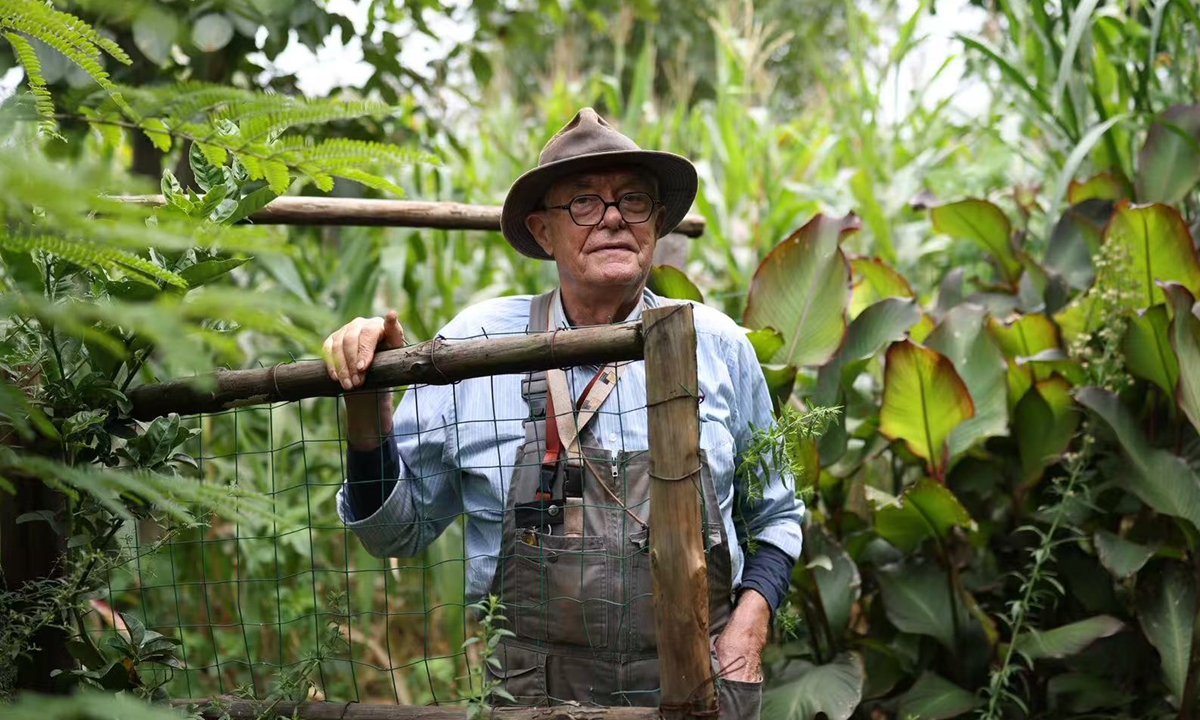
In the rugged hills of Kunming's Dongchuan district, Southwest China's Yunnan Province, a silver-haired Belgian in a straw hat bends over red soil, hoe in hand, planting, weeding, composting and harvesting much like any local farmer. Yet when he swaps the hat for a suit and tie, Patrick Nijs becomes the seasoned diplomat he once was: former Belgian ambassador to China and lifetime honorary ambassador, born into a family steeped in foreign service.
"You say China is my second home," Nijs told the Global Times during a candid conversation. "In truth, it is my first. I have never lived anywhere so long. I genuinely hope it keeps getting better."
During his interview with the Global Times, Nijs shared his genuine sentiments toward China, offered detailed observations on rural governance, and provided candid suggestions.
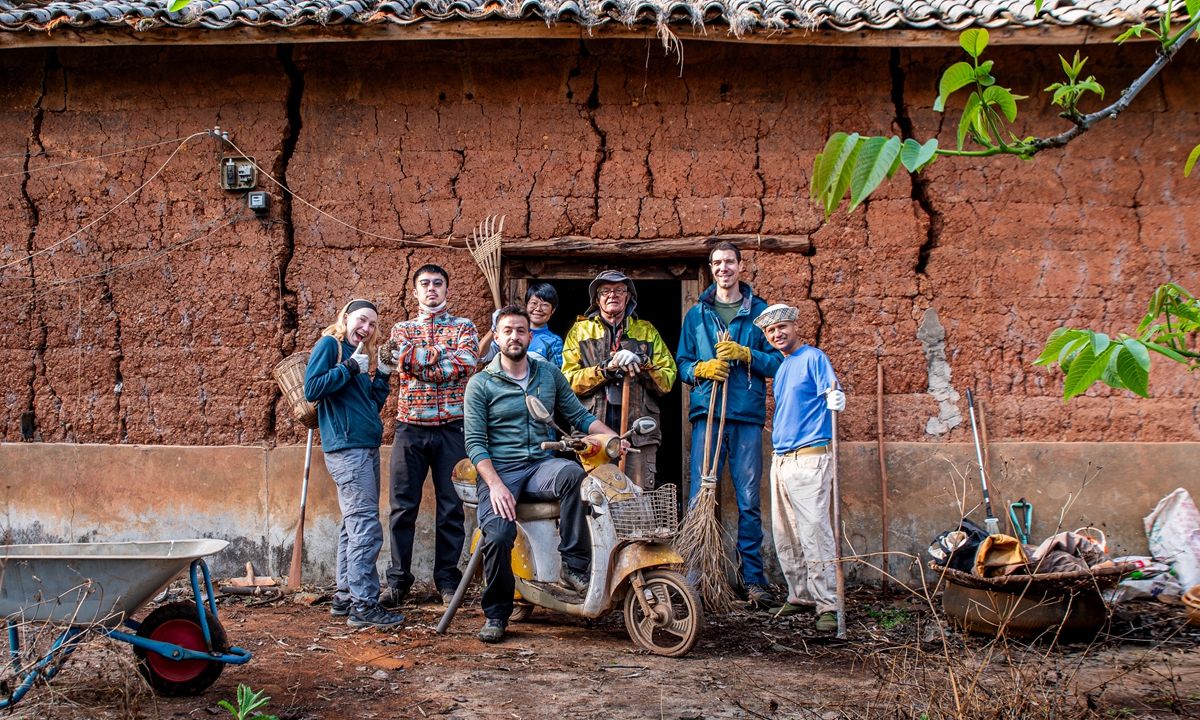
Patrick Nijs (middle), former Belgian ambassador to China, and his friends renovate local houses in Yunnan Province in May 2025. Photo: Courtesy of Nijs
Farming in the deep mountains
Nijs recalls that during high school in Belgium, he encountered the Chinese classic Tao Te Ching. The phrase "the Dao follows nature" struck him: humans are part of nature and should seek harmony rather than conquest or plunder. This aligned perfectly with the feelings he developed while growing up in Africa. From then on, Laozi, a Chinese sage who founded the Taoism school of philosophical thought over 2,500 years ago, also known as the author of the Tao Te
Ching, became his closest "kindred spirit" from the East, and he began to feel a strong attraction to China.
From 2009 to 2013, he served as Belgian Ambassador to China and contributed actively to deepening Chinese-Belgian friendship. After completing his term, he gave up the opportunity to continue his diplomatic career and came instead to a desolate patch of land in Yunnan - without water, electricity, roads, or residents. For more than a decade he has devoted himself to reviving dead soil and restoring the ecosystem.
"The ambassadorial career is over. My own life has begun," Nijs wrote on social media on the day he left office.
It was from this point that he truly began to regard Yunnan's countryside as his home. As a "settler," he has observed and experienced the logic and changes in China's rural governance, while exploring new paths for ecological and sustainable development.
"I've followed China's development since 1997, when I first served as a diplomat in Shanghai. I've clearly seen how the CPC has recognized the ecological consequences of China's rapid development. Since 2013, ecological protection has been integrated into China's governance via the five-year plans and Resolution of CPC Central Committee," Nijs told the Global Times.
"I've tracked this closely. President Xi Jinping, who was then Party secretary of China's Zhejiang Province, paid a visit to the beautiful, forest-clad, hillside town of Anji in 2005, about an hour from Hangzhou. In Anji, Xi spoke about the importance of taking care of nature and famously said that 'lucid waters and lush mountains are as invaluable as silver and gold.' This is not just a slogan, but a genuine commitment that has shaped China's entire governance system and led to the concept of ecological civilization, which is also rooted in China's Taoist tradition and has global significance," he said.
Nijs told the Global Times that he sensed rural grass-roots efforts, which had long oscillated between rapid economic growth and ecological sustainability, have gained a clearer direction and firmer resolve.
"I've lived in the countryside of Yunnan since 2013, running an organic farm inspired by urban ecological concepts. I've witnessed the effects of the rural revitalization policy, which, combined with ecological civilization, has deeply influenced local people's lives," he said.
He noted that local governments are highly responsive to central guidance, yet officials sometimes struggle to translate policies into practice. For example, local officials observed that excessive use of plastic mulch and chemical fertilizers by farmers, originally intended to safeguard food security, was impoverishing the soil and threatening the food security of future generations. To address this, local officials began going door-to-door, patiently explaining the importance of ecological protection and persuading farmers one by one to adopt more sustainable practices.
"The central government clearly recognized the importance of sustainable development, but local governments faced a dilemma: They did not want farmers to fall back into poverty, yet they lacked clear pathways to shift to a sustainable model," Nijs explained. He said he occasionally suggested to local officials that external experts should work with farmers to drive change.
Yet this is easier said than done. A frequent topic of Nijs' discussion with grass-roots officials is the tension they face: ensuring adequate food, shelter, and a decent life for local people while addressing the environmental impacts of development. When focusing on the local picture, they naturally want to stabilize residents' livelihoods, production, income, and tax revenue. At the same time, as Party members who have received years of training and education, they have developed a certain "holistic view." They realize that failing to address certain pain points and difficulties now will create hidden dangers for future generations, according to Nijs.
With clear guidance from the central government, local authorities are striving to move forward. But many officials lack specialized backgrounds in understanding ecosystem complexity. Without expert on-site guidance, they study central documents and academic papers, repeatedly test ideas in practice, and gradually find workable methods. Nijs calls this attitude: "They are always trying."
Nijs and his farm have become part of this testing process. For instance, the central government maintains strict protection of arable land to safeguard national food security. Once, local agricultural inspectors visited the farm and ordered the newly planted trees to be cut down, insisting that the land was being illegally converted from cropland to forest. Nijs calmly explained that what they were doing was not ordinary afforestation but agroforestry - integrating food-producing trees into the farming system to create edible forests that would both restore soil and yield harvests. After listening and understanding the distinction, the officials withdrew their order and allowed the trees to remain.
Patrick Nijs farms at a rural piece of land in Dongchuan, Yunnan Province. Photo: Courtesy of Nijs
Top-down holistic perspective"Such a holistic perspective cannot be separated from CPC's efficient central policy implementation system," said Nijs.
Nijs has witnessed China's remarkable governance efficiency. "In 40 years, China has achieved what Western countries took 400 years to accomplish. In 2010, Beijing's air pollution was severe; today the city enjoys blue skies again. This demonstrates the government's ability to identify the environmental costs of rapid development and formulate effective policies to address them" - an achievement he deeply admires and one of the reasons he loves China.
In his view, one of China's greatest strengths lies in the organic integration of Taoist philosophy and communist wisdom. "Taoism teaches harmony with nature and with others, but it does not offer concrete solutions for social and economic development; CPC fills that gap. While many countries overemphasize the economy at the expense of ecology and fall into stagnation, China has avoided this trap through its unique integration."
He has closely studied China's "two sessions" and the 15th Five-Year Plan. "The 'two sessions' are not limited to the central level; they also take place at provincial, municipal, and county levels. It is a sophisticated system for collecting public opinions, identifying problems, and seeking solutions - far more effective than many Europeans realize."
"Some Europeans often dismiss the 'two sessions' as a 'rubber stamp,' but this is a misconception," he told the Global Times. "The opinions collected flow upward to the CPC National Congress, which sets the direction of development, and then to local departments and other bodies," said Nijs.
"China changes very quickly, and its governance system is constantly improving - this is an undeniable fact," Nijs said. "Most European opinion leaders who criticize China have never set foot in the country; they shape their views with only superficial knowledge. Those of us who have actually lived here understand the complexity and the genuine challenges of governance. Yet when we speak positively about what we see, we are often accused of being 'manipulated by Chinese propaganda.'"
Nijs has co-founded European Union China Joint Innovation Center in 2017 and put efforts in promoting relationship between Europe and China for decades.
Think globally, act locally
With his background in diplomacy and international climate negotiations, Nijs brings a global perspective to local practice - "think globally, act locally." He sums up his contribution as helping import Europe's "software" - institutional and experiential lessons - while reviving degraded land. When he arrived, no one wanted the infertile plot. "We are not taking land from farmers," he said. "We are bringing it back to life, exploring sustainable ways to produce food before the soil turns to desert in another 30 years, even with chemicals."
His efforts have drawn curious glances from neighboring farmers. Though language can be a barrier, they have never treated the "foreign farmer" as an outsider but as a fellow practitioner sharing hard-won experience.
Yet Nijs is frank about remaining hurdles. Local governments can be cautious toward new ideas and outsiders, often waiting for explicit higher-level instructions before embracing change. That conservatism reflects the real-world constraints of grass-roots governance: constant new problems, constant experimentation, constant self-correction.
It is precisely this vitality - this capacity to adapt while staying rooted in a larger vision - that Nijs finds most impressive in China.
After more than a decade, the once-bare red terraces in front of his house have grown visibly greener and darker with organic matter. The farm pulses with life.
In much the same way, he sees a hope in China's rural governance: a system that is steadily improving, and increasingly confident in balancing immediate human needs with the long-term health of the planet.
Nijs often urges Europeans in some public occasions to move beyond superficial judgments formed on social media and to study China's complexity firsthand. "I decided to stay after 2013 because I believe China's future will shape the world's future," he said. "I want to be part of that journey. China is a rising power, and its development will affect the fate of all humanity."
In the quiet rhythm of planting and harvesting, the former ambassador continues to witness - and quietly contribute to - a vast country's ongoing effort to align local action with a global vision of sustainability.
RELATED ARTICLES