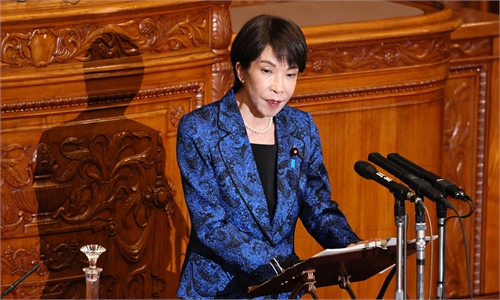
Trump’s Pearl Harbor remarks put Takaichi in an ‘uneasy’ spot, draw wide attention in Japan and beyond; expert says it exposes unequal relations in US-Japan alliance
By Published: Mar 20, 2026 02:41 PM

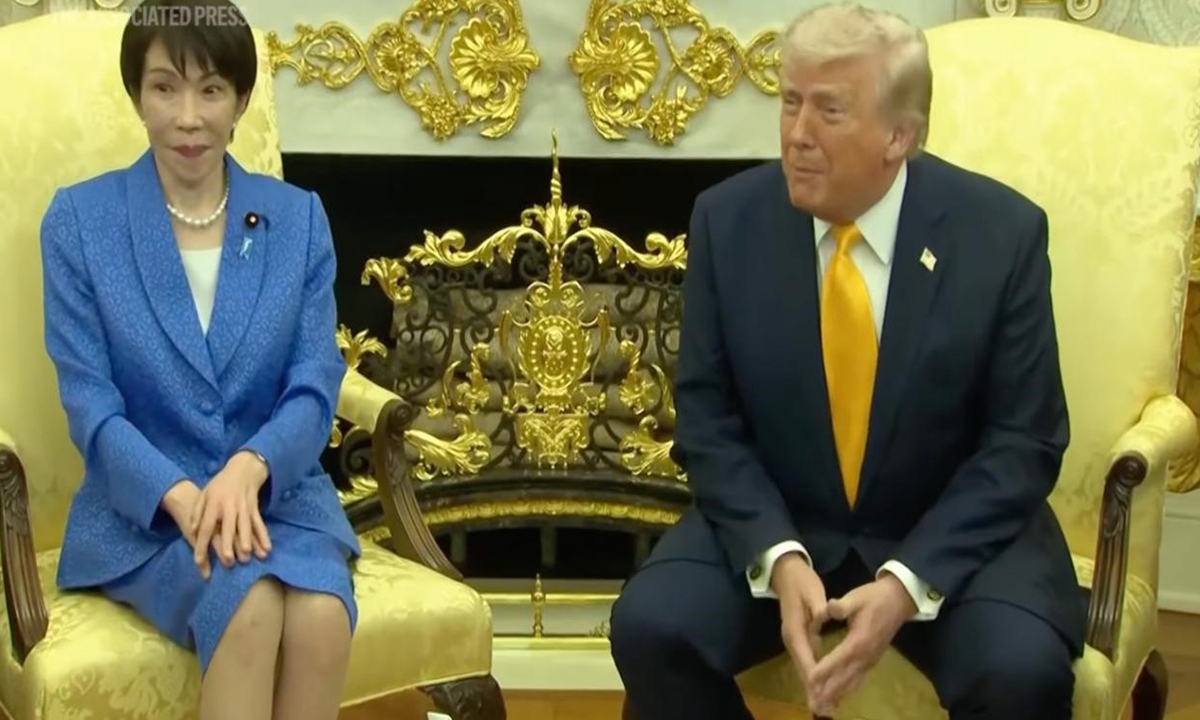
Screenshot from a video clip released by the Associated Press over US President Donald Trump and Japanese Prime Minister Sanae Takaichi in the Oval Office on March 19, 2026 local time.
US President Donald Trump's remarks about Japan's 1941 Pearl Harbor attack, made while sitting beside Japanese Prime Minister Sanae Takaichi in the Oval Office on Thursday local time as he explained why Washington did not notify allies such as Japan before striking Iran, have drawn wide media attention in Japan and beyond, with Takaichi's reaction described by some media as uneasy and embarrassing. A Chinese expert said Trump's remarks may have sounded like an off-the-cuff joke, but it revealed the US deeper view of allies and showed how the US selectively invokes historical memory to reinforce Japan's subordinate position and exert pressure.
In an apparent awkward moment at the Oval Office on Thursday when meeting with the press, Trump referenced Pearl Harbor in his first meeting with Takaichi after her landslide electoral victory while Takaichi appeared to draw a deep breath and lean back in her seat with an uneasy expression. The surprise Japanese attack on the US Pacific Fleet in 1941, which saw the deaths of over 2,400 personnel and drew the US into World War II, according to a CNBC report.
A Japanese reporter asked Trump why the US didn't alert allies like Japan ahead of the Iran strikes, a decision that the reporter said "confused" the Japanese. Trump, in his response, said his administration "didn't tell anyone" about the February 28 military action in advance. "Well one thing, you don't want to signal too much, you know?" Trump said, according to a CBS News report.
"When we go in, we went in very hard. And we didn't tell anyone about it because we wanted surprise. Who knows better about surprise than Japan? OK? Why didn't you tell me about Pearl Harbor? OK? Right?"
"We had to surprise them, and we did," the president said of Iran. "... If I go and tell everybody about it, there's no longer a surprise," Trump said, according to the report.
The CBS News report said "Takaichi appeared taken aback by the president's remarks, her eyes momentarily widening."
Trump's Pearl Harbor reference, made while seated next to Takaichi, drew wider attention from multiple media outlets. The New York Times said Trump "joked about" Pearl Harbor, while The Guardian said Trump had "mocked Japan." The Guardian wrote that there was laughter in the room before Trump asked mischievously, "Why didn't you tell me about Pearl Harbor?" It added that the laughter then died away as Takaichi's eyes widened and she shifted in her chair.
The Guardian report also noted that the Japanese attack on the US naval base in Pearl Harbor took place on 7 December 1941. Then president Franklin Delano Roosevelt called it "a date which will live in infamy." The US defeated Japan in August 1945, days after atomic bomb attacks on Hiroshima and Nagasaki killed hundreds of thousands of civilians.
A report from India Today noted that "from English praise to Pearl Harbor jab, Trump leaves Japan PM visibly uneasy." It said that Trump's meeting with Takaichi "began on a lighter note, with Trump praising Takaichi's English fluency and joking about skipping translation." "Do you understand this? Very good, I'll tell you! So nice we don't have to sit through translation," Trump said, drawing smiles, per India Today.
According to Nikkei, Takaichi began her remarks in English, saying, "Donald, thank you for inviting me to the White House." After she stumbled over part of her English remarks, Trump told her, "There is an interpreter, so you can speak in Japanese." Later, after the opening statements gave way to a Q&A with Japanese and US reporters, Trump again turned to the prime minister during his response and asked, "Are you okay without an interpreter?" Takaichi nodded.
Japanese media also gave prominent coverage to the exchange. Many outlets, including Mainichi, Asahi, Yomiuri, and Kyodo, highlighted in their headlines Trump's reference to the Pearl Harbor attack during talks with Prime Minister Takaichi.
Yomiuri reported that a former senior Japanese government official, commenting on the exchange during the Japan-US summit, claimed, "The public portion of the meeting went very well, but the comment about the Pearl Harbor attack was regrettable."
The Mainichi report noted that Trump's second son, Eric Trump, posted on X a clip of the moment the president referred to the Pearl Harbor attack, adding a laughing-with-tears emoji and describing it as "one of the great responses to a reporter in history."
An article published on Yahoo News, citing Jiji Press, AFP and BB News, noted that Trump's remarks"may have sounded lighthearted on the surface, but it is bound to stir unease in Japan, one of Washington's staunchest allies." It added that after Trump's question, "Takaichi, who was speaking through an interpreter, said nothing, but shifted in her chair and appeared to hold back a sigh. In the room packed with reporters from both Japan and the US, at least one person voiced disapproval."
The article also claimed that "The history of the wartime era remains a sensitive issue for Japanese people, who for many years have sought to build a close alliance with the US while moving beyond the memories of war. Takaichi is known for her nationalist views and has previously argued that Japan fought a war of self-defense and has apologized too much to Asian countries that suffered from its past aggression."
Mitsuru Fukuda, an associate professor of journalism at Nihon University's College of Law in Tokyo, wrote on X on Friday that whether Japan can avoid dispatching ships to the Strait of Hormuz probably depends on Trump's mood. Whether his reference to the Pearl Harbor attack in the debate over the surprise strike was meant as a joke or as pressure remains unclear.
Ryuichi Yoneyama, a Japanese politician and former governor of Niigata Prefecture, wrote on X: "This moment was also surprising. Trump's bad jokes are nothing new by now, but Takaichi, who usually talks about 'heroic spirits' and the like, did not say a single word back to him, did not even frown, and did not so much as shrug her shoulders — she simply let it pass. In the end, the 'Japanese pride' touted by conservatives is only for domestic audiences; when it comes to the US, they cannot say a thing."
Chinese media have also reported on the exchange, with the video clip of the moment going viral on social media. As of press time on Friday, a hashtag reading "Trump mentioned Japan's attack on Pearl Harbor when meeting with Takaichi" on Sina Weibo had been viewed more than 39 million times.
Trump's reference to Pearl Harbor may have seemed like a typical off-the-cuff joke, but it revealed a deeper view of US allies and a selective use of historical memory to exert pressure. By invoking Pearl Harbor in this context, he appeared to remind Japan of its subordinate position in the alliance and of Washington's dominant role in the current security cooperation, Xiang Haoyu, a research fellow at the China Institute of International Studies, told the Global Times.
The concern in Japanese media that such remarks could deepen unease over the stability of the US-Japan alliance in fact highlights Japan's subordinate position in the relationship. Despite Japan's long-standing deference to Washington, it remains in a position where it must absorb this kind of historical humiliation from the US without openly pushing back. Takaichi's strained smile at the scene was revealing. At its core, this passivity reflects Japan's deep security dependence on the US, said the expert.
As for the outcome of the summit, it appeared to deliver more one-sided gains for the United States than meaningful substantive progress. Significant differences remain on key security issues, including Washington's push for Japan to contribute to the Iran conflict and support escort operations in the Strait of Hormuz. The meeting suggested that while the alliance may look close on the surface, it is still constrained by a deeper power imbalance and lingering historical sensitivities, said Xiang.
RELATED ARTICLES