Takaichi arrives in Washington at "awkward" moment as US pressures Japan on Iran war
Trip unlikely to meet expectations under constraints, US-Japan divergence: expert
By and Zhang Yuying Published: Mar 20, 2026 12:21 AM

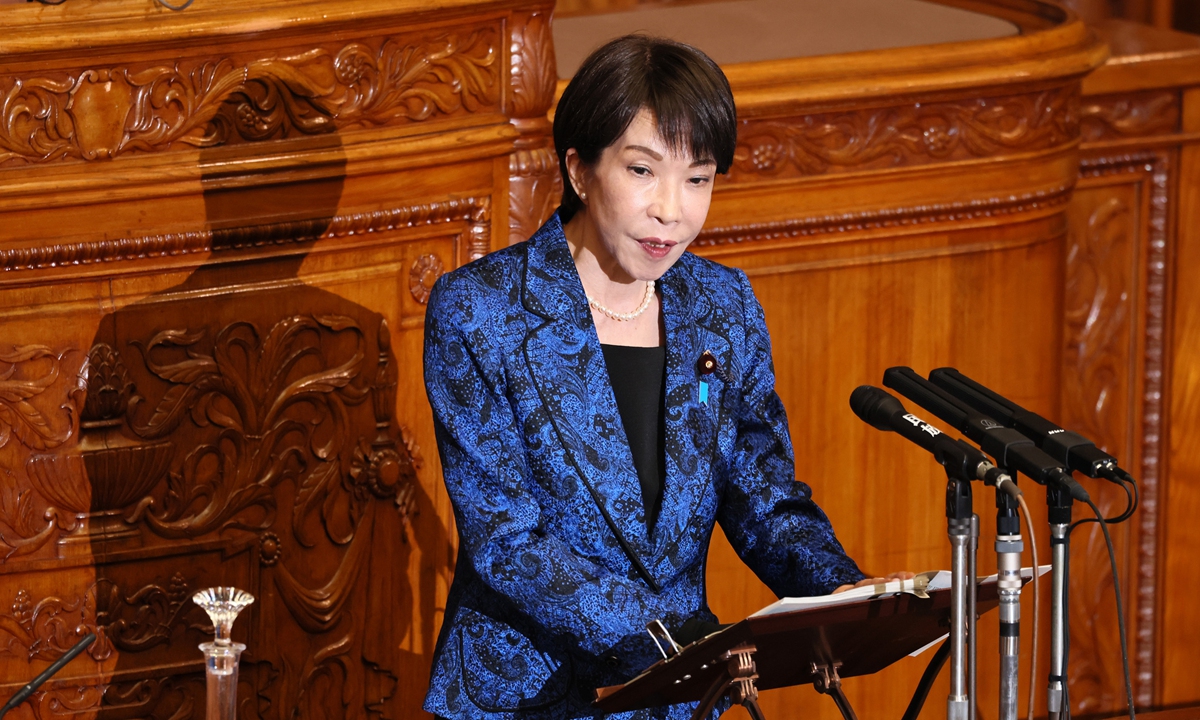
Japanese Prime Minister Sanae Takaichi responds to questions from party leaders regarding PM Takaichi's policy speech during the House of Councillors plenary session at the Diet building in Tokyo on February 25, 2026. Photo: VCG
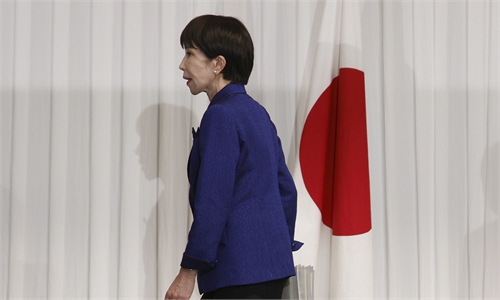
When US President Donald Trump visited Japan in October 2025, Japanese Prime Minister Sanae Takaichi greeted him with a charm offensive. Through "praise, Nobel nominations and promises of investment in the US," Takaichi secured a pledge from the US president: "Anything I can do to help Japan, we will be there." Now that it is Takaichi's turn to visit Washington, the atmosphere is markedly different, largely because of the war in Iran, and it's the US that's asking for help.
Takaichi arrived on Wednesday in Washington DC, hoping to secure American cooperation on trade, security and a tougher approach toward China. However, Reuters headlined its coverage of Takaichi's US trip with "Japan's leader faces high-wire act in Washington over Trump's Iran demands," as her agenda risks being overshadowed by US President Donald Trump's own priorities, particularly his focus on pressing Japan to assist in reopening the Strait of Hormuz - an issue on which Tokyo has been reluctant to commit.
Chinese experts noted that Takaichi's trip is unlikely to meet the expectations, highlighting the constraints and awkwardness of her diplomatic position.
Takaichi arrived at Washington, DC on Wednesday night local time and will attend a meeting with Trump at the White House on Thursday, according to Japan's Jiji press.
In order to showcase her goodwill, Takaichi is said to gift 250 Japanese cherry trees to mark US' 250th birthday. However, she will be greeted by a wartime president who's looking for a different kind of gift from her country: military assistance in the Middle East, according to Washington Post.
Spurned by European allies, Trump is expected to use the meeting to urge Japan to dispatch minesweepers and maritime forces to assist in reopening the Strait of Hormuz, as the war in the Mideast enters its third week. He has already piled on the pressure, suggesting that Japan owes the US for years of defense aid and that Japan must act because of its heavy reliance on Middle Eastern oil, according to the New York Times.
Takaichi reportedly claimed on Wednesday before leaving that if Trump were to request the deployment of Japan's Self-Defense Forces to the strait, she would "clearly explain, in accordance with Japanese law, what can and cannot be done." She also stated that Japan has been working to ease tensions by leveraging its friendly relations with Iran, adding that "we will firmly convey this position of Japan as well," Jiji reported.
She also admitted on Wednesday that she expects a "very difficult" meeting with Trump, the Associated Press reported.
In terms of matters related to the Middle East tensions triggered by the US-Israeli operations against Iran, Takaichi is constrained not just by Japan's domestic law, but also overwhelming public opposition. In a nationwide telephone poll conducted by the Asahi Shimbun from March 14 to 15, 82 percent of respondents said they do not support the US attack on Iran, while only nine percent expressed support.
Japan's Nippon Television cited a senior Japanese Foreign Ministry official as saying that "frankly, we don't know what kind of demands President Trump might suddenly come out with," underscoring a sense of caution.
If he is displeased, Japan could face unfavorable demands on tariffs or security issues, Japan's Hokkaido Shimbun reported.
Takaichi's visit to Washington has unfolded awkwardly on multiple fronts. She had hoped to use the trip to strengthen the alliance, advance economic cooperation and seek greater flexibility from Washington on Japan's security posture. But those ambitions now appear increasingly difficult to achieve, as US frustration over Japan's cautious response to calls for cooperation in safeguarding shipping through the Strait of Hormuz has added strain to the talks, Lü Chao, an expert at the Liaoning Academy of Social Sciences, told the Global Times.
Lü noted that Takaichi's provocative stance against China was intended to signal alignment with Washington. However, recent signals from Trump about engaging Beijing on broader international issues stand in contrast to Japan's more confrontational posture, potentially weakening Japan's anticipation, Lü noted.
If Japan were to deploy Self-Defense Forces to the Strait of Hormuz, it would be seen in Japanese society as almost equivalent to "entering a war." This would be regarded as a substantive step breaking through the constraints of the pacifist constitution, making it highly sensitive and unlikely to gain broad support. At the international level, it would also provoke strong backlash from Asia and other countries, Lü said.
Unpopular figure
Since taking office, Takaichi's rightward shift and push to strengthen Japan's military build-up have raised concerns among multiple countries.
Japan's Sankei news reported that leaders from Japan and the US will confirm their policy of jointly promoting a "Free and Open Indo-Pacific." The Japanese prime minister also intends to stress the importance of peace and stability in the Taiwan Straits.
Takaichi also plans to reassure Trump of Japan's military buildup, emphasizing the acceleration of long-range missile deployment to enhance offensive capabilities. This breaks from Japan's postwar self-defense-only principle and reflects closer alignment with the US, per AP.
Japan's Kyodo News reported ahead of the visit on Tuesday that Takaichi is also considering expressing Japan's desire to cooperate on the US "Golden Dome" next-generation missile defense system at her upcoming meeting with Trump, citing Japanese government sources.
Sending a clear warning to Japan, Russian Foreign Ministry spokesperson Maria Zakharova said at a regular briefing on Wednesday that Japan has been consistently undertaking steps toward remilitarization, including the procurement of strike weapons such as cruise missiles, which cannot be classified as defensive weapons. Zakharova said if new missile threats to Russian territory emerge, Russia will respond and take necessary measures to ensure its defense capability, Xinhua reported.
A Chinese defense spokesperson on Wednesday denounced Japan for hyping up China's military budget, saying that it is nothing more than a thief crying "stop thief" so as to find excuses for its own hidden ambition of military expansion.
Jiang Bin, a spokesperson for the Ministry of National Defense, made the comment in response to Japanese politicians' misinterpretation about China's defense expenditure.
Jiang added, Japan's defense budget has grown for 14 years in a row and increased over 60 percent in the past five years, reaching 2 percent of its GDP. Moreover, Japan's per capita military spending is more than three times that of China.
Since taking office, Takaichi has been faced with growing challenges on the diplomatic front, with her policies unsettling several of Japan's neighbors. While the US has offered her a high-level welcome, it remains wary of what it sees as a rightward shift in Japan and any signs of renewed militarism - seeking to make use of Tokyo as an ally while ensuring it does not move beyond Washington's strategic bounds, said Xiang Haoyu, a research fellow at the China Institute of International Studies, in remarks to the Global Times.
Xiang added that Takaichi's deeper concern is that the US could seek engagement with China even as Japan adopts a harder line. Such a divergence, he argued, could leave Japan in an awkward position in the Asia-Pacific.
Commenting on Takaichi's US visit, former Japanese prime minister Yukio Hatoyama said he views the current prime minister as having "a strong inclination toward subordination to the US," according to The Tokyo Shimbun.
"The Japan-US security treaty, which is meant to preserve peace, must not become something that leads Japan into war," he said.
RELATED ARTICLES