Chinese FM urges Japan to adhere to peaceful development path amid LDP's election win
Dire fiscal reality could constrain Tokyo's military agenda: expert
By and Xing Xiaojing Published: Feb 09, 2026 11:31 PM

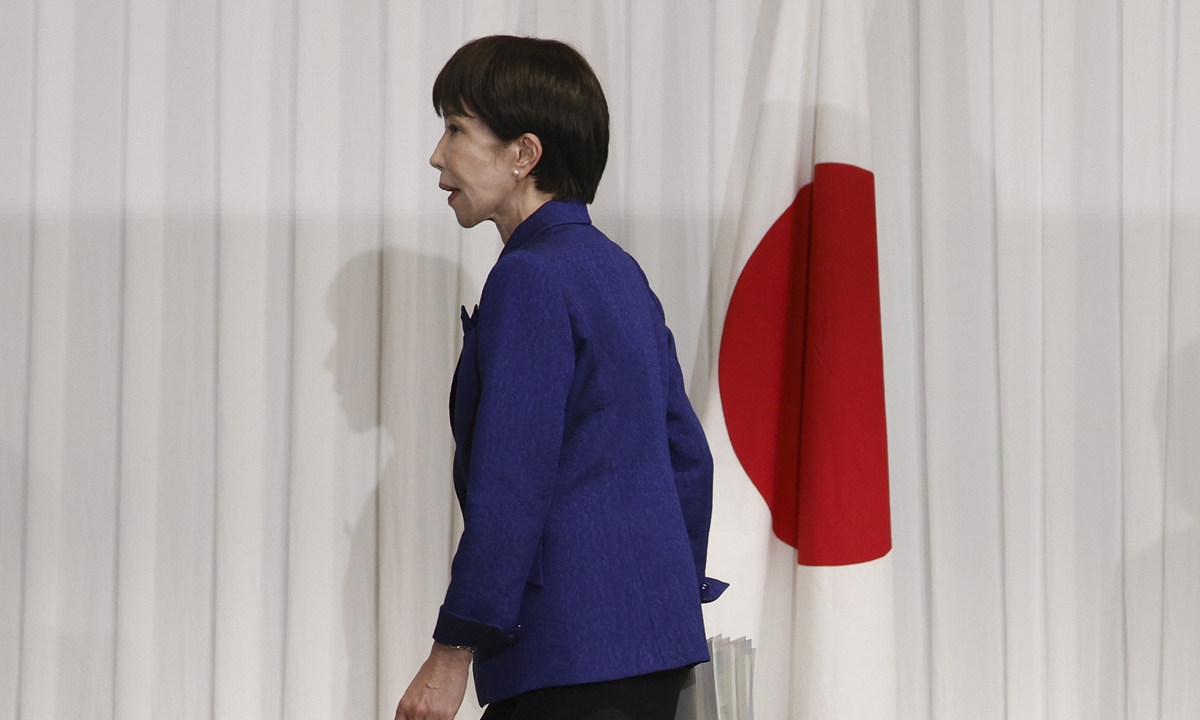
Japan's Prime Minister Sanae Takaichi, leader of the ruling Liberal Democratic Party (LDP), leaves after speaking during a press conference at the LDP headquarters in Tokyo, Japan, on February 9, 2026. Photo: VCG
The Chinese Foreign Ministry responded intensively to inquiries concerning Japan's Lower House election results on Monday, addressing at least five questions, in which the ministry spokesperson noted a clear path for the Japan's ruling authorities, urging them to take seriously rather than brush aside the concerns of the international community, follow the path of peaceful development rather than return to militarism, and abide by the four political documents between China and Japan rather than go back on commitments made.Meanwhile, immediately after the election win, the Japanese Prime Minister has shown dangerous tendency regarding the constitutional revision, Yasukuni Shrine issue and intention to consolidating alliance with the US. Chinese experts voiced concerns that the victory of the Liberal Democratic Party (LDP) could pave the way to potential extreme and populist trajectory of Japan's domestic and foreign policies as the ruling pattern lacks balance, but other expert said the dire fiscal conditions may become constraining factors for its military agenda.
Results early Monday showed that the LDP, which had 198 seats before the election, had won 316 seats. Together with its coalition partner, the Japan Innovation Party (JIP), the bloc had won 352 seats, significantly expanding its majority of 233, according to the report.
On Monday afternoon, Takaichi held a press conference at the LDP headquarters following the election victory. She claimed, "We will take on the challenge of constitutional revision." Also, she claimed that she is intended to advance policies strongly marked by the "Takaichi color," including "responsible proactive fiscal measures," Jiji Press reported.
Shortly after the election concluded on Sunday evening, Takaichi, a figure considered to be with ultraright leanings, openly revealed her dangerous and misguided historical inclinations.
She claimed on Sunday evening during a TV program that she will first seek "understanding" from Japan's ally the US and neighbors, noting that she has been "trying to prepare an environment" before she makes any visit to the infamous Yasukuni Shrine, Kyodo News reported.
In response, Chinese Foreign Ministry spokesperson Lin Jian said on Monday that the Yasukuni war shrine is a spiritual tool and symbol of Japanese militarists' war of aggression. "The nature of the issue concerning the Yasukuni war shrine is whether Japan is able to rightly perceive and deeply reflect on its history of militarist aggression. The issue bears on human conscience, the political foundation of China-Japan relations and the credibility of Japan as a nation,'' the spokesperson said, adding that amnesia of history means betrayal, and denial of responsibility spells relapse.
Later on Monday morning, Takaichi thanked the US President Donald Trump for his congratulations on her election victory, vowing to "further strengthen the Japan-US Alliance" in a post on X in both English and Japanese. Trump on Friday made a rare endorsement for the Takaichi administration.
Responding to an inquiry regarding US President's comment on Japanese election result, Lin Jian stated on Monday that the way that the US and Japan handle their bilateral relations should be conducive to keeping the region peaceful and stable.
Takaichi has apparently adopted a proactive alignment posture, seeking to pursue tacit US acceptance of Japan's "normalization" and "militarization" through closely binding US-Japan security interests, Xiang Haoyu, a distinguished research fellow at the China Institute of International Studies, told the Global Times, noting that Japan is transitioning from a "follower" to an "active driver" of the US so-called Indo-Pacific Strategy.
"For the Asia-Pacific region, this pronounced trend toward bloc alignment could potentially intensify the arms race and undermine regional equilibrium. The geopolitical landscape of the Asia-Pacific risks further sliding into a Cold War-style bloc confrontation," Xiang warned.
Concern from home
Former Japanese Prime Minister Shigeru Ishiba said that the ruling LDP's landslide victory in Japan's House of Representatives election does not amount to a "blank check" for the government to act without restraint, stressing that electoral success should not be interpreted as permission to "do whatever it wants," according to a report by Fuji News on Monday local time.
Nikkei Shimbun on Monday commented that "with only 16 days between the dissolution of the lower house and the vote - the shortest period in postwar history - voters had limited time to scrutinize policies. Discussions on 'money and politics' also remained subdued, and public distrust of the LDP is unlikely to have been dispelled. It would be a mistake to assume the election victory grants a free hand to implement policies at will."
Nomura Research Institute, a leading Japanese think-tank, published an article on Monday saying that since LDP's landslide victory, "there is a growing sense that Japan's financial markets have already entered a 'crisis mode.'''
"If the Takaichi administration, buoyed by strong public support from the House of Representatives election, refuses to adjust or even intensifies its expansionary fiscal policies, the financial market turmoil could deepen further," the think-tank said, warning of a potential severe market turmoil like the "Truss shock," which would deliver a "significant blow to both the Japanese economy and the lives of its citizens."
Xiang warned that after the LDP's victory, the imbalanced structure in Japan's political landscape enables the Takaichi administration to advance controversial agendas - such as expansionary fiscal policies, constitutional revision, and military buildup - with minimal obstruction, raising concerns about the potential extreme and populist trajectory of Japan's domestic and foreign policies.
Koichi Nakano, associate professor of political science, told the Global Times on Monday that while the ruling party's intent to pursue a militarization path is unquestionable, the dire fiscal conditions and the real need for tax increases may become constraining factors for this agenda.
Tokyo urged to adhere to peaceful path
Concerns are also mounting over the Takaichi administration's foreign and security policy, Tokyo Shimbun wrote on Monday, emphasizing that the pressing priority is to mend China-Japan relations, which have deteriorated due to Takaichi's erroneous remarks on Taiwan.
The article noted that "Even if the Prime Minister's popularity is underpinned by anti-China and Sinophobic public opinion, the international community still hopes that he will make a rational judgment from the overall perspective of economic development for both China and Japan and the de-escalation of regional tensions."
When asked about what kind of foreign policy China hopes the new Takaichi administration will pursue, Lin Jian said on Monday that the election is Japan's internal affairs.
"We urge those running the Japanese government to take seriously rather than brush aside the concerns of the international community, follow the path of peaceful development rather than return to militarism, and abide by the four political documents between China and Japan rather than go back on commitments made. If Japan's far-right forces miscalculate and act recklessly, they will be met by resistance from the Japanese people and serious backlash from the international community," Lin added, noting that China's policy on Japan has been stable and consistent, and will not change because of one election.
RELATED ARTICLES