Sanae Takaichi’s US visit is a high-cost ‘political show’: Global Times editorial
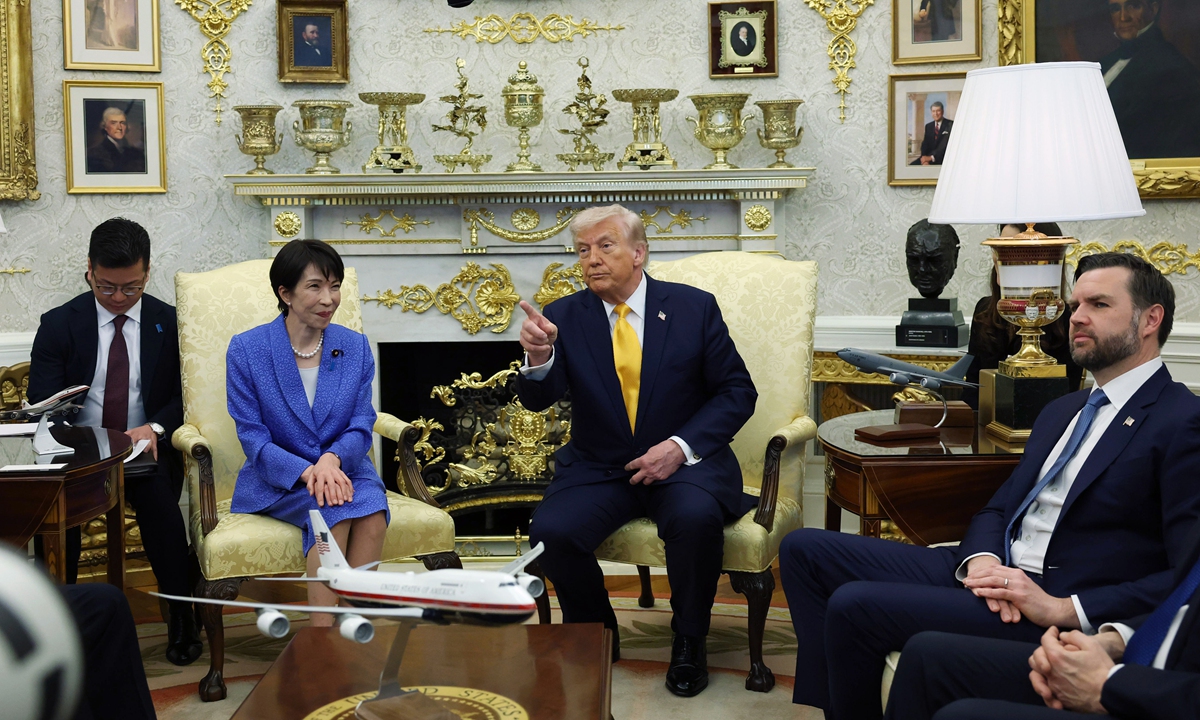
US President Donald Trump and Japanese Prime Minister Sanae Takaichi hold a meeting at the White House in Washington, DC, on March 19, 2026. Photo: VCG
Japanese Prime Minister Sanae Takaichi arrived in Washington "bearing lavish gifts" - only to be handed a "long bill" in return. From massive investment pledges and expanded energy purchases to defense spending commitments, virtually every "promise" Japan made to the US came with a concrete price tag. What the US offered in exchange was vague at best. This high-cost "political show" Tokyo put on has not only laid bare the deep imbalance at the heart of the so-called US-Japan alliance, but has also stoked growing unease inside Japan.What drew the most attention during Takaichi's visit was an investment package totaling a staggering $73 billion. This includes $40 billion for the construction of small modular nuclear reactors in Tennessee and Alabama, and over $33 billion in natural gas power plant investments in Pennsylvania and Texas. Combined with the around $36-billion investment commitment announced in February, Japan has now handed over more than $100 billion in investments under the pressure of US tariffs.
On the surface, this is being touted as an "achievement" of the so-called Japan-US Strategic Investment Initiative - but in reality, it looks far more like "protection money" paid by Takaichi to Washington. It is worth recalling what that initiative actually entails. The framework, reached last year, essentially requires Japan to invest $550 billion by 2029 "at US direction" to "rebuild and expand core American industries." Under the terms of the agreement, the US side will receive 50 percent of the returns before costs of the projects are recouped, and 90 percent thereafter. The deal has prompted some voices in Japan to denounce it as a "humiliating unequal treaty." The more resolutely Takaichi pushes this agreement forward, the deeper the hole she digs for Japanese society.
At a time when domestic prices are rising and the yen continues to depreciate, Takaichi's insistence on channeling tens of trillions of yen into US infrastructure amounts to redirecting Japanese national wealth to underwrite US reindustrialization - a course that risks plunging Japan into a serious fiscal crisis and hollowing out its industrial base. Even within right-wing circles in Japan, critics have spoken out, accusing Takaichi of turning Japan into a country that "cannot say no" and branding her a prime minister who "damages Japan's national interests."
In the security sphere, this is even more apparent. Japan and the US have reached agreements on the joint development and production of missiles, as well as cooperation on critical minerals, but the essence of these deals is that Japan will shoulder the steep costs of research, development, and production, helping to ease the US burden. To pave the way for her visit to Washington, Takaichi had earlier pushed hard for budget deliberations at home. Yet the budget bill, whose overall size and defense spending both hit record highs, was rushed through deliberations in Japan's House of Representatives in what was described as the shortest review time "of this century," drawing fierce criticism within Japan. Based on a Toyo Keizai report, Takaichi was willing to stake her own reputation on pushing the ruling bloc to force the budget through the House of Representatives.
On the Middle East issue, which is of great concern in Japanese public opinion, Takaichi ignored Japan's traditionally friendly ties with Iran and openly condemned Tehran. However, the latest Asahi Shimbun poll shows that an overwhelming 82 percent of Japanese voters do not support the US attack against Iran. Takaichi has also tried to strike some sort of compromise by offering non-combat support, such as logistical supplies and intelligence sharing, to accommodate Washington. This not only disregards Japan's "pacifist constitution" and domestic public opinion, but is also a voluntary abandonment of the country's traditionally balanced diplomacy in the Middle East.
In relations with China, Takaichi's conduct makes her nature as a political opportunist even clearer. She claims that Japan is "open to all sorts of dialogue with China" and has been addressing relations with China "in a calm manner"; yet she has never taken concrete steps to correct her mistaken course.
Besides, she has tried to portray herself as being in a "weak" position facing the US in order to win sympathy and support, while at the same time pushing for deeper military-security cooperation in US-Japan talks, hoping to keep Washington engaged and strengthen its leverage against China. This line of "relying on the US to contain China" will do nothing to help Japan escape the diplomatic predicament it faces with its neighbors.
It is not hard to see that Takaichi's so-called effort to maintain the "solidity of the US-Japan alliance" is, in fact, little more than using Japan's future and the interests of its people as bargaining chips in exchange for the stability of her position and political backing from Washington. Japan's subordinate and deferential posture in its dealings with the US lays bare the weakness of Japanese diplomacy under Takaichi. A Japanese media outlet noted that Washington has long looked down on the Japan-US "alliance," and in the face of direct US demands for greater "contributions," Takaichi will inevitably face extremely difficult choices ahead. Her foreign policy line has also come under heavy criticism at home. During her visit to the US, some Japanese citizens protested outside the prime minister's official residence in Tokyo, voicing deep concern over Japan's foreign policy and military posture.
During her campaign and after taking office, Takaichi repeatedly promoted the idea of a "strong Japan." But from opposition parties and the media to voices even within the ruling camp, many in Japan have warned that this diplomatic path - abandoning strategic autonomy and blindly following the US - is pushing the country toward a dangerous abyss. Takaichi's approach will only send Japan further down the path of decline, and may even turn it into a "landmine" for regional peace and stability. In the end, it is the Japanese people who will suffer most.
RELATED ARTICLES