ARTS / CULTURE & LEISURE
Artist Zao Wou-Ki bridges East and West with Swiss show
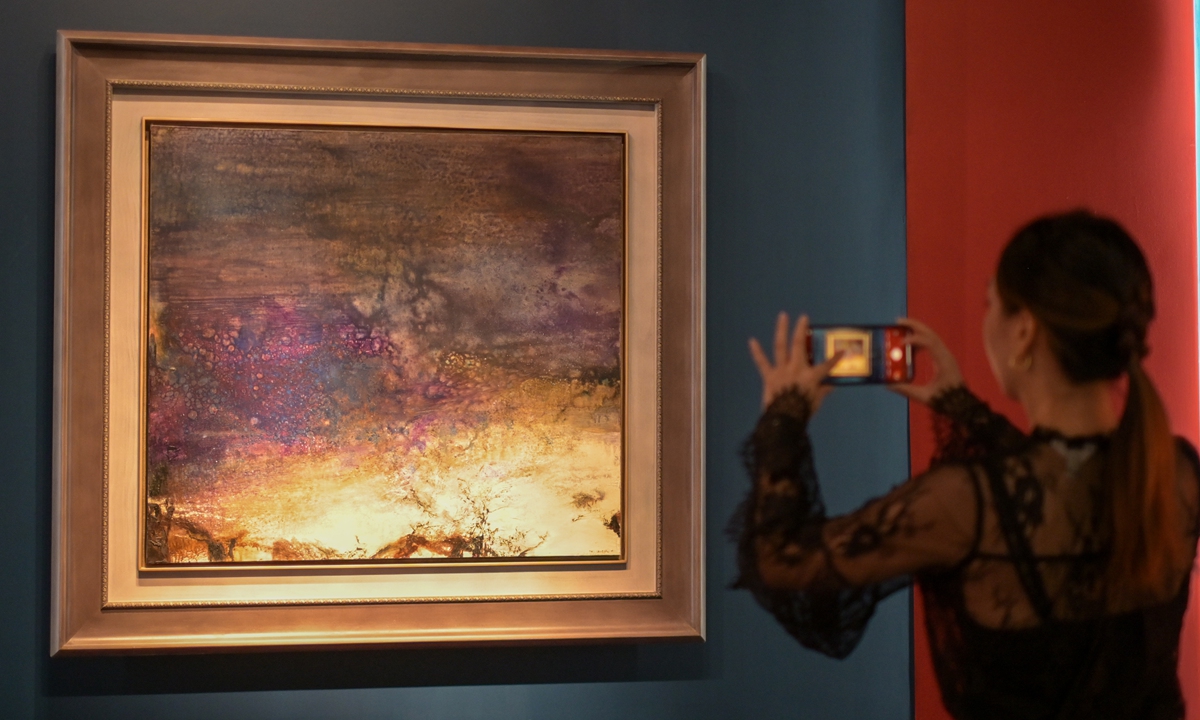
A viewer takes a photo of one of Zao Wou-Ki's artworks on in China's Hong Kong Special Administrative Region HKSAR. Photo: VCG
Zao Wou-Ki, a renowned French painter of Chinese descent, is celebrated worldwide for his abstract art. For a long time, my understanding of Zao Wou-Ki had remained limited to this until I arrived in Locarno, Switzerland.There, I found myself moved by the enduring guardianship and affection people still have for him eight decades on, in this distant foreign land.
Stepping off the train onto the platform, I spotted Veronica Provenzale approaching. Veronica is a local art historian and the curator of Locarno's current exhibition: Zao Wou-Ki: Garden of Symbols. "Zao Wou-Ki arrived in France in 1948 and came to Switzerland as early as 1950. His connection with Switzerland was forged instantane-ously," Veronica remarked. "I happen to know a local elderly lady who told me that she possessed a painting by Zao Wou-Ki. Her husband acquired it over 60 years ago at his solo exhibition in Locarno."
The exhibition Zao Wou-Ki: Garden of Symbols is hosted at Locarno's Casorella Museum. Housed in a late 16th-century building, its warm ochre-hued brickwork exudes understated elegance. Upon entering the museum, we found Director Peter Sébastien. Usually reserved and taciturn, he gave a poetic and precise presentation on Zao Wou-Ki.
The first work to meet our gaze among the exhibition halls was Zao Wou-Ki's 1955 oil painting, Birds Returning to the Forest. This piece was chosen to open the exhibition as an example of Zao Wou-Ki's life-long attempt to depict the world's unseen vitality and unnoticed rhythms. "We hope visitors can sense this quest," Veronica explained.
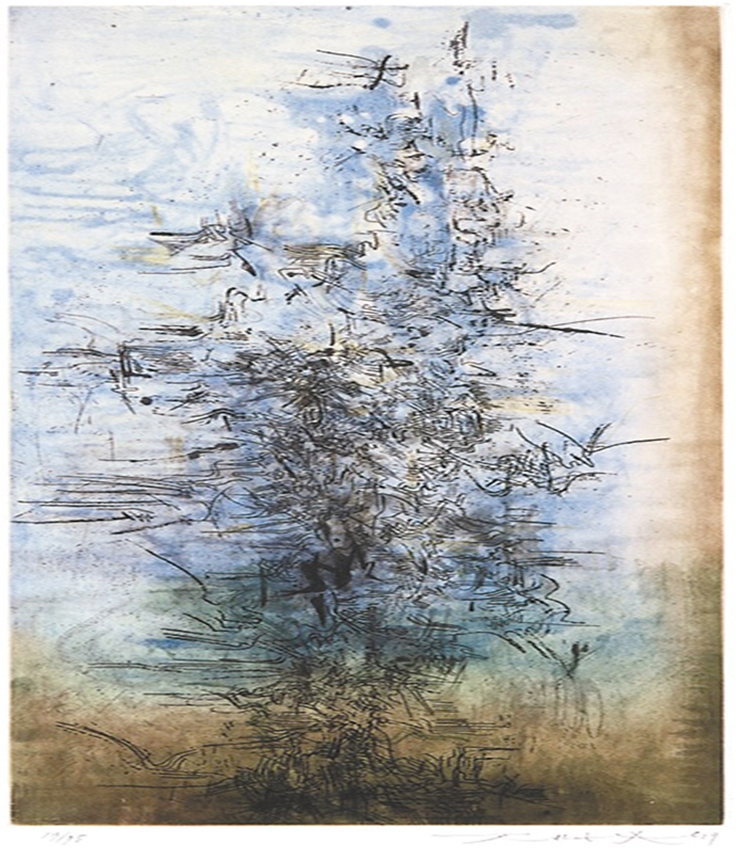
An artwork created by Zao Wou-Ki in 1959, titled "Untitled" Photo: Courtesy of Casorella Museum
This exhibition presents 89 works by Zao Wou-Ki created between 1949 and 1965. In the eyes of Sébastien and Veronica, it is precisely Zao Wou-Ki's oeuvre that anchors Locarno within the global map of art history, highlighting the city's spirit of openness. The exhibition has attracted numerous visitors, including collectors from Europe and China, and garnered significant attention from major Chinese media outlets, a source of considerable wonder and pride for the organizers.The pieces on display are predominantly small in size. One of Veronica's favorite pieces, the painting Grass is Growing, she told me that Zao Wou-Ki's smaller works "radiate an exquisite sensitivity, refinement, and poetry. Zao possessed profound perceptiveness, viewing the world through a unique lens. He pursued his own truth, not mere representation. This is a rare quality among artists and precisely why I like him."
Sébastien explained that appreciating Zao's work "takes time" to be fully appreciated. Indeed, the pieces initially seem easily comprehensible, yet, upon reflection, they often later reveal "a sense of novelty and a hint of unease."
"While his art is rooted in the great tradition of Chinese painting, it also resonates with Western modernity, remaining suspended between the two. Thus, it offers both a familiar resonance and a sense of alienating dislocation," said Sébastien. "What resonates with me most is Zao Wou-Ki's relationship to identity. Although often presented as a bridge between East and West, he never reduced himself to that role. He did not illustrate cultural identity; he worked through it. This quiet consistency, maintained across different cultures and contexts, is what gives his trajectory its rare strength."
Sébastien' s words reminded me of a remark by Claude Roy, French poet, a good friend of Zao Wou-Ki, and one of the earliest European collectors of his work. Claude once said: "China? France? East? West? The truth is, Zao Wou-Ki dwells in but one realm, a realm called Zao Wou-Ki. He buries himself deep within it."
"Look here." Amidst these paintings, Sébastien and Veronica gesturing me towards an inscription-on-painting reading "To my friend Nesto."
Nesto Jacometti, a Swiss national, was a pivotal figure in Europe's printmaking renaissance of the 1950s - a central link connecting artists, publishers and exhibitions. All works in this exhibition originate from Jacometti's bequest. In 1974, he donated his entire collection - comprising 11 oil paintings, 34 works on paper, and over 100 prints by Zao Wou-Ki - to his hometown of Locarno. This endowment established the city as home to Switzerland's, indeed Europe's, most extensive public collection of Zao Wou-Ki's art.
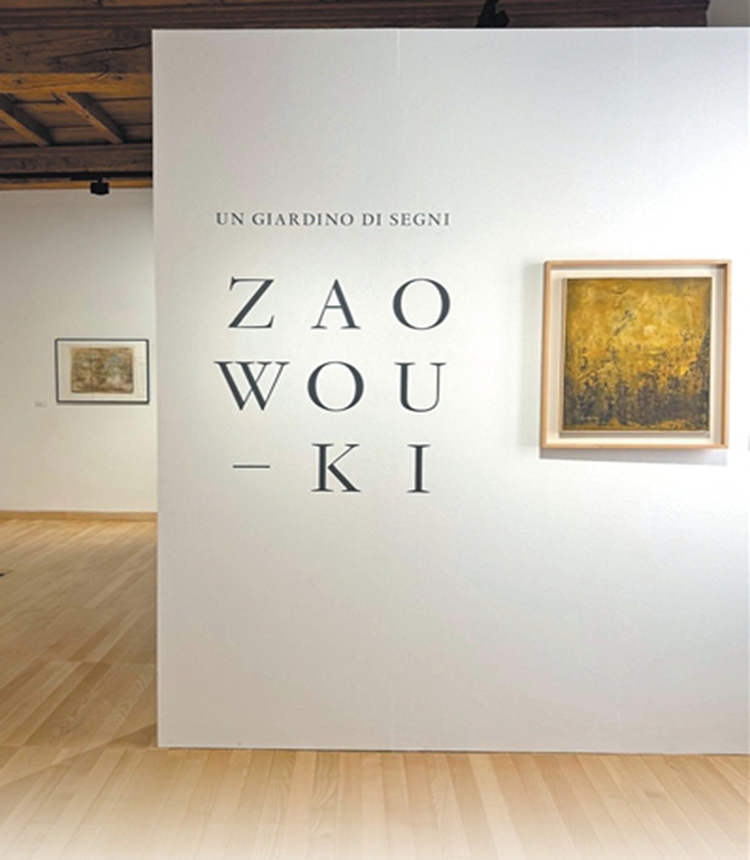
A view of the exhibition hall of Zao Wou-Ki: Garden of Symbols at Casorella Museum in Locarno, Switzerland. Photo: Courtesy of Casorella Museum
Aside Jacometti, Henri Michaux—Zao Wou-Ki's most vital confidant—is strikingly prominent. From the exhibition's title, Zao Wou-Ki: Garden of Symbols, to the extensive quotations adorning the gallery walls, all draw from Michaux's poetry. Two of the eight lithographs that cemented their lifelong friendship, accompanied by Michaux's verses, are also on display.In Locarno, I meet another admirer of Zao's works. His name is Peter Carls, a renowned maxillofacial surgeon residing in Switzerland.
Like Veronica and Sébastien, Carls describes himself as a contemporary kindred spirit to Zao Wou-Ki and a 'super fan.' Despite splitting his time between Switzerland and the UK for his medical practice, he travels whenever possible to see Zao's works. Not an insider in the art world, he has nonetheless been quietly weaving a network of connections between European museums and collectors, with the aim of promoting Zao Wou-Ki to a wider audience.
"I have been researching Zao Wou-Ki for eight years. My mission is to broaden his recognition beyond France, America and China. The exhibition currently running in Locarno, Switzerland—not far from where I live— is well worth a visit."
Before departing Locarno, Sébastien presented me with a gift: the substantial 2013 retrospective catalogue "Life, Happiness, Zao Wou-Ki." In 2013, Zao Wou-Ki passed away in Nyon, Switzerland. That same year, Locarno had hosted that major retrospective in his memory.
The author is a journalist with the European Center of the People's Daily. The article was first published in the People's Daily in Chinese on March 20.
RELATED ARTICLES