Key projects make fresh progress as infrastructure efforts unfold in Q1
Trend to form vital stabilizer for China’s economy: analyst
By Published: Mar 22, 2026 11:32 PM

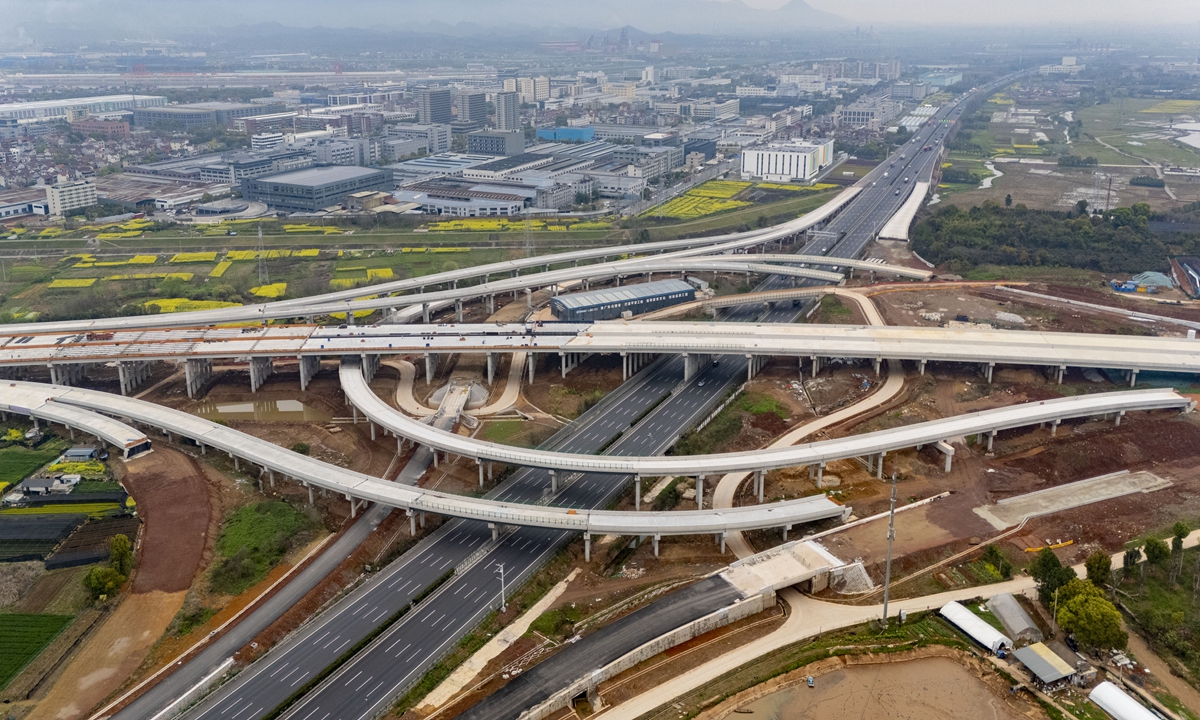
Construction work is underway on the mainline bridge at the Lanxi hub of the Jiande-Wuyi expressway in Jinhua, East China's Zhejiang Province on March 22, 2026. Photo: VCG
A number of major projects have made fresh progress recently, highlighting a potential acceleration in the country's infrastructure buildup and supporting overall investment, Chinese experts pointed out on Sunday.
On Sunday, the right-line shield tunneling of the Haitai Yangtze River Tunnel passed the halfway point in its excavation progress, marking a critical new phase in the construction of the world's longest underwater shield tunnel for a highway as it officially enters the main water area of the Yangtze River, according to CCTV News.
The Haitai Yangtze River Tunnel has a total length of 39.07 kilometers, of which the river-crossing section measures 11.19 kilometers. The right-line shield section spans 9.32 kilometers in total. The tunnel boring machine advances at a pace of 16 meters a day.
On Saturday, China Huadian Corp announced that the country's first 550-megawatt F-class gas turbine unit had officially started generating power after completing 168 hours of full-load operation, marking a new breakthrough in the application of large-capacity, high-efficiency clean-energy equipment, the Xinhua News Agency reported on Sunday.
The unit is part of the Huadian Chongqing Tongnan gas power project in Southwest China's Chongqing Municipality. With a total installed capacity of about 1.1 million kilowatts, it is currently the largest and most efficient single F-class heavy-duty gas turbine unit in China. Once fully operational, the project is expected to generate about 2.1 billion kilowatt-hours of electricity annually, enough to meet the yearly power demand of about 1.75 million households, according to the report.
Groundbreaking took place on Friday on a massive coal-to-ethylene glycol project in Turpan, Northwest China's Xinjiang Uygur Autonomous Region, China News Service reported on Saturday.
The project will produce 2.4 million tons per year of high-quality polyester-grade ethylene glycol upon completion, along with high-value-added byproducts such as dimethyl carbonate and coal-based ethanol.
According to the China News Service report, the project is expected to create more than 1,700 jobs upon completion, effectively driving the cluster development of upstream and downstream industries such as high-end chemicals, equipment manufacturing, and modern logistics, and injecting strong momentum into local efforts to stabilize employment, increase tax revenue, and promote industrial transformation and upgrading.
Reports about these projects come as China attaches greater importance to key projects in 2026, which marks the first year of its 15th Five-Year Plan (2026-30) period.
Han Wenxiu, executive deputy director of the Office of the Central Committee for Financial and Economic Affairs, said at the China Development Forum on Sunday that there is enormous investment potential in areas such as urban renewal, upgrading of traditional infrastructure, and construction of new infrastructure.
China has mapped out 109 major projects over the next five years in areas including the development of new quality productive forces, modern infrastructure, urban-rural integration, and the improvement of people's well-being, according to the Xinhua News Agency.
Sun Chuanwang, a professor at the School of Economics at Xiamen University, told the Global Times on Sunday that driven by the dual engines of policy support and capital funding, infrastructure investment has accelerated since the beginning of 2026.
This year's infrastructure investment is precisely focused on areas such as building a modern infrastructure system, fostering new quality productive forces, addressing shortcomings, and improving people's livelihoods, Sun said, noting that efforts will primarily revolve around the core directions of the 109 major projects outlined in the country's development blueprint.
Infrastructure investment in 2026 represents a concentrated effort under the framework of the 15th Five-Year Plan and is poised to become a key driver of stable economic growth, Sun said.
Bian Yongzu, executive deputy editor-in-chief of Modernization of Management magazine, told the Global Times on Sunday that China's proactive fiscal policy at the start of 2026 has provided sufficient project capital for infrastructure construction, greatly reducing start-up barriers compared with 2025.
Supported by special treasury bonds and targeted funding, the early fiscal efforts effectively guarantee the smooth launch and progress of major infrastructure projects.
RELATED ARTICLES