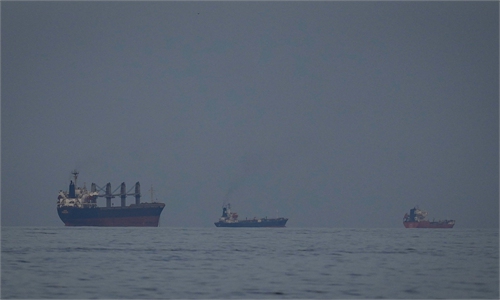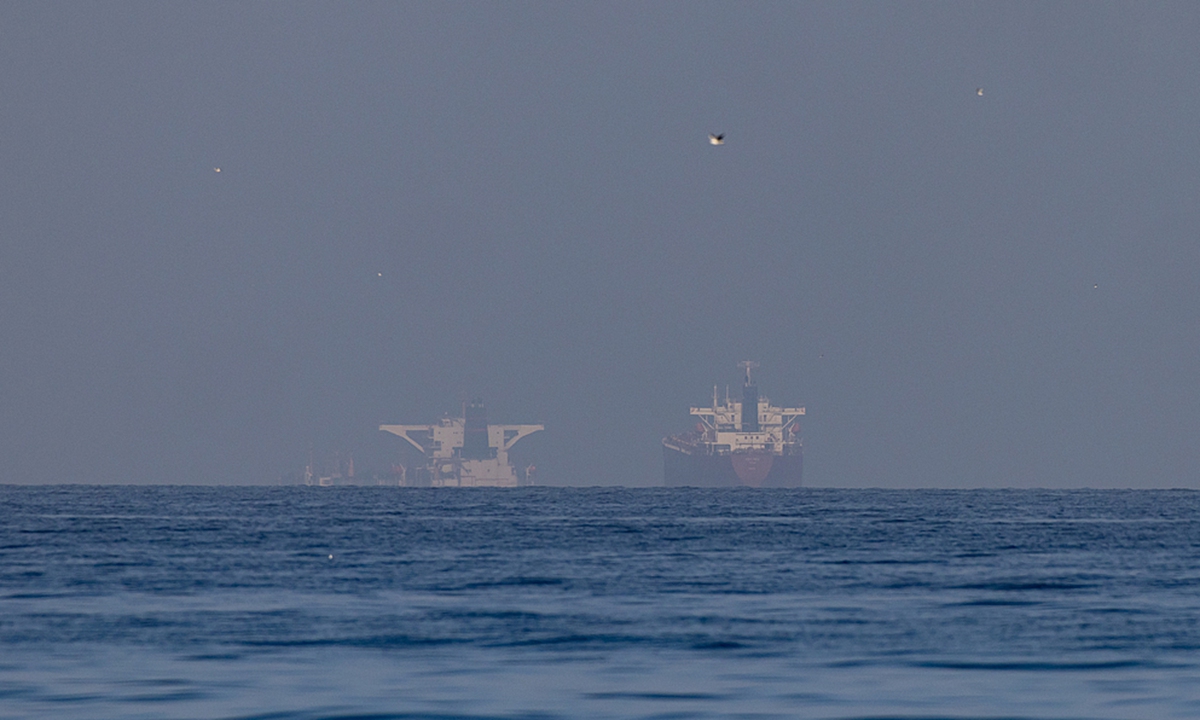
Commercial vessels are seen in the Gulf, near the Strait of Hormuz on March 22, 2026 in northern Ras al Khaimah, United Arab Emirates. Photo: VCG
The 23-day conflict between the US, Israel, and Iran hurtled toward a dangerous new flashpoint after US President Donald Trump issued a 48-hour ultimatum on social media, threatening to "hit and obliterate" Iranian power plants if the Strait of Hormuz remains closed. In a swift rebuke, Iran on Sunday vowed sweeping retaliation against energy infrastructure in the region.
Analysts warned that the 48-hour deadline acts as a ticking time bomb as escalating tensions fuel volatility of global markets. Experts caution that as both sides traded threats to take extreme measures, it also suggests that neither side can secure a decisive victory, and ultimately, the conflict will have to be resolved through negotiations.
48-hour ultimatum
"If Iran doesn't FULLY OPEN, WITHOUT THREAT, the Strait of Hormuz, within 48 HOURS from this exact point in time, the United States of America will hit and obliterate their various POWER PLANTS, STARTING WITH THE BIGGEST ONE FIRST!" Trump wrote in a post on Truth Social.
Iran's response came on Sunday through its highest military coordination body.
"If Iran's fuel and energy infrastructure is attacked by the enemy, all energy infrastructure, as well as information technology (IT) and water desalination facilities, belonging to the US and the regime in the region will be targeted pursuant to previous warnings," said spokesman for the Khatam al-Anbiya Central Headquarters Lieutenant Colonel Ebrahim Zolfaqari, Iran-based media Press TV reported Sunday.
Second Brigadier General Ebrahim Zolfaghari and Iran's Parliament Speaker Mohammad-Bagher Ghalibaf made similar warnings later the same day.
Iran's highest operational command unit later issued a stronger statement saying that the Islamic Republic will completely close the Strait of Hormuz if its electricity generation infrastructure comes under attack, per Press TV.
The escalation in the ongoing US-Israeli war on Iran came amid soaring global oil prices and stalled maritime traffic through the vital Strait of Hormuz.
"The war has escalated into a stalemate. Both sides are threatening to take extreme measures, but it also suggests that neither side can secure a decisive victory. Ultimately, the conflict will have to be resolved through negotiations," Ding Long, a professor at the Middle East Studies Institute of Shanghai International Studies University, told the Global Times on Sunday.
Russian Foreign Minister Sergey Lavrov offered sharp criticism on Saturday during an interview with Russian media. Lavrov accused the US of seeking to dominate global energy markets "by any means," including coups, abductions, and assassinations of leaders in resource-rich countries.
He specifically cited Venezuela and Iran as examples where Washington has not hidden its oil-driven motives, adding that the US prioritizes its own interests above any international agreements and is actively trying to push Russia out of energy markets, according to a report released by the Russian Foreign Ministry on Saturday.
Despite US' promises that the war would be only a "short excursion," limited operations for US boots on the ground remain on the table - whether to seize nuclear sites or Iran's oil-exporting hub, Kharg Island, Fortune noted in a report.
Iranian Commander of the Khatam al-Anbiya Central Headquarters, Major General Abdollahi, said Iran's military doctrine has shifted from defensive to offensive, with tactics adapted accordingly, Press TV reported in an X post on Sunday.
The Islamic Revolutionary Guards Corps (IRGC) announced in the early hours of Sunday that military installations and security sites in Arad, Dimona, Eilat, Be'er Sheva and Kiryat Gat in southern Israel were hit by Iranian missiles including "Fattah," "Ghadr" and "Emad," along with drones. It also claimed that US airbases in the region - including Ali Al Salem, Al Minhad and Al Dhafra - were targeted by Iranian missiles and drones, Mehr News Agency reported.
The war in Iran has disrupted economies, supply chains and ordinary routines far beyond the Middle East. Israeli warplanes have conducted strikes over Tehran, while Iranian ballistic missiles have struck southern Israeli cities including Arad and Dimona (near the nuclear facilities), causing dozens of casualties.
Approximately 1,000 ocean-going ships and 20,000 sailors are currently unable to transit the Strait of Hormuz, exacerbating global oil supply concerns and driving prices higher. In response to surging fuel costs and shortages, Vietnam has urged citizens to work from home where possible, while the Philippine government has shifted public sector employees to a four-day work week, according to public information.
Adding to the economic alarm, Kirill Dmitriev, CEO of the Russian Direct Investment Fund (RDIF) and special presidential representative for foreign investment and economic cooperation, warned on X platform that the EU and UK face an imminent fuel crisis, with rationing likely within weeks.
He described the situation bluntly as "Reality bites."
Out of control
Multiple international media outlets suggest that the US appears to have lost control over both the situation and the conflict. The Guardian said, "There are growing concerns the US does not have a clean exit strategy from the conflict that can guarantee a stable resumption of the oil trade through the Strait of Hormuz."
Japan's Yomiuri Shimbun on Saturday bluntly stated that the US president is facing a "triple dilemma" of global energy crisis, expanding warfare, and cold treatment from allies.
A Reuters article titled "Three weeks in, Iran war escalates beyond Trump's control" on Saturday stated more straightforwardly: "President Donald Trump ends the third week of the Iran war confronting a crisis that seems to be slipping out of his hands: Global energy prices are surging, the US stands isolated from allies and more troops are preparing to deploy despite his promise the war would be only a 'short excursion.'"
"A war without a clear endgame is more likely to spiral out of control than lead to victory," Zhu Yongbiao, director of the Center for Afghanistan Studies at Lanzhou University, told the Global Times, noting that military force can destroy targets but cannot rebuild order.
Winning a war and ending one could be two very different things, Zhu said, adding that since the conflict erupted, the US has yet to present a clear plan. While Washington seeks to avoid being deeply drawn into the war, it also hopes to preserve its image and secure a "dignified exit." Iran, meanwhile, wants a clear outcome to the conflict, while Israel has its own demands, further complicating the situation.
Amid all pressing questions rising from the crisis, the first is the Strait of Hormuz. How to ensure stable shipping through the narrow waterway only a few nautical miles wide? Missiles cannot solve the problem, only negotiations can, Ding Long said.
Ding said restoring normal navigation through the Strait of Hormuz is now an urgent priority, warning that tensions between Iran and Gulf states are already at a tipping point and the broader Gulf situation risks spiraling out of control.
Such risks are compounded by the second problem of nuclear issue, perhaps the most alarming concern, the expert said.
"Beyond that, the biggest challenge is how could the war end and what comes next? The reconstruction? how can Iran's security and stability be guaranteed? And would Iran be willing to help ensure safe passage through the Strait of Hormuz?"
"None of these questions can be solved by force. Only negotiations can provide a way out," Ding noted.
RELATED ARTICLES