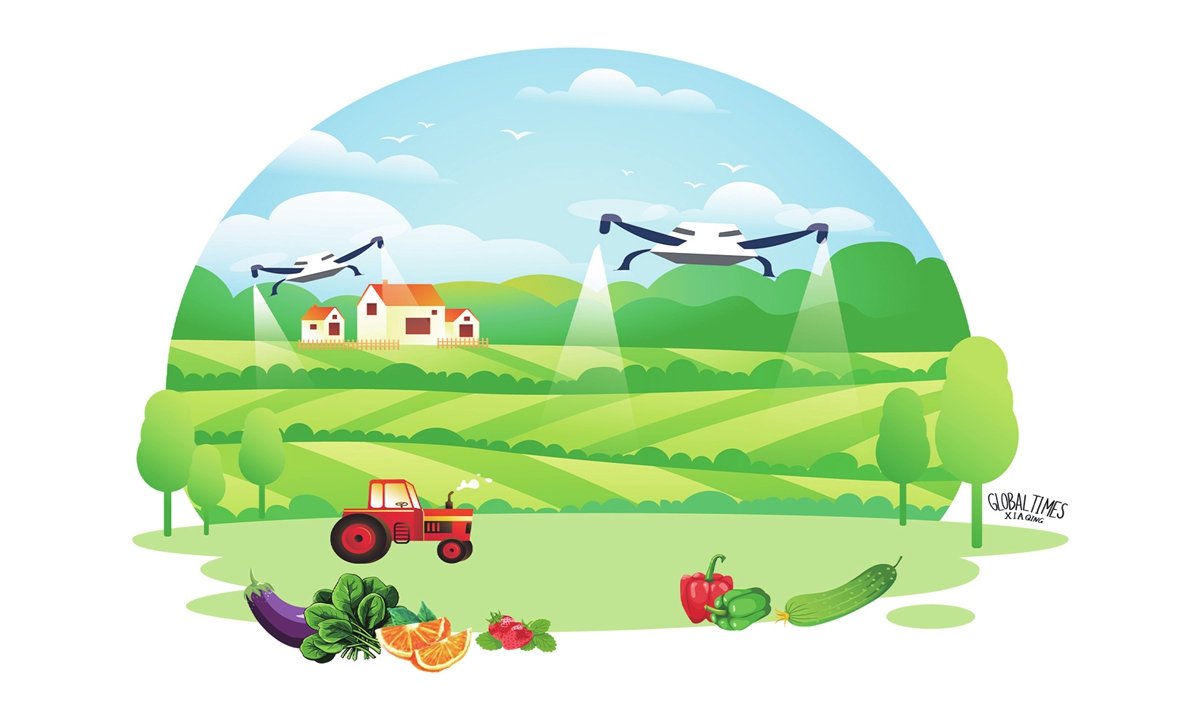
Illustration: Xia Qing/GT
As temperatures rise and farming activity intensifies, a drone equipped with the BeiDou navigation system was recently deployed on a farm in Hai'an, East China's Jiangsu Province, to spray pesticides. While this might seem like a minor scene amid the busy spring plowing season, it highlights a much broader trend: the growing accessibility of advanced technology in agriculture in China.The drone serves as a microcosm of this broader trend. According to CCTV.com, this spring, a new range of agricultural equipment, including artificial intelligence (AI)-powered plant protection drones and smart watering and fertilizer robots that can "communicate" with farmers, has become important tools for farmers. These innovations are enabling farmers to work more efficiently and precisely in managing their crops.
According to a report on xinhuanet.com on Monday, the number of plant protection drones in China reached 251,000 in 2025, covering an area of 2.67 billion mu (178 million hectares), making China the global leader in both categories.
These figures would have seemed nearly unimaginable just a few years ago. A 2017 article in the Economic Information Daily noted that in terms of crop management, while 17 percent of global farmland utilizes aerial plant protection, China's aerial plant protection rate stood at just 2 percent, with drone coverage accounting for less than 1 percent.
What has fueled the growing use of agricultural drones? There are several factors. The first appears to be the decreasing cost of these drones. The financial media outlet Yicai reported in 2024 that as manufacturers continually updated their models, the price of drones from a particular company dropped from about 100,000 yuan ($14,469) in 2016 to about 40,000 yuan.
As agricultural drones become increasingly advanced, their growing affordability has made cutting-edge technologies like precise navigation systems more widely accessible. This has allowed such innovations to be adopted across a broader range of farming operations. As a result, the agricultural machinery market is expanding, creating new opportunities for growth within the sector.
As of 2025, China's agricultural drone fleet had exceeded 300,000 units - the largest in the world. Still, agricultural drones are not an isolated development. China is rapidly advancing the digital and intelligent transformation of its agricultural sector, with a wide array of smart equipment becoming increasingly integral to production. According to the China Science Daily, technologies such as smart harvesting robots, intelligent irrigation systems, and AI-powered laser weeding robots are beginning to be deployed in agricultural operations, further enhancing efficiency and precision across the industry.
China's overall level of agricultural science and technology innovation has entered the world's top tier. As of the end of 2024, the contribution rate of agricultural technological progress reached 63.2 percent, up 2.5 percentage points from the end of 2020, according to the National Bureau of Statistics. Data from the Ministry of Agriculture and Rural Affairs showed that this figure further rose to more than 64 percent in 2025.
A report by China News Service in February noted that in Hami Prefecture, Northwest China's Xinjiang Uygur Autonomous Region, AI technology is being deeply integrated into agricultural production.
Taking the local key cash crop - Hami melons - as an example. AI systems can precisely control irrigation volume and timing based on the crop's water needs. Behind such examples lies a large and growing market - one that encompasses, but is not limited to, AI-driven agricultural machinery. This market is being fueled by the combination of advanced technological applications and the cost reductions driven by ongoing innovations.
Agriculture is a price-sensitive sector, with profit margins often constrained by the cost of production. For AI and other advanced technologies to establish a substantial market in this field, they must be affordable. The widespread adoption of AI-driven tools in farming depends on making these innovations economically accessible.
By contrast, industries outside of agriculture generally face less pressure on pricing, offering more flexibility for the application of emerging technologies such as AI. These sectors can absorb higher upfront costs, as the long-term productivity gains, efficiency improvements, and enhanced capabilities often justify the initial investment.
China's rapid adoption of AI and related technologies is enhancing efficiency and driving the creation of new markets. The proven economic viability of drone-based pesticide application, for instance, highlights the practical value of such innovations, with similar technology-driven markets now emerging across agriculture and other sectors. These emerging developments warrant close attention.
The author is a reporter with the Global Times. bizopinion@globaltimes.com.cn
RELATED ARTICLES