China imposes temporary measures to limit fuel prices, to buffer spikes due to geopolitical impact, showing institutional advantage
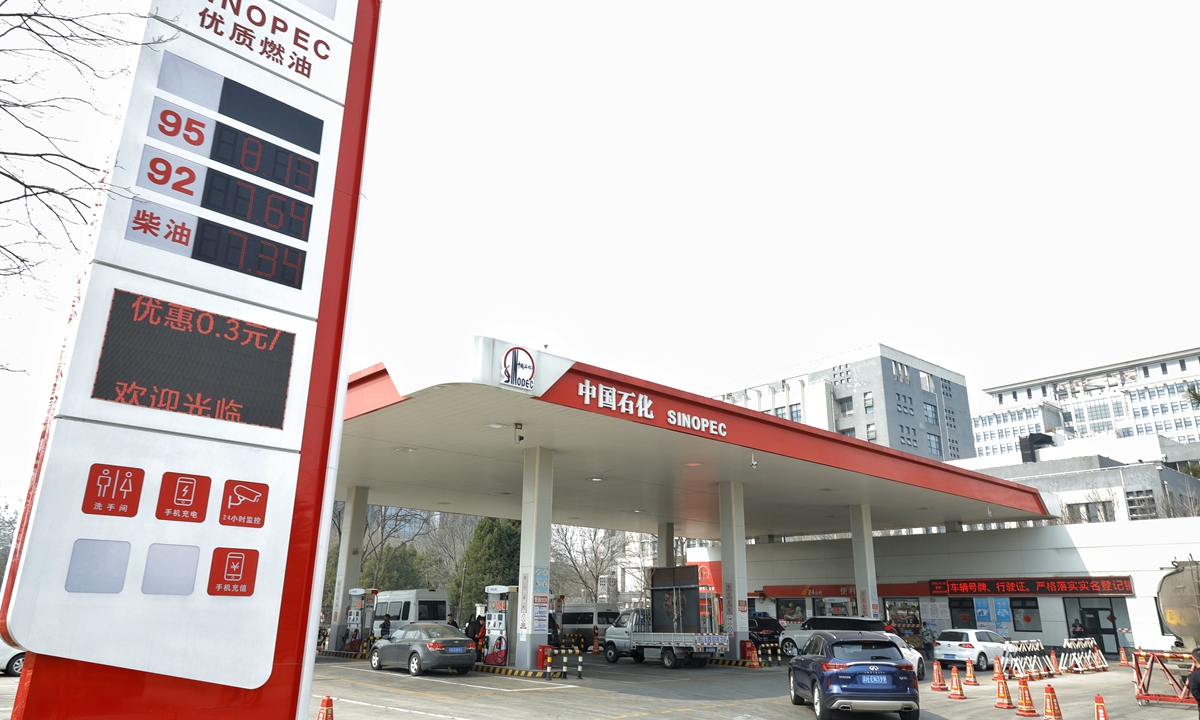
Car owners refuel at a gas station in Shijingshan district, Beijing on March 23, 2026, the day when the National Development and Reform Commission announced a temporary adjustment to refined oil prices. Photo: Li Hao/GT
Following the hustle and bustle of work over the past weekend, staff members from a gas station in Beijing's Chaoyang district breathed a sigh of relief as Monday afternoon turned out to be less hectic than the previous day after the country's top economic planner announced on Monday afternoon that it is taking temporary regulatory measures on domestic gasoline and diesel prices to shield the economy and consumers from a recent sharp spike in international crude oil prices.
"Due to the measures, domestic prices for No. 95 gasoline will increase by less than 1 yuan ($0.15) per liter - around 0.9 yuan per liter - compared with the speculated 1.6 yuan or 1.8 yuan per liter previously," a staff member from the gas station told the Global Times on Monday.
It came after China's National Development and Reform Commission (NDRC), the country's top economic planner, said on Monday afternoon that it would adopt temporary regulatory measures on domestic refined oil prices.
Starting at midnight on Monday, retail prices of gasoline and diesel (standard products) will actually be increased by 1,160 yuan ($163) and 1,115 yuan per ton after the adjustment instead of a steeper hike of 2,205 yuan and 2,120 yuan per ton respectively under the current pricing mechanism, according to the NDRC.
Stabilizing market
The NDRC said that to cushion the impact of the abnormal spike in global oil prices, ease the burden on downstream users, and ensure stable economic operations and people's basic livelihoods, it has introduced temporary regulatory measures on domestic refined oil prices within the existing pricing mechanism framework.
The NDRC vowed to guide refiners and distributors to step up production, logistics and supply arrangements to ensure market supply, while working with relevant authorities to strengthen market supervision and inspections. Violations such as non-compliance with state pricing policies will be strictly penalized to safeguard market order and protect consumer interests, according to NDRC.
Under China's current pricing mechanism, the NDRC reviews retail gasoline and diesel prices every 10 working days and applies adjustments based on fluctuations in international crude oil prices. The previous adjustment of domestic refined oil prices occurred on March 9, which saw domestic prices for gasoline and diesel increased by 695 yuan and 670 yuan per ton, respectively, according to the NDRC.
Over the weekend, speculation arose that domestic oil prices would see a significant increase, prompting many car owners to rush to fill up their tanks ahead of the price adjustment.
According to an early China Media Group (CMG) report, analysts said that with the adjustment window approaching, the crude price change rate may continue to rise in the short term, with the final increase in retail prices possibly reaching around 2,200 yuan per ton.
On a per-liter basis, No. 92 gasoline could rise by 1.73 yuan, No. 95 gasoline by 1.83 yuan, and No. 0 diesel by 1.87 yuan, per the CMG report.
However, Monday's NDRC's announcement of temporary intervention results in a moderated increase of 1,160 yuan and 1,115 yuan metric ton, respectively.
This marks the first regulatory intervention since the mechanism was introduced in 2013, the Xinhua News Agency reported.
According to NDRC's notice in 2013, in special circumstances - such as a significant rise in the overall domestic price level, the occurrence of major emergencies, or sharp fluctuations in international oil prices over a short period - that necessitate adjustments to refined oil product prices, temporary regulatory measures shall be implemented in accordance with the law. Upon approval by the State Council, as requested by the National Development and Reform Commission, price adjustments may be suspended, postponed, or the magnitude of such adjustments reduced.
Experts said the move represents a timely and robust response to the sharp rise in global oil prices, and will play a key role in ensuring stable domestic economic operations, according to Xinhua.
The temporary regulatory measures are aimed at easing the burden on downstream users, effectively limiting the increase in domestic gasoline and diesel prices to 1,160 yuan and 1,115 yuan per ton, respectively—1,045 yuan and 1,005 yuan less than it would have been increased -- equivalent to about 0.85 yuan less per liter nationwide on average, China Media Group reported after the announcement.
For private car owners, based on a 50-60 liter fuel tank, filling up with 92-octane gasoline would cost 40-50 yuan less per tank; for heavy truck drivers, based on a 400-600 liter tank, the savings would amount to 300-500 yuan per fill-up, the report said.
Lin Boqiang, director of the China Center for Energy Economics Research at Xiamen University, told the Global Times on Monday that NDRC's move, in line with the mechanism, fully demonstrates the country's institutional advantages, serves as a timely and forceful response to abnormal fluctuations in the international market, and plays an important role in ensuring the stable operation of the domestic economy.
International response
China's temporary regulatory measures on domestic refined oil prices came as multiple countries scrambled to cope with the energy crisis caused by the escalating geopolitical tensions in the Middle East.
In an interview with NBC on Sunday local time, US Treasury Secretary Scott Bessent, when talking about the impact of the conflict on consumers, said that "I think the American people understand that any 50 - I'm not going to put a time on it but let's just pick 50 days of temporary elevated prices, prices will come off on the other side, for 50 years of not having an Iranian regime with a nuclear weapon."
When asked whether prices could start to come down as he said 50 days, Bessent said, "I was just picking a point. I don't know whether it's going to be 30 days. I don't know whether it's going to be 50 days. I don't know whether it's going to be 100 days."
When commenting on a post regarding Bessent's remarks, one X user named Cara Pace said on Monday that "Once again the US taxpayer is asked to pay for non American problems." Another netizen posted "Since it's so flippant and not that big of a deal, how about the government write a check for the next 50 days for Americans..."
Lin, the expert, noted that once again the US makes consumers pay the price for the conflict it has initiated.
Bert Hofman, former World Bank Country Director for China and professor at the East Asian Institute at the National University of Singapore, told the Global Times on Monday in Beijing on the sidelines of the China Development Forum the longer the conflict persists and the more intensive it comes, the more it affects global markets. The oil markets and the gas markets are severely disrupted at the moment, and that affects the world economy.
According to Hofman, although China will also be affected, the country is "actually relatively well positioned", given that it has a "pretty balanced" energy structure.
China has a much more diversified import energy structure than countries like Japan and India, which have got a lot more of their imports from the Gulf, according to Hofman. "So China is pretty well done," he said.
Chinese Foreign Ministry spokesperson Lin Jian said on Monday that the situation in the Middle East has dealt a blow to global energy and trade security. Relevant countries should immediately stop military operations and prevent the regional turmoil from causing a greater impact on global economic growth.
RELATED ARTICLES