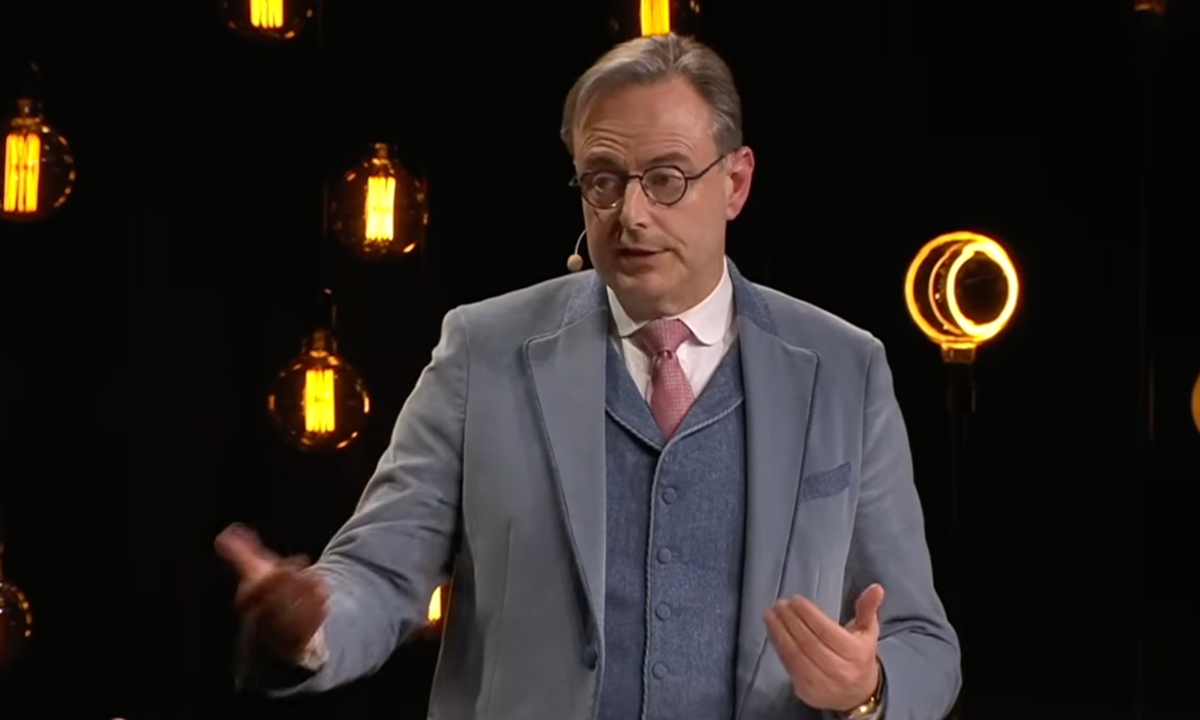
Belgian Prime Minister Bart De Wever speaks at the annual New Year forum "The Future of Europe," co-hosted by leading Belgian financial newspapers De Tijd and L'Echo. Photo: Screenshot from website.
According to European media reports, Belgian Prime Minister Bart De Wever recently wrote to European Commission President Ursula von der Leyen, claiming that China "is devastating our economy" and calling for discussions on "adopting a firmer approach toward China" at the European Council summit in April. Such radical remarks are surprising. Not only does the so-called "China shock" narrative he promotes not align with the facts, but the proposed solutions in the letter are also digging a hole for the EU.In his letter, De Wever claimed that China is accelerating an export-led growth strategy in sectors such as chemicals, pharmaceuticals, and the green transition, with related export volumes increasing by 20 percent within a year, stating that "we have reached a point of no return." The view that equates trade deficits with "Europe at a disadvantage" is fairly representative in Europe and has misled some people.
Fifty percent of China-EU trade consists of intermediate products. Through trade with China, European companies have significantly reduced production costs and earned higher profits - a case of "surplus in China, profits in Europe." Take Belgium as an example: The Port of Antwerp, a major European hub, imports large quantities of products such as batteries and automobiles from China, which are then re-exported to other EU countries via Belgium. Not long ago, a direct shipping route was launched between the Port of Jiangyin in Wuxi, China, and the Port of Antwerp, enabling large volumes of high-quality, well-priced "Made in China" products to reach Western Europe directly. As a former long-time mayor of Antwerp, De Wever should have been well aware of whether Belgium is truly "at a disadvantage."
Belgium was among the earliest Western developed countries to actively welcome China's reform and opening-up policy and to invest and do business in China. Companies such as Solvay, Bekaert, Barco, and earlier Janssen Pharmaceuticals have supported China's development while also reaping substantial returns. Meanwhile, projects like Volvo's Ghent plant, COSCO's Zeebrugge Terminal, and the Cainiao smart logistics hub in Liège have expanded the space of mutually beneficial cooperation between China and Belgium, creating a large number of job opportunities and enhancing Belgium's competitiveness in manufacturing and logistics. By 2024, bilateral trade had grown to nearly 2,000 times its level at the beginning of diplomatic relations, which vividly reflects the complementary strengths and win-win cooperation between China and Europe.
In fact, De Wever's remarks show a stark contrast over time. Last summer, he acknowledged the long-standing history of Belgium-China engagement, emphasized Belgium's role as a gateway in EU-China cooperation, and advocated for stronger exchanges and greater mutual trust. Yet in just over half a year, he first claimed at Davos that "people want to join the European Union … nobody wants to join China," and more recently went further, portraying China as "devastating Europe's economy." Some analysts believe that more than a year into his tenure, De Wever is facing various domestic pressures, and criticizing "the increase in Chinese exports" has conveniently become a tool for him to deflect internal pressures and to boost Brussels' influence within the EU externally.
Many of the pressures Europe is facing today do not originate from China but from its own long-accumulated structural issues: weak economic growth, high energy costs, insufficient industrial investment, sluggish innovation translation, slow policy coordination, and significant internal market constraints. In other words, what Europe should truly be thinking about today is, first and foremost, how to fix itself rather than assuming that simply pushing back against China can resolve its competitiveness challenges. On the contrary, the more China is cast as a "scapegoat" for Europe's difficulties, the more it risks obscuring the internal problems that Europe truly needs to confront and address. Attributing challenges such as strains on Europe's industrial base, pressure on economic competitiveness, and rising supply chain anxieties solely to China "controlling" production and supply chains is, in itself, a form of political laziness that merely blames external factors.
De Wever's remarks also reveal some European politicians' cognitive biases toward China, their deliberate belittlement of non-Western models of economic and social development, their unwillingness to confront the European decline, and their adherence to a flawed "Eurocentrism." In their view, the EU is the touchstone of Western civilization. They are self-absorbed in Europe's soft power, which includes normative power, a unified large market, development dividends, and alliances of interest, lamenting that "the EU is attractive to many countries, while neither China nor the US can compare in a similar sense." However, this perception overlooks the essence of international relations - equality, mutual benefit, and win-win cooperation are the cornerstones of national relationships, rather than cliques and forced binding.
We prefer to view De Wever's remarks on China as a form of political trend-following rather than a well-considered cognitive conclusion. In 2025, the bilateral trade volume between China and Belgium reached $40.37 billion, a year-on-year increase of 3 percent. This mutually beneficial cooperation is something the Belgian prime minister cannot ignore. While he was hyping the "China Shock" narrative, Chinese export packages were continuously arriving in Europe via cargo flights at Liège Airport, and Antwerp has become a busy European freight hub under the Belt and Road Initiative. We advise De Wever and others that instead of being mired in biases and outdated rhetoric when making remarks about China, they should embrace greater strategic clarity and policy honesty, and think carefully before taking action.
RELATED ARTICLES