IN-DEPTH / IN-DEPTH
China’s 15th Five-Year Plan ushers in new chapter for Africa partnership: AU envoy
Prosper together
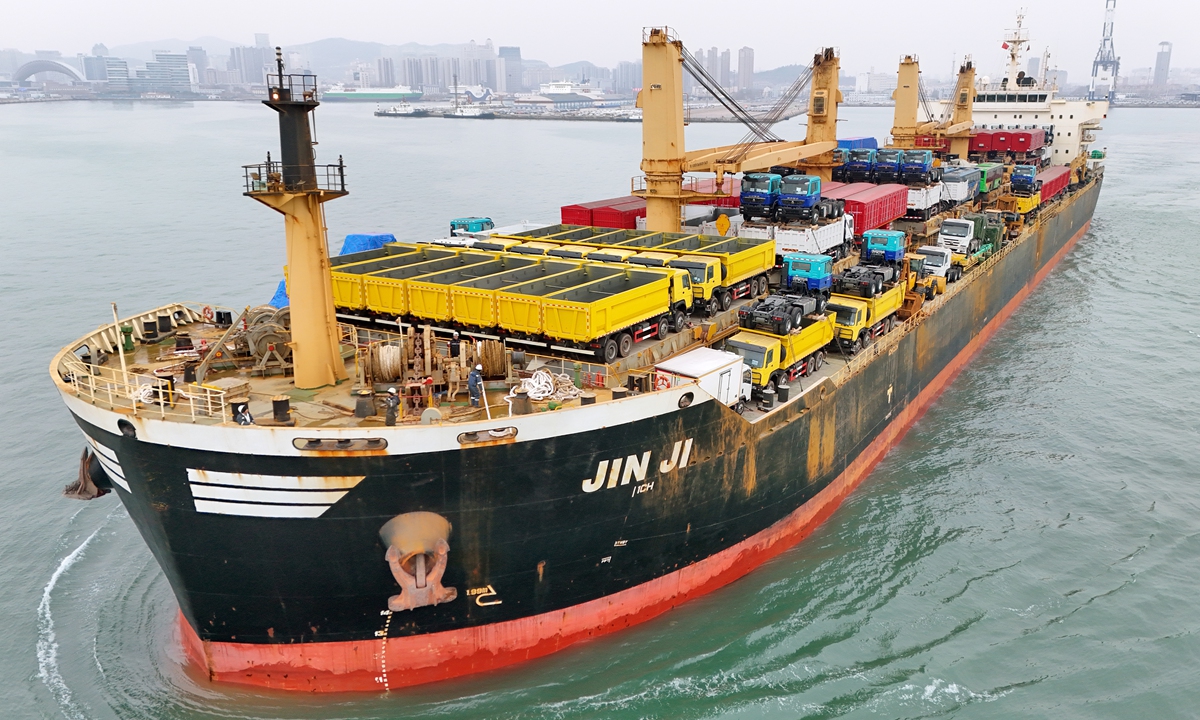
A China-Africa liner, loaded with Chinese-made vehicles, departs from Yantai Port in East China's Shandong Province for Cote d'Ivoire in Africa on January 14, 2026. Photo: VCG
Just four months into his posting in Beijing, Alhaji Mohamed Sarjoh Bah, the African Union's (AU) newly appointed Permanent Representative to China, already maintains a busy working schedule to deepen cooperation between China and Africa.This year marks the 70th anniversary of diplomatic relations between China and Africa and has been designated China-Africa Year of People-to-People Exchanges. Bah told the Global Times that the timing is "extremely important" and that he sees himself as present at a "historic moment."
The past few months have given the African envoy his first real taste of life in China. He was particularly struck by walking Beijing's streets, where he found himself constantly surrounded by electric vehicles - an impression that has stayed with him. "I've never owned an electric vehicle," he confessed, "but increasingly I think these are technologies that we need to be able to look at."
Bah comes from Sierra Leone and holds a PhD in International Relations. He has more than 20 years' experience in the area of peace, security and governance. Before joining the AU, he worked with the Center of International Cooperation at New York University, and within the AU, he once worked as the chief advisor for the AU Permanent Observer Mission to the UN in New York, and later served as director of conflict management within the Political Affairs Peace and Security Department of AU, according to the website of AU.
During the interview, he firmly rejected the smear from some Western media outlets and politicians that China is "exploiting" African resources. "We don't need anyone from outside of Africa to tell us what is good for us," he stated. "After 70 years of diplomatic ties with China, I don't think anyone should come and lecture us."
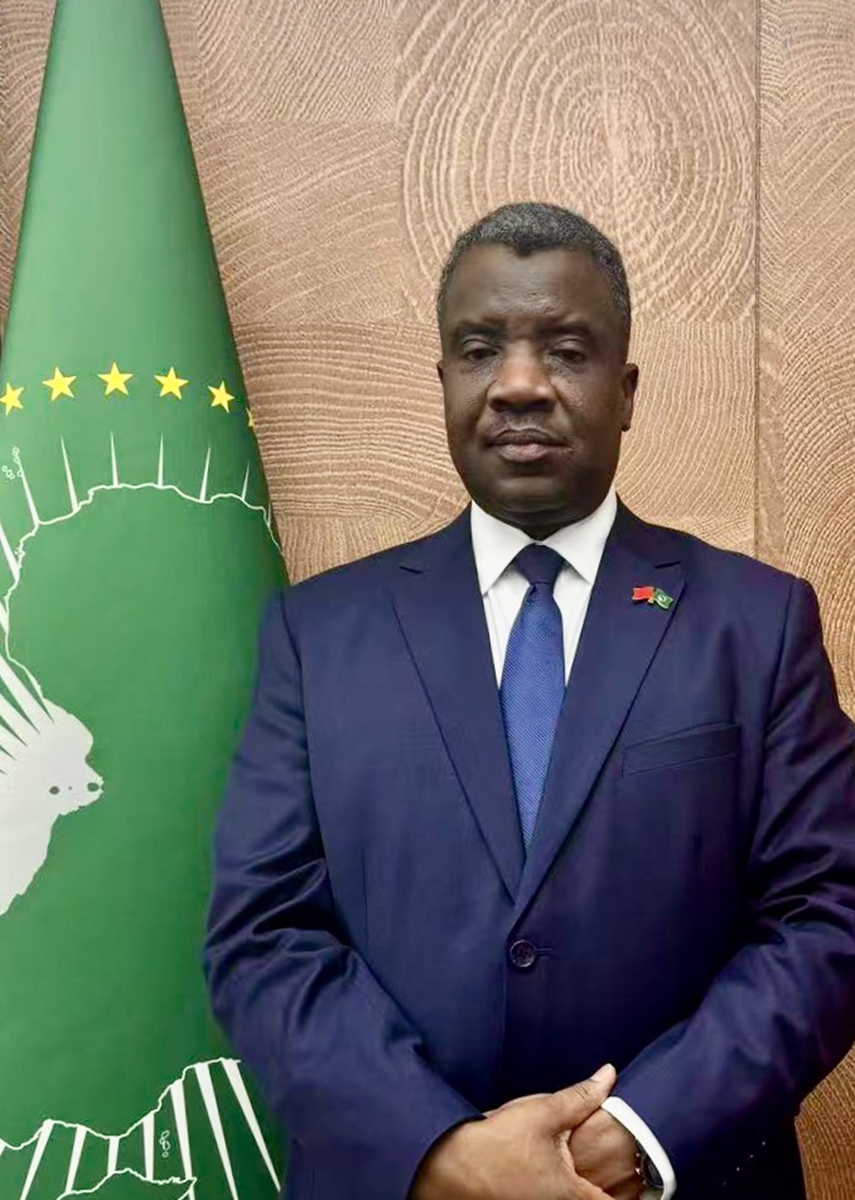
Alhaji Mohamed Sarjoh Bah Photo: Xie Wenting/GT
Sharing in China's growing prosperityThe African envoy stood among delegates and representatives at the opening of China's two sessions in early March. For a diplomat whose continent is racing toward its own 2063 vision, the sessions were more than ceremony - they offered a living blueprint. The 15th Five-Year Plan (2026-30), Bah believes can help Africa chart a steadier course.
"The two sessions bring together different aspects of Chinese society," Bah told the Global Times.
He was impressed by the sheer scale and depth of the deliberations. "If you look at the way it is organized, then you look at the details and the depth of the issues, the way they are discussed, the reports of the different committees, the diversity of the participants," he said.
"It tells you that it's an inclusive process… meant to come up with a clear roadmap for China over the next five years," Bah noted.
He watched policy move from grass-roots consultations to national strategy, then outward to engagement with neighbors and the wider world, including Africa. "For me, I look at these from the standpoint of Africa," Bah explained. "I see a lot of opportunities for us to learn from each other."
China's 15th Five-Year Plan mirrors key elements of the AU's second 10-year implementation plan of Agenda 2063, he noted. "There are a lot of opportunities for synergy, there are a lot of opportunities for coordination."
Four themes, he noted, resonated with him in particular: China's drive for self-reliance in science and technology, the centrality of people's well-being in every discussion, a confident opening-up to the world, and a serious attention on food, energy and security.
"If you don't have control over science and technology, you are terribly disadvantaged in the current global order," Bah said. "China's aspiration in that direction is something that we are watching very closely." The emphasis on opening-up, he believes, "opens the door for Africa… to partner and to trade and to invest and to share in China's growing prosperity."
Learning transition lessons firsthand
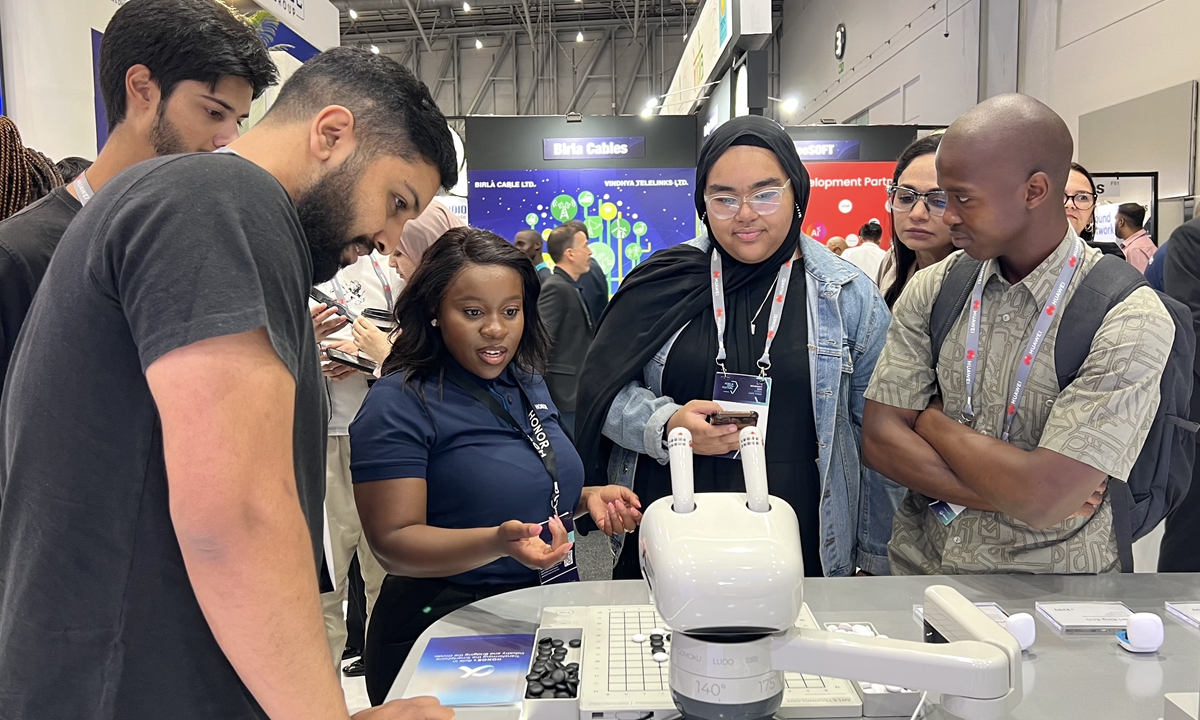
Attendees explore a Go-playing robot at the Chinese enterprise exhibition area during the 2025 Africa Tech Festival in Cape Town, South Africa, on November 11, 2025. Photo: IC
When asked about his take on "new quality productive forces," Bah offered a clear-eyed interpretation rooted in China's transformation. "China has moved from what it was 20 years or 25 years ago where it was doing mass production," he said. "Labor was considered cheap. That is no longer the China that we have in 2026."Instead, he sees a deliberate scaling-up of human resources, technology and artificial intelligence to produce goods that can compete anywhere. "High-quality production can only happen when you have a highly trained human resource workforce… teamed with technology and artificial intelligence." For Africa, the shift creates concrete openings. China now leads in renewable-energy technology; Africa holds vast sunlight, hydro and wind potential but lacks the know-how to harness it.
"China has the technology, Africa has the resources," Bah stated.
According to the African envoy, critical minerals could be an important field in the bilateral cooperation. "That is another area where China and Africa can collaborate so that it would be a win-win partnership for both sides."
Bah is already planning action: Later this year he intends to convene a high-level meeting in Beijing bringing African mining stakeholders and relevant Chinese players to draft a framework for managing these minerals together.
During the past months, Bah has traveled to Central China's Henan Province, and Hangzhou in Zhejiang Province. Each stop deepened his conviction that local-to-local cooperation is the next frontier.
In Henan, he toured an agricultural valley and what he saw astonished him. "It is highly impressive because what you see is high-quality research that will improve on the quality of the seeds," he recalled. Scientists there have developed varieties that grow year-round and produce high-quality crops, directly supporting China's food-security goals.
According to Bah, Henan's development story has moved him most so far. "It used to be an agricultural province, but now it has moved and diversified," he said, noting that it's important to learn from how Henan transitioned from being China's breadbasket to producing iPhones and other high-tech products.
The visit reinforced Bah's belief in province-to-state and city-to-city partnerships. "I am still new, having been here for four months, but I'm quite impressed," he admitted. "I see real opportunities at various levels - whether it is state-owned enterprises, whether it is at the provincial levels or even some of the big cities."
He said that he now plans to visit Shandong Province, where he will tour pharmaceutical plants, machinery and automotive factories. "We need to be able to produce drugs locally," Bah said, adding that he wants Chinese pharma partners to help African manufacturers.
Besides, Bah has already been in touch with the Beijing office of Chinese tech giant Huawei. When I change my phone, my next one will have to be a Chinese brand, said Bah with a smile. "It's a commitment I've made to myself."
China-Africa cooperation a key stabilizing force

Chinese tourists experience African tribal dances with Ugandan performers at the 2025 China (Guangdong) International Tourism Industry Expo in Guangzhou, South China's Guangdong Province, on September 13, 2025. Photo: VCG
The inheritance of China-Africa friendship, the stability of China's Africa policy and the solidarity of developing countries together are the reasons why Africa has been the destination of the Chinese foreign minister's first overseas visit each year for 36 years, said Chinese Foreign Minister Wang Yi during a visit to Africa in January 2026, the Xinhua News Agency reported.Wang said that China's domestic and foreign policies have remained highly stable, providing the world with much-needed certainty, and this consistency extends to China's engagement with Africa. Noting that China and Africa both belong to the Global South and share similar historical experiences and common aspirations, Wang added that with the 2.8 billion people of China and Africa united in solidarity and endeavor, they can overcome any difficulty or challenge, accelerate the pace of their shared path toward modernization, and contribute to a more equitable, cooperative, harmonious and stable world, Xinhua reported.
In an era of global economic uncertainty and rising protectionism, Bah sees China-Africa cooperation as a stabilizing force.
"China has stepped forward to help write the next chapter," Bah said.
This partnership, grounded in mutual respect, mutual benefit and solidarity, has stood the test of time because both sides share a clear vision and common goals. "Where there are challenges, we can recalibrate," Bah told the Global Times. "We are quite determined to continue on the path that we are on with China." Bah said he has drawn direct inspiration from China's rural-revitalization drive. According to him, Africa today mirrors China of 20-25 years ago: Rapid rural-to-urban migration, cities swelling while countryside services lag. China's current push to bring water, electricity, jobs and slower-paced living back to villages offers a roadmap.
"You can actually attract some people to move from the urban centers back to the rural areas," Bah observed. "This for me is something I'm paying very close attention to."
He also noted that technology transfer is already underway. African countries are importing Chinese electric vehicles, and the next step, he believes, will be local assembly and knowledge sharing.
In April, he will bring gather African ambassadors in Beijing to prepare for China's zero-tariff policy for all African countries with diplomatic ties, which will take effect on May 1. "China's market is huge, very lucrative," he noted, adding that African exporters must meet quality standards.
"We need to work on the quality infrastructure," Bah explained, "so that African products can find their way into the Chinese market."
To young Africans studying in China or watching from home, Bah summed up his four months of observation in a powerful message. "China rejected a status quo that left it weak and vulnerable," he said. By doing so, "it has transformed itself into the second-largest economy in the world."
He noted China's five-year plans provided clear direction and discipline. "If you want to learn one lesson from China… reject the status quo that makes you weak and vulnerable," he said. As his term in Beijing progresses, Bah's mandate is clear: to strengthen, consolidate and elevate the partnership to a truly strategic level.
"I am not here to be distracted by any commentary," he said. "We make the final decision on who our partners are." After 70 years of friendship, the direction is set - win-win cooperation not just in name, but in the real lives of people on both continents.
RELATED ARTICLES