GT Voice: Protectionism hurts US consumers but can’t diminish appeal of Chinese EVs
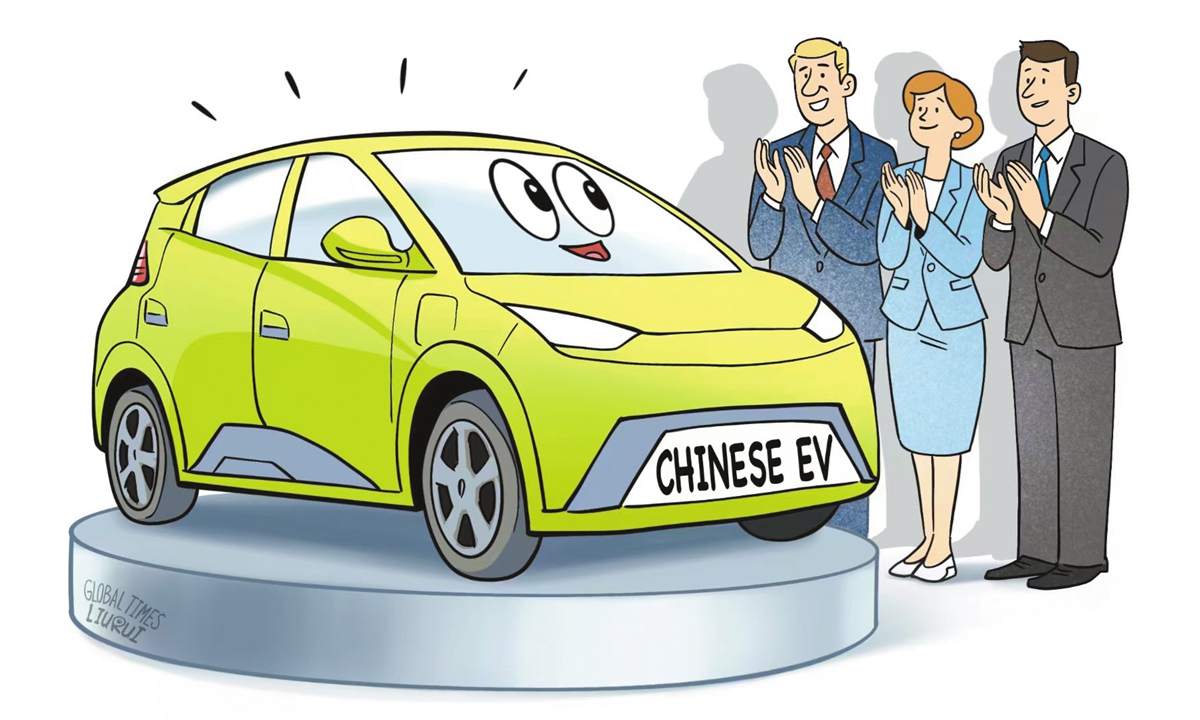
Illustration: Chen Xia/GT
As interest in Chinese electric vehicles (EVs) grows among American consumers, one fact is becoming increasingly clear: trade protectionism cannot block the appeal of truly competitive products.As the average price of a new car in the US approaches $50,000, more potential vehicle purchasers are open to buying cost-effective Chinese models, despite resistance from the industry, Reuters reported on Monday. The report cited a Cox survey of 802 US consumers who expect to buy a car in the next two years, which found that 49 percent of respondents rated Chinese cars as having very good or excellent value, with 40 percent saying they support the idea of Chinese auto brands in the US market.
Yet earlier this month, major auto trade groups submitted a letter urging the US government to keep Chinese carmakers out of the country, citing competitiveness concerns, according to another Reuters report.
On one side stands consumers' desire for affordable, high-quality products; on the other, interest groups seek to erect walls to protect their market shares. These opposing attitudes toward Chinese EVs lay bare the essence of US trade protectionism: a disregard for market demand and indifference to consumer interests. What is particularly striking is that, as the survey indicates, US consumer interest in Chinese EVs has emerged even though these vehicles are not yet available in the American market, underscoring the existence of a real and substantial demand for Chinese EVs among American consumers.
This demand stems from consumers' fundamental desire for reasonable prices, reliable quality, and greater choice. As average new car prices in the US continue to rise, placing increasing financial strain on ordinary households, Chinese EVs - increasingly popular around the world - have captured the attention of American consumers.
From Europe to Latin America, from Southeast Asia to the Middle East, a growing number of markets are opening their doors to Chinese vehicles, drawn by their quality and technological innovation.
The US imposed a 100 percent tariff on Chinese EVs in 2024, creating a high trade barrier that effectively restricts US consumers' access to Chinese EVs. Even though American consumers cannot yet purchase Chinese brands locally, they have come to recognize the value of these vehicles through various information channels. The message is clear: trade protectionism may erect tariff barriers and create obstacles, but it cannot distort genuine consumer demand, nor can it block the appeal of truly competitive products.
The resistance from the US auto industry reveals that, in defiance of market demand, vested interest groups are attempting to entrench market barriers. The direct consequence of such actions is a further constriction of American consumers' car-buying options. When affordable foreign products are shut out by tariff walls, consumers are left with limited choices - forced either to accept higher prices or to postpone their purchase plans. In either case, it is ordinary American consumers who ultimately bear the cost. Amid lingering inflationary pressures, artificially inflating the price of a major consumer product such as a car amounts to a steady erosion of people's purchasing power.
What deserves even greater scrutiny is the long-term cost of trade protectionism. Protecting domestic industries from competition not only deprives consumers of choice but also weakens the innovative drive of local industries. Experience has repeatedly shown that protected market environments tend to foster policy dependency, prompting companies to rely on political shields to preserve existing interests rather than commit resources to technological breakthroughs.
If the US auto industry continues to pin its hopes on policy protection rather than product innovation, the strategy may safeguard market share in the short term, but it risks widening the technological gap over the long run, ultimately leaving the domestic industry in an even more passive position.
In the global shift toward electrified and intelligent automobiles, it is important for policymakers in Washington to recognize that continuing to apply protectionism to the changing industrial reality harms the interests of American consumers. This strategy also risks causing the US to miss opportunities on the critical track of the global green transition.
When a substantial portion of potential car purchasers express support for or interest in Chinese brands, policymakers ought to listen to this grassroots voice and reassess the rationale behind their trade restrictions.
RELATED ARTICLES