ARTS / CULTURE & LEISURE
AI doesn’t favor arts or science; it demands hybrid talent
By Published: Mar 24, 2026 11:35 PM
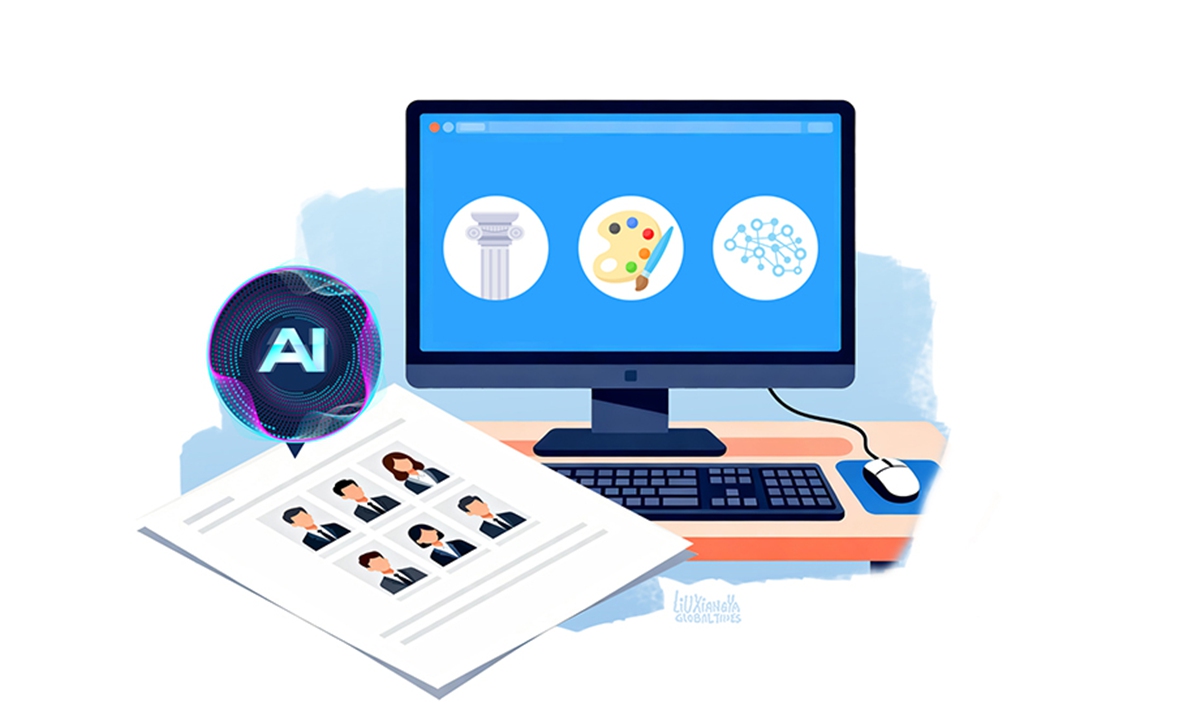
Illustration: Liu Xiangya/GT
In the 2026 Spring campus recruitment season, a shift has swept through China's job market. Nearly half of all positions now explicitly require AI literacy, extending far beyond tech roles to operations, design and marketing, the Guangming Daily reported.Headlines blare that liberal arts graduates are now the most sought-after hires, with top firms offering five-figure salaries, reawakening a decades-old debate over whether discipline of arts or science holds the key to future success.
Some experts told the Global Times that this is neither a win for the liberal arts nor a setback for STEM (science, technology, engineering, and mathematics) - what we are seeing is the end of rigid disciplinary labels, and the unstoppable rise of interdisciplinary, hybrid talent.
The debate over "liberal arts superiority" stems from certain misunderstanding of what employers actually value.
AI has evolved far beyond a computational tool. It now navigates emotional interaction, ethical judgment and social context, fields where humanistic thinking shines. And these tasks naturally require thinking training in disciplines such as linguistics, philosophy, psychology, and communication studies. This has spawned coveted new roles: AI narrative designers, human-AI ethics consultants and algorithm governance specialists. Yet these positions do not reward a mere liberal arts diploma. Instead, they reward rigorous, critical humanistic capacity.
Wang Xianhua, dean of the School of Humanities at the Shanghai University of Finance and Economics, told the Global Times on Tuesday that the myth that any liberal arts graduate can guide AI ethics is hollow comfort.
"A history or philosophy major does not automatically grant deep ethical judgment or emotional insight," he argues. "Without rigorous academic training and layered critical thinking, liberal arts input in AI risks becoming shallow moralizing that is useless at best, harmful at worst."
Wang further explained that the market is not chasing the label of "arts graduate," but the ability to interpret humanity, define purpose and ask the questions AI cannot. This is not liberal arts triumphing over science; it is humanistic literacy becoming non-negotiable for all.
In addition, if you draw the conclusion that "science students are going to be eliminated," you are merely falling into another extreme binary narrative. Pure coding skills, once the backbone of engineering, are increasingly automated by AI itself. The most valuable engineers today are those who pair technical mastery with human awareness: developers who build stable AI systems and anticipate their social impact, data scientists who interpret numbers and understand cultural bias.
A successful AI product requires both robust algorithms and empathetic design; technical skill without humanistic judgment creates tools that function but fail people.
In short, STEM's future no longer lies in specialization alone, but in the fusion with the humanities.
This mismatch exposes a deep flaw in higher education: decades of disciplinary silos have left liberal arts students adrift from technology and STEM students disconnected from ethics.
Zhang Peng, an associate professor at Nanjing Normal University, diagnoses the phenomenon as a structural disconnect. "Liberal arts education has become trapped in closed disciplines, prioritizing employment statistics over critical thinking," he told the Global Times. "Universities teach replaceable skills rather than the sharp humanistic insight the market craves."
From a sociological perspective, Yang Lichao, a sociologist at Beijing Normal University, told the Global Times that this debate rests on some fallacies, including the binary trap of framing arts and science as rivals while ignoring knowledge's inherent interconnectedness.
In addition, many people hold the static belief that university education can sustain a lifelong career, even as AI accelerates knowledge obsolescence.
"AI is dismantling these old rules. Basic hard skills, including coding, writing, data analysis, will soon be as universal as office software. The only irreplaceable advantage will be hybrid capability, such as cross-domain learning, critical questioning, complex problem-solving and ethical reasoning," she said.
Yang predicts a new social elite defined not by majors or diplomas, but by well-rounded competence, which is deep expertise in one field paired with broad literacy across others.
"The solution is not to pick sides, but to tear down the walls between them," Yang said, adding that forward-thinking universities are already launching "new liberal arts" and "new engineering" programs, blending AI with management, economics and ethics.
Some universities are leading with interdisciplinary micro-majors, mandatory tech literacy for arts students and humanities modules for STEM learners. Businesses must follow, designing recruitment and training that reward integration over narrow specialization. For individuals, the path is clear: reject the limits of "arts" or "science" labels, and build a skill set that speaks both human and machine, Yang suggested.
The so-called liberal arts vs. science debate fueled by AI is a distraction. Technology does not favor one discipline over the other, it punishes rigidity and rewards adaptability.
In an era where AI executes tasks, humans define meaning. The future belongs not to those who carry a single label, but to those who can push the boundaries of technology and humanity into a powerful capacity.
The author is a reporter with the Global Times. life@globaltimes.com.cn
RELATED ARTICLES