Will the development of emerging industries come at the expense of public welfare?: Global Times editorial
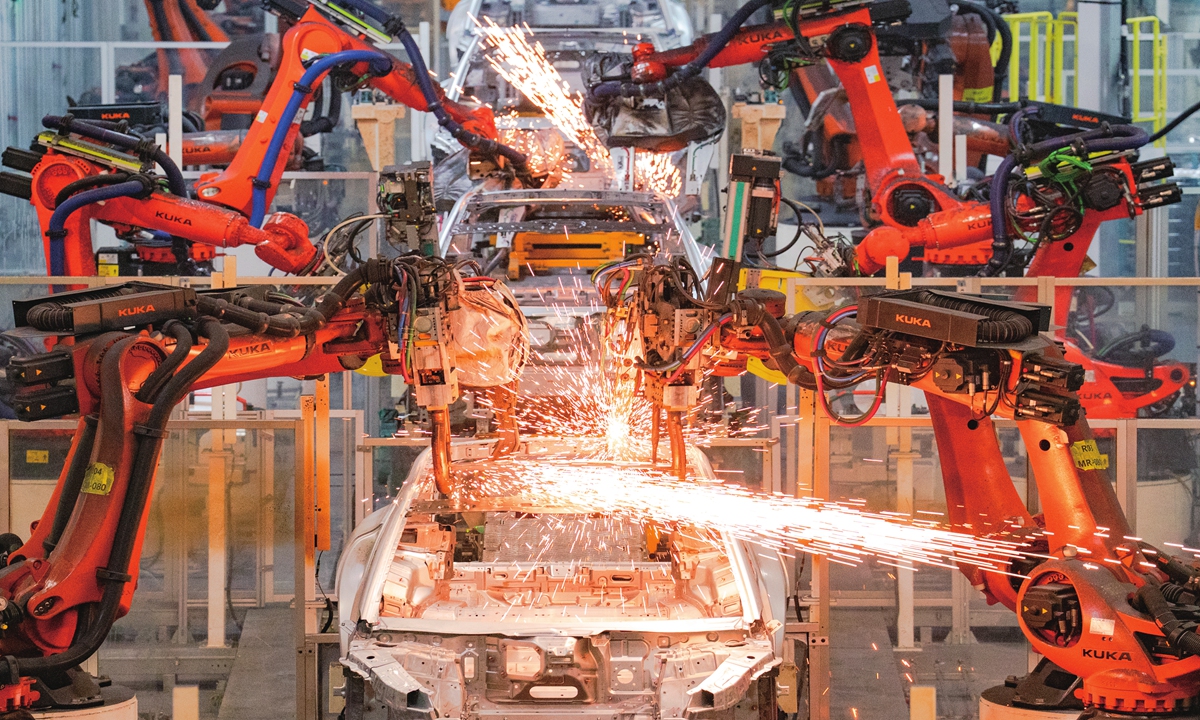
Robots perform welding operations at the BAIC New Energy Super Factory in Beijing on December 12, 2025. Photo: VCG
Editor's Note:Currently, China's economy is steadily advancing along the path of high-quality development, even as domestic and international circumstances become increasingly complex. Some Western media outlets, due to misunderstanding or bias, have repeatedly questioned or even distorted China's economic development. Accordingly, the Global Times has launched the "Q&A on China's Economy" column to publish opinion pieces to present facts and clarify perceptions.
As China's emerging industries - such as artificial intelligence (AI), digital technologies, automation and semiconductors - flourish, a rather peculiar narrative has surfaced. It claims that national resources are being overly concentrated in high-tech sectors, crowding out the livelihood economy and even "triggering a downward economic spiral." Such an argument, if not an attempt to deliberately mislead and sow confusion, at least reflects a failure to grasp the profound underlying mechanism of the new wave of technological revolution and industrial transformation. It artificially severs the dialectical relationship between a strong nation and a prosperous people.
People often say that what ordinary people seek is nothing more than security and well-being. This phrase makes clear that security underpins and enables well-being. Likewise, for a country without national security and industrial self-reliance, people's well-being would be like water without a source or a tree without roots. Imagine if China were entirely dependent on imported chips - any external supply disruption would threaten the operation of smartphones, home appliances, automobiles, and even the entire digital infrastructure of society. If the lifeline of energy security were controlled by others, fluctuations in international energy prices would pose a direct threat to domestic industry and people's livelihoods.
Therefore, vigorously developing strategic emerging industries such as semiconductors and aerospace is not only about seizing the initiative in the new technological revolution, but also about preparing a form of "basic insurance" for the peaceful lives of more than 1.4 billion people. Especially amid profound global changes unseen in a century, a stable, secure and predictable domestic industrial base is both a precious resource in turbulent times and the most universal and fundamental form of public welfare. Without such macro-level stability, any micro-level improvement in livelihoods would be unsustainable.
But are emerging industries really absorbing resources excessively and crowding out public welfare? First, these industries are not black holes that only consume resources without generating output. Rather, they possess strong industrial linkage and spillover effects. Some analyses show that one job in the semiconductor industry can generate 5.7 additional jobs in the downstream economy. Meanwhile, a large chip manufacturing project can stimulate upstream equipment, materials and software suppliers, as well as downstream packaging, testing and application development.
While the number of jobs at a single high-end manufacturing plant may be limited, the number of jobs it generates in peripheral high-value-added service sectors - such as R&D and design, data services, inspection and testing, supply chain management, modern logistics, and legal services - is by no means insignificant. As can be seen, these high-tech industries have not only created a large number of jobs at various levels, but have also fostered entirely new and more resilient industrial chains. This represents a profound transformation and upgrade of the employment structure, rather than a simple disappearance of existing jobs.
Furthermore, the development of China's technology sector is, in itself, a process of technological inclusivity. China's AI, semiconductor and high-end manufacturing sectors have been deeply rooted in China's vast market since their inception. Capital is primarily concentrated in front-end R&D and infrastructure development. Once their technologies mature, they empower all industries and benefit the general public at extremely low marginal costs.
For example, AI-assisted diagnostic systems have significantly enhanced the diagnostic capabilities of primary-care hospitals, while AI-powered personalized learning systems are providing high-quality educational resources at a lower cost. Government cloud platforms based on domestically produced chips and operating systems have improved the efficiency of grassroots administrative services, making it more convenient for citizens to conduct business; smart city initiatives have made transportation smoother and urban governance more refined… Cutting living costs, expanding public services, and multiplying consumer options all vividly show how the dividends of emerging industries are permeating every aspect of people's daily lives.
The pressures currently felt by some members of the public do not stem from technological change itself, but rather from issues of skill retraining and the distribution of benefits during the transition from old to new growth drivers. What we should do next is not to halt investment in the technology sector, but to build more agile and equitable transmission mechanisms and distribution systems, allowing the benefits of technology to permeate faster, wider, and deeper.
We see that from the central to local levels, a series of policies are being intensively implemented: in the face of technological change, China is vigorously promoting initiatives to enhance digital literacy and skills among the entire population, helping more workers bridge the digital divide; major projects such as the "East Data, West Computing" initiative are enabling more small- and medium-sized enterprises and individual developers to leverage high-quality data and computing power for innovation and entrepreneurship; through policies such as special funds and tax incentives, leading enterprises are being encouraged to build more open innovation platforms and supply chain systems; and more robust unemployment insurance, medical insurance, and pension systems are being established to create a more solid social safety net … All of this touches the lives of each and every one of us.
"National strength" and "people's prosperity" have always been dialectically unified and mutually reinforcing. Every investment China makes today in cutting-edge technology is building up momentum for the broad improvement of people's well-being in the future. The giant vessel of Chinese modernization, carrying the dreams of over 1.4 billion people, has gained the immense strength to weather storms and sail steadily into the future precisely through the process of overcoming one technological challenge after another and forging emerging industrial clusters one by one.
RELATED ARTICLES