HKSAR Security Bureau tells GT that police must obtain court warrants before accessing devices, rejecting foreign media smears
By Published: Mar 26, 2026 01:04 PM

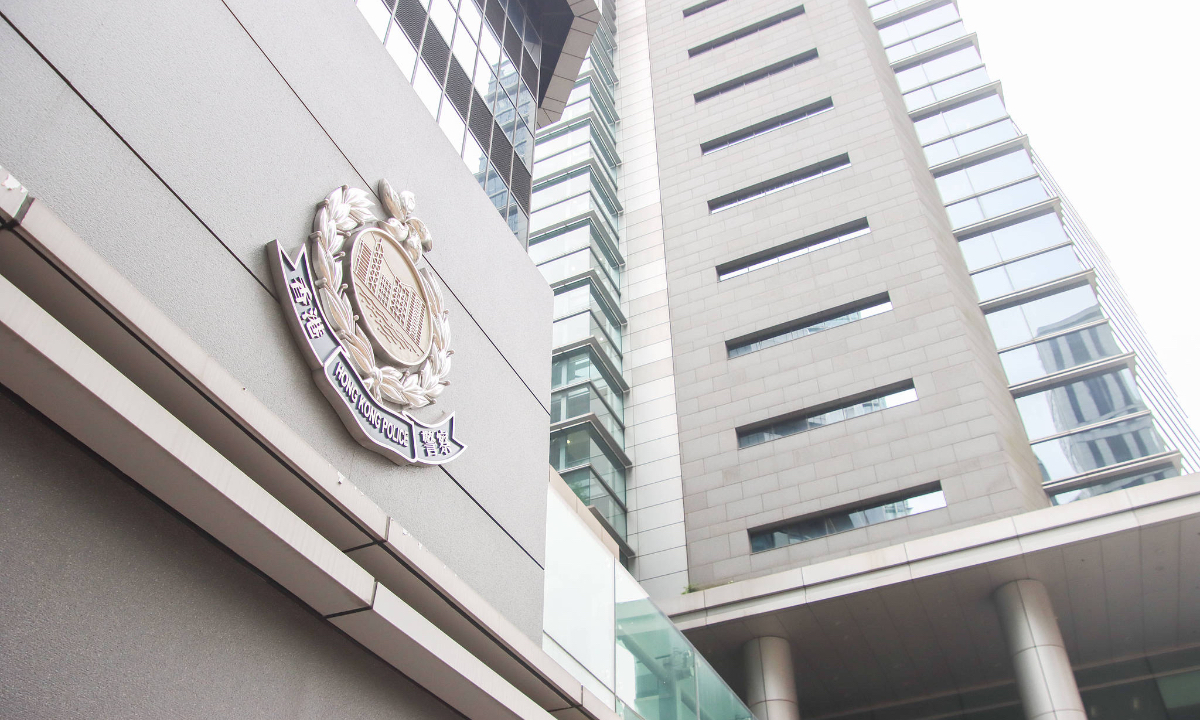
Headquarters of the Hong Kong Police Force Photo: VCG
In response to foreign media reports claiming that Hong Kong police can now demand phone or computer passwords from people suspected of breaching the National Security Law (NSL) for Hong Kong, portraying the new rules as a "further crackdown on dissents," a spokesperson from the Security Bureau of the Hong Kong Special Administrative Region (HKSAR) told the Global Times on Thursday that the reports are misleading, noting that law enforcement officers must apply to the court for a warrant and obtain judicial approval before searching electronic devices such as mobile phones.Regarding certain erroneous reports by individual foreign media outlets, the claim that revised rules to the NSL for Hong Kong would allow Hong Kong police to randomly demand pedestrians to hand over their mobile phones and provide passwords is completely false and misleading, the Security Bureau firmly clarified, the spokesperson said. "We strongly condemn such selective, sensationalized reporting that attempts to create panic with exaggerated and inaccurate headlines, and that seeks to smear and malign the HKSAR's work in safeguarding national security."
The spokesperson noted that many Western countries have similar laws or rules on police obtaining information from electronic devices during investigation.
Some foreign media outlets including the Guardian, BBC, the Australian Broadcasting Corporation and the Al Jazeera reported the new rules under the NSL for Hong Kong. BBC claimed those who refuse to cooperate with the law enforcement personnel could "face up to a year in jail and a fine of up to HK$100,000 ($12,700), and individuals who provide false or misleading information could face up to three years in jail."
The Guardian claimed this move aims to "further crackdown on dissent."
Many common law jurisdictions authorize law enforcement officers, during investigations and evidence collection, to require relevant individuals to provide means of decrypting electronic devices, the spokesperson said, noting that examples include the UK's Regulation of Investigatory Powers Act 2000, Australia's Crimes Act 1914, New Zealand's Search and Surveillance Act 2012, and Singapore's Criminal Procedure Code 2010.
Those foreign media reports came after some new amendments to a bylaw under the NSL for Hong Kong that the government gazetted on Monday.
In a legislative council session on Tuesday, Secretary for Security Chris Tang pointed out that law enforcement officers must, on national security grounds, apply to the court for a warrant under oath, and may only search the relevant electronic devices once the court has granted approval. "It is not the case that officers can casually demand citizens hand over their phone passwords on the street," Tang said, according to local media reports.
For example, if police are executing a search at a premises and someone inside blocks the door with an object, they may be in violation of the offense of obstructing a public officer. Therefore, the newly introduced penalties are entirely reasonable. Similar provisions exist in many other jurisdictions, including the UK, Australia, New Zealand, Ireland, and Singapore, Tang said, per RTHK.
In fact, prior to the amendment, the rules already authorized law enforcement officers, under general circumstances, to search electronic devices containing evidence of offenses that may endanger national security, provided they obtained a court-approved warrant. This includes the power to bypass or unlock such devices, the spokesperson said.
The current revision merely authorizes law enforcement officers, when exercising those powers, to require a "specified person" to provide decryption methods, thereby enabling officers to carry out the searches. It does not constitute any additional intrusion into freedom of communication or the secrecy of communications, the spokesperson noted.
Although the BBC report noted that law enforcement officials in many parts of the world have the authority to demand access to electronic devices as part of criminal investigation, it accused the NSL of covering "vaguely defined" offences.
"Some foreign media outlets deliberately conceal the legal boundaries and procedural constraints of the law, distorting law enforcement measures targeting criminal suspects as restrictions imposed on the general public. At its core, this amounts to using the issue of rule of law to interfere in Hong Kong affairs and to discredit the successful implementation of 'One Country, Two Systems,'" Louis Chen, a member of the Election Committee, told the Global Times.
Hong Kong's rule of law is solidly grounded, and law enforcement is carried out strictly in accordance with the law. It safeguards national security and fully protects citizens' legitimate rights while maintaining normal social order, Chen said.
"Any biased smear or sensationalism cannot change the fact that Hong Kong has moved from chaos to governance and is on the path toward long-term stability," he added.
RELATED ARTICLES