China unveils urban warfare drill featuring latest generation of robotic wolf units
By Liang Rui and Published: Mar 26, 2026 05:00 PM

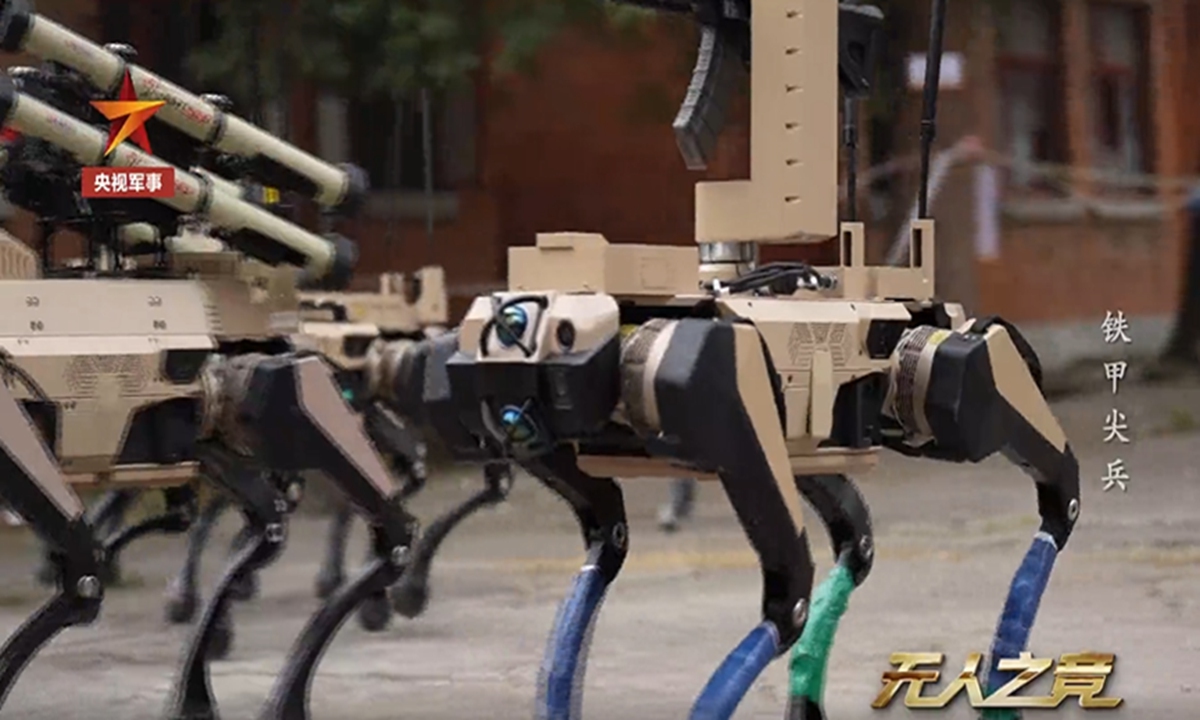
The latest-generation robotic wolf units conduct urban combat drills. Photo: Screenshot from the military channel of CCTV News
An official media report on Thursday revealed an urban warfare drill featuring the latest generation of robotic wolf units, describing them as having "stronger bodies, smarter brains, and more combat-ready capabilities."
A Chinese military affairs expert told the Global Times that such unmanned systems can take on high-risk frontline tasks, enhance real-time battlefield awareness, and improve both operational flexibility and psychological deterrence in urban warfare.
Automation Research Institute Co., Ltd. of China South Industries Group Corporation has independently developed a new-generation robotic wolf pack system, capable of carrying a wider range of weapon payloads, including micro-missiles and grenade launchers, enabling effective fire suppression against targets, according to the CCTV News.
Based on mission roles, the robotic wolves are categorized into reconnaissance units, strike units, and support units.
Compared with the previous generation, the new models feature significantly enhanced stability and mobility. They can traverse uneven rubble at speed, reaching a top speed of 15 kilometers per hour. This level of mobility allows them to operate across urban areas, ruins, shorelines, and sandy terrain with ease. With 12 degrees of freedom in their limb joints - mimicking real wolves - they are highly agile and capable of switching gaits dynamically. Even while carrying loads of up to 25 kilograms, they can easily overcome obstacles as high as 30 centimeters, thanks to improved motor power. This adaptability enables them to charge uphill in mountainous terrain or maneuver through urban ruins, achieving near full-spectrum operational coverage, said the CCTV News.
The robotic wolf pack can also conduct coordinated decision-making, with each unit sharing real-time sensor data to form a common operational picture. This enables autonomous collaboration, joint assessment, and synchronized action, the CCTV News said.
Footage showed a coordinated urban combat scenario involving both aerial and ground units. Upon reaching the target area, two reconnaissance units worked together to map the environment and transmit the data to a triple-screen command terminal. This command system serves as the operational hub of the wolf pack, capable of integrating frontline data in real time and coordinating multiple robotic units - as well as aerial drones - to enable joint air-ground operations.
In actual operations, robotic wolves typically perform autonomous target recognition and aiming, with human operators authorizing engagement. Depending on mission requirements, they can also be equipped with different weapon payloads, reported the CCTV News.
Another report published by the military channel of CCTV News on Thursday revealed that the system has now entered mass production.
When discussing the significance of deploying robotic wolf systems and other unmanned equipment in urban warfare, their value can be understood across several key dimensions, Zhang Junshe, a military affairs expert, told the Global Times on Thursday.
Urban combat is highly complex, often involving concealed firing positions, explosive devices, and confined spaces. Direct entry by soldiers carries substantial risk. Unmanned systems like robotic wolves can enter hazardous areas first to conduct reconnaissance, probe enemy fire, and carry out assault missions, effectively assuming high-risk roles in place of human troops and significantly reducing casualties, Zhang said.
These platforms can be equipped with radar, thermal imaging, and acoustic sensors, enabling real-time data collection and a three-dimensional battlefield picture that provides commanders with accurate intelligence for decision-making, said Zhang.
They also surpass the mobility limitations of conventional equipment in urban environments, offering greater tactical flexibility, the expert said. Moreover, their unpredictable movement and firepower can impose psychological pressure on adversaries, undermining morale, combat effectiveness, and decision-making capacity.
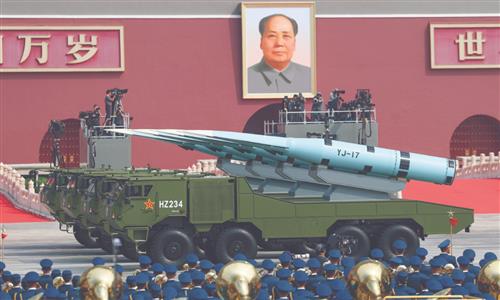
At China's V-Day military parade to mark the 80th anniversary of the victory in the Chinese People's War of Resistance Against Japanese Aggression and the World Anti-Fascist War in September 2025, robotic wolves were featured in the land-based unmanned combat unit that marched in review.
The mature application of unmanned systems relies on robust information-based networked combat systems and strong anti-electronic interference capabilities. China has invested heavily in these areas, achieving operational readiness. China's land-based unmanned combat technology now ranks among the world's best, military affairs expert Wang Yunfei told the Global Times in a previous interview.
RELATED ARTICLES