ARTS / ART
Running enthusiasts rethink hidden risks of overtraining
When discipline meets limits

A photo captures a person jogging by a river on a sunny day. Photo: VCG
On a park track in the early morning, pace alerts chime one after another. Some runners glance down at their watches, while others have just logged their run and are easing into a cooldown. As usual, the track is sparsely populated, and the rhythm is steady and routine.Beyond the track, however, a piece of news began spreading rapidly across Chinese social media and among running circles lately: Zhang Xuefeng, an education content creator with over 26 million followers on Douyin (Chinese version of TikTok), had died of sudden cardiac arrest.
According to his personal social media account, just two days before the incident, he had logged a 7-kilometer run; his total mileage for the month had reached 72 kilometers.
Training rethink
The incident quickly drew widespread attention online. Posts with strong emotional overtones, such as a post titled "Breaking: a 'major shock' in the running community" and "Is marathon running about health - or borrowing against your life?" began to circulate on China's lifestyle-sharing social media platform Xiaohongshu, or RedNote.
"Among runners I know, people have repeatedly started bringing up words like 'sleep,' 'fatigue,' and 'workload,'" Guo Xiaowei, a Marathon participant based in Beijing, told the Global Times. "Some believe it's not that you shouldn't run, but it's that you shouldn't run in that condition."
"For many urban runners, running is no longer just an exercise; it's also a way to relieve stress and maintain a sense of order," Guo said.
Guo noted that many runners are beginning to rethink their training habits, especially the tendency to treat running as a way to offset long working hours and a lack of rest.
"In the past, people like me focused a lot on mileage, pace, and consistency. Today, more are talking about whether they are well-rested before heading out," he said. "There's also more awareness that pushing through fatigue or discomfort is not discipline, but a potential risk."
The conversation has since shifted toward a deeper examination of the causes and implications, with users debating potential health risks associated with running and its suitability for different individuals.
"Whether it is safe to exercise under conditions of overwork has become a new focal point of discussion in the running community," Guo added.
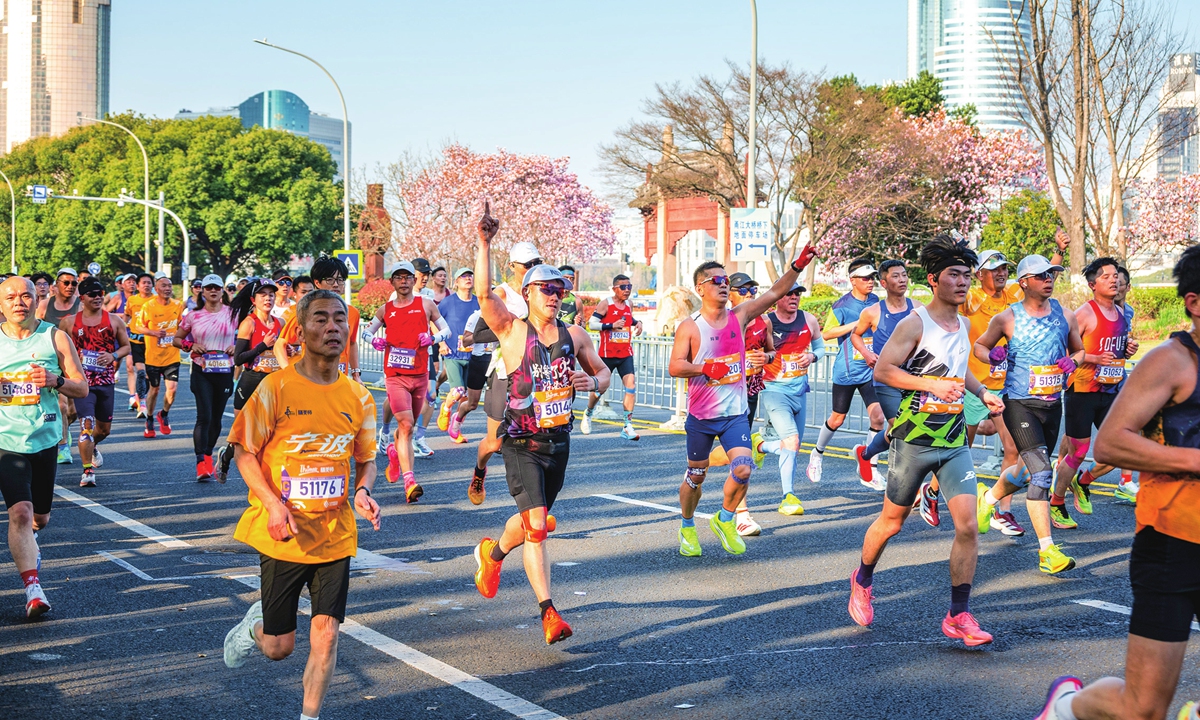
Runners take part in the 2026 Ningbo Marathon in Ningbo, Zhejiang Province. Photo: IC
Physiological limitsSome runners like Guo have begun to shift the focus away from running itself, instead pointing to the combination of overwork, sleep deprivation, and improper training as a key concern.
"Continuing to train while sleep-deprived or physically unwell is more concerning than simply 'running too much,'" Li Ziyao, a biomedical PhD from Hong Kong Polytechnic University, told the Global Times.
In Li's view, it is precisely the repeated application of training stress under conditions of insufficient recovery that turns an otherwise manageable activity into a potential risk amplifier.
"Sudden cardiac death often occurs in people who appear otherwise healthy, with multiple factors typically at play," he noted.
"Chronic sleep deprivation keeps the sympathetic nervous system in a heightened state, impairing the body's ability to regulate heart rate and blood pressure. Engaging in high-intensity exercise under such conditions may further increase the risk of arrhythmia," Li said. "In other words, the question is not whether to exercise, but under what condition."
This shift in thinking is influencing running-related content.
Some runners have begun to move away from emphasizing mileage, pace, and daily check-in to focusing more on recovery, heart rate management, and listening to bodily signals.
Recovery balance
Health risks associated with running are not caused by the activity itself, but by repeatedly placing high-intensity demands on a body that has not fully recovered.
Luo Chaofan, a rehabilitation therapist with China's National Health Commission, told the Global Times that such incidents are often the result of underlying cardiovascular conditions combined with multiple triggering factors. From a physiological perspective, some individuals may already have atherosclerosis in their coronary arteries.
According to Luo, during exercise, the inner lining of blood vessels can be damaged, leading to clot formation, which may block blood flow, trigger a myocardial infarction, and ultimately result in cardiac arrest.
"In many cases, it's not a single cause, but a combination of factors," Luo said. Chronic sleep deprivation and excessive fatigue keep the body in a prolonged state of stress; adding high-intensity exercise on top of that significantly increases the risk.
"This is especially true in cold environments, where blood vessels constrict more noticeably. Sudden shifts between cold and heat can increase the likelihood of vascular spasms or even rupture," he noted.
Luo advises that individuals with cardiovascular or cerebrovascular conditions, or related risk factors, should strictly control exercise intensity, generally keeping it at a moderate level.
"Adequate sleep is essential, and exercise should only be undertaken when one is in a good physical and mental state," he said. "For those with known cardiovascular issues, training plans should be developed based on professional medical assessment."
"There's no magic solution - the key is to listen to your body," Luo emphasized. If symptoms such as chest tightness or unusual fatigue occur during exercise, one should seek medical evaluation rather than pushing through.
From a broader perspective, Zhang's case highlights a shift in how urban health is being reconsidered.
As chronic sleep deprivation and disciplined exercise routines coexist, the body's limits are often overlooked.
For many, what needs to be rebuilt is not just an exercise habit or preference, but a sustainable balance between work, rest, and the body's natural rhythms.
RELATED ARTICLES