EU to set up customs authority in France ahead of small parcel taxes; move to raise consumer prices: Chinese expert
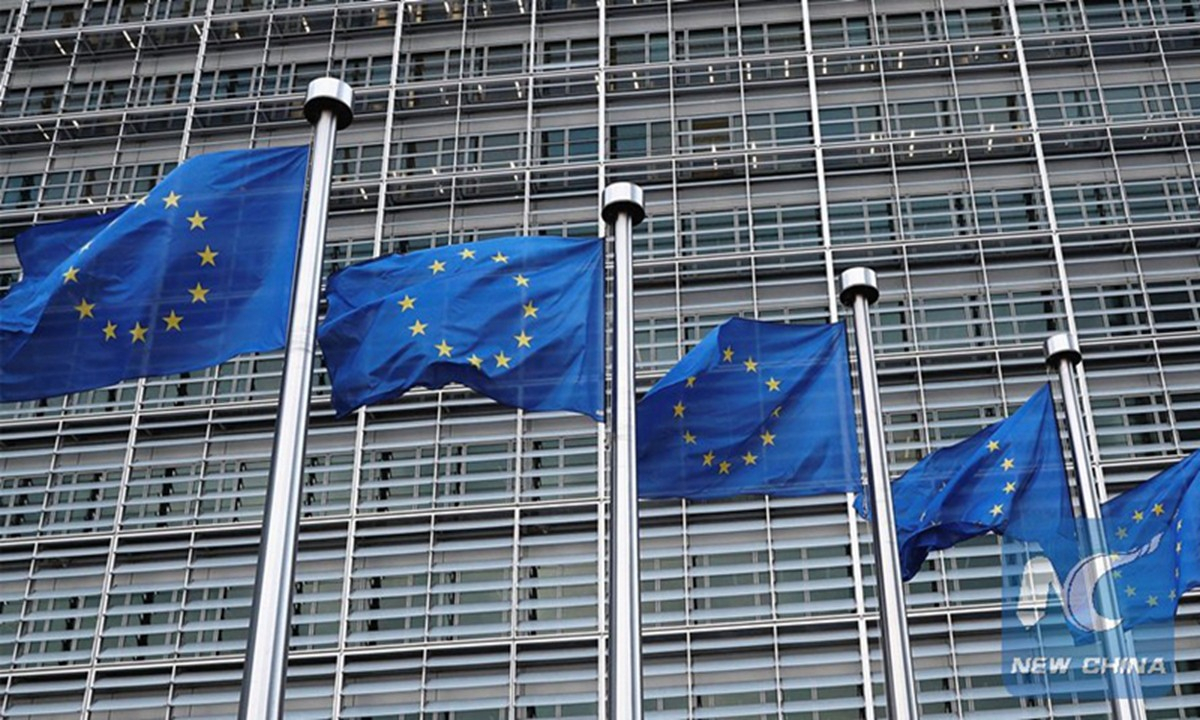
The European Union flags in front of EU headquarters in Brussels, Belgium. Photo: Xinhua
For years, European consumers have been enjoying cheaper products shipped directly from China and other countries by e-commerce platforms, thanks in part to tax exemptions on small parcels; however, EU authorities are moving to end that. In the latest development, the Council of the EU and the European Parliament announced that they had selected Lille, a city in France, as the host city for the future EU customs authority (EUCA), which reportedly will help harmonize the bloc's customs rules and tackle an influx of packages from China.
In China, analysts slammed the EU's move as another step toward growing protectionism in the bloc, that they say will not only undermine bilateral cooperation but will also harm European consumers by artificially raising prices even as they are already facing surging costs of living. Chinese officials have also called on the EU to abide by the principles of market economy.
In a press release on Wednesday, the Council of the EU said that the establishment of the new authority forms part of the work to reform the EU's overall customs framework so that it can deal with the significant pressure arising from increased trade flows, fragmented national systems, the rapid rise of e-commerce and shifting geopolitical realities.
While the press release did not mention specific trading partners, some Western media outlets have linked the move to growing shipments of small parcels from China to the EU. Bloomberg claimed that the EU to set up the new customs agency in Lille, France, "to help harmonize the bloc's rules and tackle an influx of cheap packages from China."
Reuters also claimed that the EU does not apply customs duty on parcels valued at less than 150 euros ($173.85), which has fueled rapid growth of online shopping platforms such as Shein, Temu, and AliExpress, which send consumers packages direct from China.
The Global Times has reached out to the Chinese platforms for comment, but has not received a response as of press time on Thursday.
Chinese analysts have slammed the EU's latest move, saying that it equates to trade protectionism that not only violates WTO rules and market principles, but will also drive up the cost of living for European consumers, who are already struggling with surging energy prices triggered by rising Middle East geopolitical tensions.
The establishment of the customs office, which will pave the way for making the duties on small parcels a permanent measure, has gone against the EU's self-proclaimed support for free trade and openness, Cui Hongjian, a professor at the Academy of Regional and Global Governance at Beijing Foreign Studies University, told the Global Times on Thursday.
The establishment of the EUCA comes ahead of the EU's plan to impose a temporary levy of 3 euros ($3.47) on small parcels starting in July, according to a Bloomberg report, which noted that permanent customs duties "will kick in two years after that, once a new EU customs data hub is in place."
Cui pointed out that such a move would undermine what has been a win-win, mutually beneficial collaboration, under which small commodities from Chinese e-commerce platforms - taking advantage of their manufacturing and logistics networks - help the Europeans to cut household spending.
Underscoring high demand among EU consumers for these affordable packages, in 2025, 5.8-billion-euro worth of low-value parcels entered the EU, an increase of more than four times compared with 2022 and a 20 per cent jump on 2024 alone, with nine out of 10 coming from China, the Financial Times reported, citing European Commission data.
Dong Yifan, an associate researcher at the Institute of Country and Regional Studies at Beijing Language and Culture University, told the Global Times that considering the EU's dual challenges of weak economic growth and high inflation, even if the EU imposed taxes on Chinese parcels, it would remain difficult to disrupt the trade patterns shaped by market forces, or to significantly alter European consumers' strong preference for high-quality, affordable Chinese goods.
Notably, a senior EU official has also admitted in recent days that the planned EU tax on small parcels would not stem the flood of Chinese goods entering the bloc, according to a Financial Times report.
Still, the EU's move has drawn criticism from the Chinese side. In November, asked to comment on reports that EU states had agreed to remove a bloc-wide duty exemption on low-value orders, which would hit retail giants like Temu and Shein and is a move seen as helping to tackle the flood of cheap Chinese imports into the EU, Lin Jian, a spokesperson for the Chinese Foreign Ministry, said that "we hope the EU will abide by the principles of market economy and provide a fair, transparent and non-discriminatory business environment for companies from China and other countries."
RELATED ARTICLES