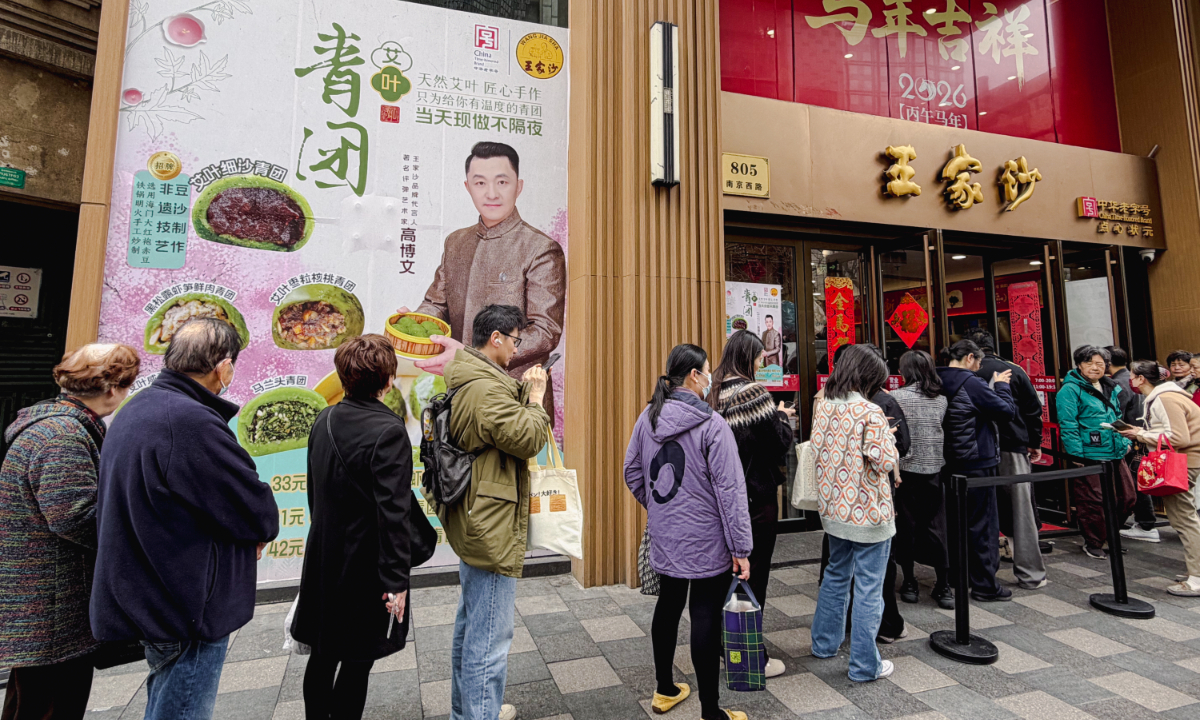
As the Qingming Festival approaches, a long queue of customers forms outside the main store of Wangjiasha on West Nanjing Road, waiting to buy qingtuan on March 27, 2026, in Shanghai. Photo: VCG
As temperatures rise across China, a wave of spring-limited delicacies — ranging from fresh wild vegetables at local markets to elaborate spring feasts and viral limited-edition snacks — has swept through cities and towns.
These seasonal flavors and spring-themed elements have become a key driver of consumer interest and spending, forming a vibrant spring consumption economy, a Chinese expert said.
The arrival of spring has fueled enthusiasm for seasonal vegetables on dinner tables. As the season unfolds, spring vegetables are hitting the market in batches, with more varieties and ample supply. Consumers are eager to pick up these seasonal treats, savoring the one-of-a-kind freshness that only spring can bring.
Data from Beijing Xinfadi, the capital's largest produce market showed that the daily supply of spring vegetables is about 800 tons, accounting for 4 percent of the total vegetable trading volume. Zhang Yuelin, general manager of the market, revealed that due to expanded planting areas and sufficient supply in producing regions this year, the wholesale price of toona sinensis has dropped by more than 85 percent year-on-year, and Zhang expected more seasonal spring delicacies to hit the market in late March, the Xinhua News Agency reported.
Data from online platforms also confirm the trend. On Taobao Flash Sale, orders for amaranth since March have surged 2.3 times month-on-month, orders for broad beans have more than doubled, and orders for alfalfa greens and shepherd’s purse both doubled. In addition, orders for coarse grains such as oats and buckwheat climbed 87 percent, as consumers shift from heavy winter diets to fresher and healthier spring food, according to data sent by Alibaba to the Global Times on Sunday.
Since mid-March, national search volume for spring vegetables on Meituan has increased by 17.4 percent year-on-year, according to data provided by Meituan to the Global Times on Sunday. Demand for spring delicacies has also boosted seasonal catering: searches for spring vegetable congee rose 85.4 percent, stir-fried spring vegetables 91.9 percent, and spring vegetable rice 108.9 percent year-on-year, according to Meituan.
Retailers have also introduced innovative seasonal produce to meet diverse consumer needs.
According to Taobao Flash Sale, this year has seen an explosion of creative qingtuan flavors. Innovative sweet options including red bean with malted milk, coconut durian, and Thai salted cheese have emerged, offering consumers refreshing new taste experiences. Orders for qingtuan on the platform skyrocketed 690 percent month-on-month in March.
Meanwhile, orders for seasonal snacks such as cherry blossom biscuits, spring bean biscuits, and mugwort whole-wheat tortillas have kept growing. Popular spring drinks including cherry blossom lattes, cherry blossom milkshakes, and mulberry-themed bottled have become must-haves for camping, according to Taobao.
On Douyin, views of spring tea-related products have skyrocketed by 1,140 percent year-on-year since the start of spring, with Longjing tea alone seeing a 484 percent increase, the Economic Information Daily reported.
The fresh flavors of spring not only delight the taste buds but also connect with a range of scenarios such as farming experiences, rural leisure activities, and tourism.
“We’ve just received fresh seasonal produce including early chives and lettuce—all of which are extremely popular. Business has been really good lately. We have long waiting lines on weekends, so guests need to book private rooms in advance,” the owner of a Shanghai-based rural homestay told the Global Times on Sunday.
Wang Peng, an associate research fellow at the Beijing Academy of Social Sciences, told the Global Times on Sunday that the spring consumer market is upgrading, shifting from a simple "taste experience" to diversified scenarios like nature-based experiences and cultural immersion.
Traditional spring foods and ingredients are being reimagined with limited-edition and novel products to stimulate consumption. Meanwhile, the urban-rural consumption linkage has been further strengthened, as urban leisure demands complement rural spring resources, thereby expanding the overall market space, Wang said.
With the introduction of a new spring break policy for students, the spring consumer market’s growth potential is expected to be further unleashed. Wang said that spring products such as spring tea, spring vegetables and spring-themed snacks, will hit a sales peak around the Qingming Festival, becoming the core engine for the market’s growth.
RELATED ARTICLES