China tests first ship-based cross-domain unmanned cluster system, advancing intelligent shipping
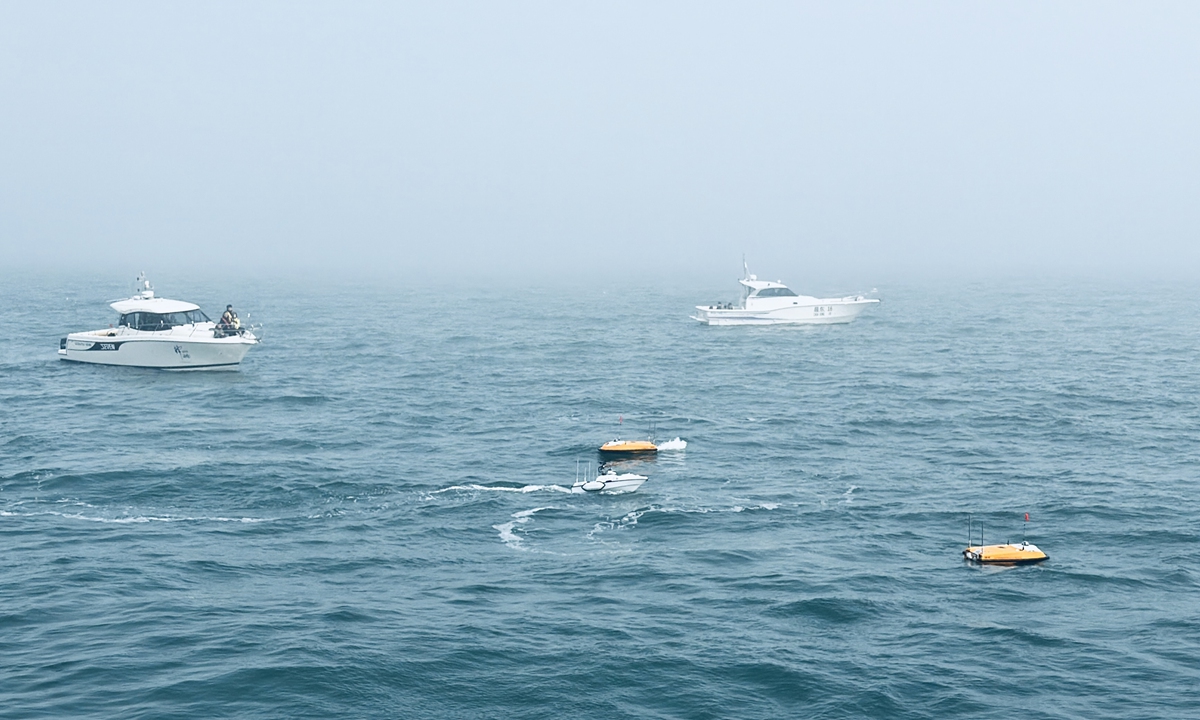
The unmanned surface vessel fleet is seen in a demonstration. Photo: Science and Technology Daily
China's first ship-based cross-domain unmanned cluster system is being tested at sea, marking a shift from developing individual technologies to building fully integrated systems for intelligent shipping, the Science and Technology Daily reported on Sunday.
Since Thursday, Dalian Maritime University has been conducting demonstration trials using the Xinhongzhuan vessel. The system brings together sea, land, air, and underwater technologies into one coordinated network, built around a real ship as its core platform, making it China's first operational platform of its kind, the report said.
All the showcased equipment, including drone swarms, unmanned surface vessel fleets, and underwater robots, were fully developed in-house by Dalian Maritime University's research teams, with complete independent intellectual property rights, Lü Hongguang, deputy director of the Science and Technology Department at Dalian Maritime University, was quoted by the report as saying.
This integrated sea-land-air-underwater unmanned system demonstrates the efficiency, safety, and coordination that advanced technologies can bring to maritime operations, while highlighting the potential of technology to empower high-quality development of China's marine industry, Liu Shuguang, a professor at the Ocean University of China, told the Global Times on Sunday.
As this year marks the first year of the 15th Five-Year Plan (2026-30) period, the marine economy faces new strategic opportunities. Liu said that technological innovation has become a key driver of high-quality development, noting that "from intelligent shipping and ocean monitoring to marine resource exploitation, advanced technologies continuously enhance operational efficiency, safety, and resource utilization."
During the 15th Five Year Plan period, China aims to advance marine development, utilization and protection, that include "increase our capacity for innovations in regard to marine science and technology, and consolidate and further enhance our strengths in shipbuilding and marine equipment manufacturing."
This provides strong support for China's goal of building a strong maritime nation and achieving high-quality development, Liu said.
The system is built around the next-generation intelligent research and training vessel, Xinhongzhuan, which serves as the "central brain" of the entire unmanned fleet.
Measuring 69.83 meters in length, the ship is equipped with more than 15,000 smart sensors and a ship-shore coordinated control link. It supports remote, shore-based piloting while assigning tasks and managing coordinated operations across aerial, surface, and underwater unmanned systems.
Drone clusters play a critical role. With visual range capabilities of more than 10 kilometers, they can act as airborne relay nodes, ensuring stable command links between the mother ship and shore based control centers, while bridging communications between surface unmanned vessels and the ship.
At the same time, drones also take on emergency supply delivery tasks, delivering life buoys, medical supplies, and other aid precisely to people in distress during rescue operations.
Unmanned surface vessels are mainly responsible for escorting the mother ship and maintaining situational awareness ability. They can operate in coordinated formations around the vessel, monitoring nearby ship traffic and marine conditions in real time, and can approach shallow waters and reefs where the mother ship cannot navigate to carry out detection tasks.
Underwater robots are used for inspecting the hull structure of the Xinhongzhuan, conducting seabed geological surveys, performing maintenance on underwater infrastructure, and retrieving samples from the seabed.
Overall, China has made positive strides in advancing high-tech development to promote high-quality development in the marine economy.
On February 21, the nation's first commercially operated intelligent container ship, the Zhifei, docked at an automated berth at Qingdao Port in East China's Shandong Province using fully autonomous navigation. This marked the country's first full-process unmanned operation for a container vessel, covering navigation, docking, and cargo handling, CCTV News reported.
RELATED ARTICLES