From ‘for China’ to ‘for the world’: how foreign firms are tapping into the country's innovation boom

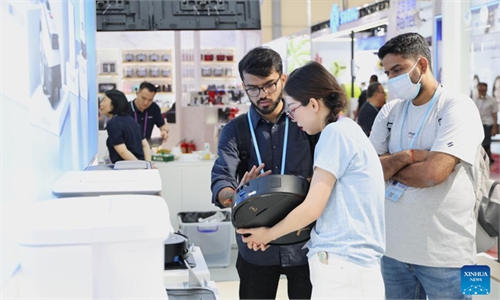
Visitors explore the exhibits at the Mercedes-Benz booth at the Guangzhou International Automobile Exhibition in Guangzhou, South China's Guangdong Province, on November 21, 2025. Photo: VCG
Ola Källenius, chairman of the Board of Management of Mercedes-Benz Group AG, still remembers the first time he met Cao Xudong, founder of Chinese technology company Momenta, back in 2017 when the startup was still in its infancy.
"After our conversation, I thought, 'This looks like a really good team. Let's invest," Källenius told the Global Times in a recent interview.
That investment marked Mercedes-Benz's first in a Chinese autonomous driving startup. Less than a decade later, the company has rolled out urban and highway navigation-assisted driving, along with advanced parking assists.
On February 26, 2026, German Chancellor Friedrich Merz took the new Mercedes-Benz S-Class for a test ride in Beijing, and experienced the intelligent assisted driving system during his official visit to China.
"This is amazing. I think it's one of the future technologies for mobility," Merz said after the experience, commending the close cooperation between German manufacturers and Chinese technology, according to the Xinhua News Agency.
The system was jointly developed by Mercedes-Benz and Momenta.
From investment to co-creation
This collaboration is just one example. The innovation footprint of foreign companies in China is shifting from "Made in China" to "Created in China," supporting global markets through local R&D and industrial chain collaboration.
On March 13, the first vehicle model co-developed by Volkswagen Group and Chinese EV maker XPeng rolled off the production line in China, underscoring the deepening partnership between the German auto giant and its Chinese counterpart.
French pharmaceutical giant Sanofi has officially launched its first China Innovation and Operation Center in Chengdu, Southwest China's Sichuan Province. The center oversees operations spanning R&D, clinical trials and supply chain services, with plans to fill more than 600 professional posts by the end of 2026.
Swiss pharmaceutical firm Novartis has announced plans to invest more than 3.3 billion yuan ($460 million) to expand its R&D, manufacturing capacity, and operations in China.
On Saturday, a total of 55 Tesla electric vehicle supercharging stations commenced operation in Southwest China's Chongqing Municipality. According to information provided by the US automaker to the Global Times, this project represents Tesla's largest single initiative in China in terms of the number of service-area supercharging stations constructed.
Amid rising uncertainties in the international environment, China is providing multinational companies with a stable operating environment through institutional opening-up. A growing number of multinational companies no longer view China merely as a production base or sales market, but are upgrading it into a hub for R&D and industrial chain collaboration within their global strategies, Liu Minghua, CEO of Deloitte China, said on company's official website on March 18.
Multinational companies are undergoing a profound transformation in their China strategy — shifting from "In China, for China" to "In China, for the world," he said.
From China to the world
In Källenius's view, collaboration with Chinese tech companies goes beyond a win-win arrangement — it also involves leveraging the company's China-based R&D team to bring local innovations to global markets.
He noted that the new S-Class's high-end rear-seat entertainment system was developed by the company's China R&D team. "They did an outstanding job. We decided: 'Let's roll this out to the world,'" he said. The same applies to its parking assist algorithms. "Any parking scenario you can think of can probably be found in China," he added. "If you can solve parking assist here, it's ready for the global market."
In the auto sector, China is home to a wealth of innovation that can be leveraged to support global markets, he said.
In fields such as energy transition, biotechnology, the digital economy, and advanced manufacturing, China is giving rise to a new wave of innovation.
China is not only a key market for Siemens Energy but also an important part of its global supply chain, innovation, and manufacturing network. The company has continued to invest in and expand capacity in China to meet growing demand for power equipment in both the domestic and overseas markets. It is also strengthening collaboration with Chinese partners in innovation, digitalization, and green manufacturing, while exploring opportunities together in third-party markets to support global energy infrastructure, the Global Times learned.
The deepening of foreign companies' innovation footprint in China would not be possible without the sustained growth of China's indigenous innovation capabilities, supported by both favorable policies and market conditions.
In 2025, China became one of the top three countries of origin for patent applications at the European Patent Office (EPO) for the first time, surpassing Japan. Applications from China accounted for 10.9 percent of the EPO's total, representing a year-on-year increase of 9.7 percent — the highest growth rate among the top 10 filing countries.
In an e-mail reply from the EPO, EPO spokesperson Roberta Romano-Götsch said China's growth reflects both the country's overall increased innovation output and changing innovation trends - from computer technologies (including AI-related fields) to digital communication (driven by the global race to develop 6G) to energy transition (powered by rapid advances in battery technologies). These are all fields where China has redoubled its efforts and now possesses considerable strength and specialization.
Even though nearly half (45.8 percent) of all applications at the EPO from China are filed in its top three technologies, the country is also diversifying, showing strong growth across a wide range of other technologies, the spokesperson said.
Data from the Ministry of Commerce (MOFCOM) showed that 8,631 new foreign-invested firms were established across China in the first two months of the year, up 14 percent year-on-year. High-tech industries attracted 63.21 billion yuan in foreign direct investment (FDI) during the period, up 20.4 percent year-on-year and accounting for 39.2 percent of the nation's total FDI.
"For multinationals, investing in China has shifted from a discretionary choice to a strategic necessity," He Yongqian, a MOFCOM spokesperson, said on Thursday.
"Some have asked, 'Will you continue to serve China?' The answer is unequivocal. We have a long-term commitment here. China is where we are firmly entrenched. We want to leverage this dynamic innovation market to drive our business in China and globally," Källenius said.
RELATED ARTICLES