ARTS / CULTURE & LEISURE
First batch of ‘master craftsmen’ honored with eye on skill, innovation
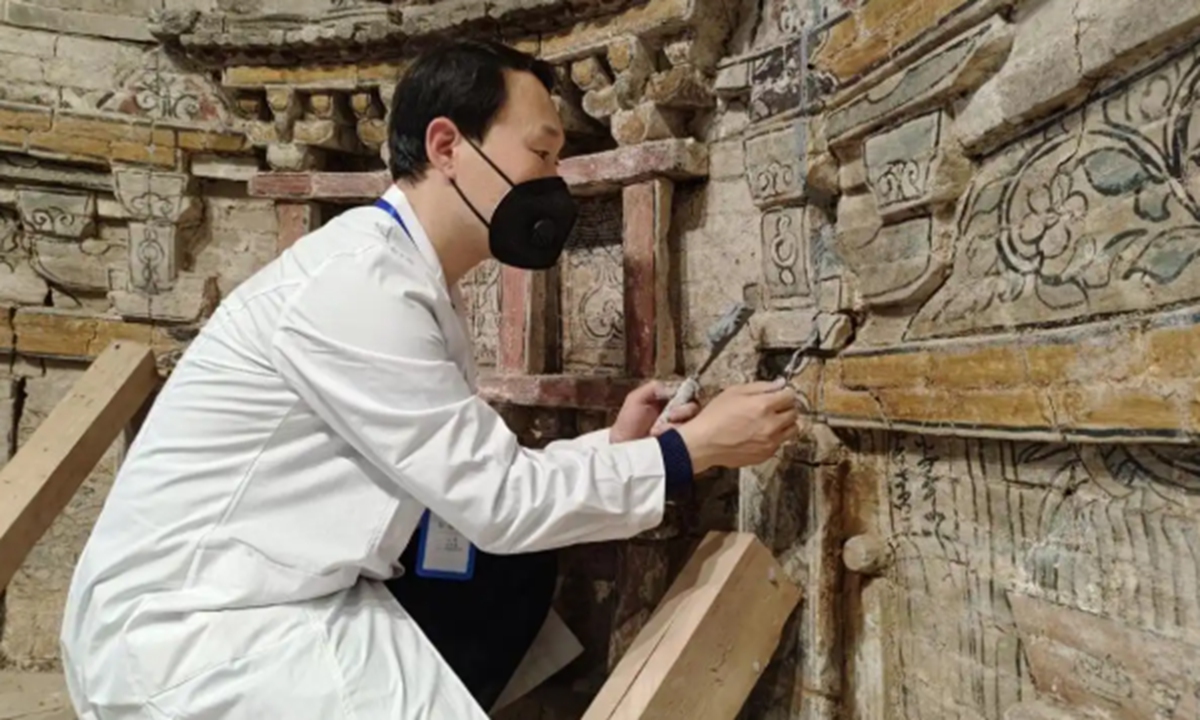
Photo: screenshot
Selecting from niche fields spanning pottery to grotto conservation, a total of 10 Chinese cultural heritage conservators have recently been honored as "national master craftsmen of cultural relics." The selection marks the first of its kind in China, and the 10 honorees also stand as the inaugural cohort of nationally recognized cultural heritage skilled talent.The honorees share two distinctive features. First, they work in a wide variety of cultural relic conservation fields. Some have long been dedicated to the restoration of movable cultural relics such as ceramics and textiles. Others are veteran professionals who have been engaged in archaeological excavation since the 1990s.
Still others specialize in the restoration of immovable cultural relics, including ancient architecture and grotto temple conservation. Additionally, some honorees are committed to integrating trending technology with traditional restoration techniques.
Besides this, these honorees come from different regions across the country, each dedicated to preservation work in their respective locales. In North and Northwest China, master craftsmen Xu Kai from Shanxi Province and Ma Yu from Shaanxi Province have long been engaged in the restoration of cultural relics such as ceramics, stone armor, and more.
Take Ma as an example. During his more than three-decade efforts in the conservation field, he has restored over 700 artifacts, including key pieces such as a set of stone armor from the Emperor Qinshihuang's Mausoleum Site Museum.
Xu Kai from Shanxi Province, on the other hand, is renowned for his unique "porcelain riveting restoration technique." The technique is an ancient folk craft that restores broken ceramics through the most minimalist and unadorned methods - using just a few small rivets, a small hammer, and a small bow drill.
Experts Zhang Peichen and Chen Huili, meanwhile, come from the two municipalities of Shanghai and Chongqing. Zhang is an expert in bronze restoration. Inside his laboratory, he carries out meticulous restoration work; outside the lab, he has become a star online with over 4 million followers, using his platform to promote traditional culture to a wider audience.
Chen Huili, on the other hand, is known as the "stone carving doctor" for her efforts in preserving the Dazu Rock Carvings in Chongqing. Since entering the field in 1996, she has restored over 50,000 statues, including the 800-year-old thousand-armed Avalokitesvara statue, also known as Qianshou Guanyin.
"Beyond the honor itself, I feel that the title of 'national master craftsman' speaks to the nation's attention toward the work I am engaged in. That is what gratifies me most," Chen told the Global Times.
In East China's Jiangsu Province, expert Xue Lingen focuses on the restoration of ancient architecture. Like Xue, Jiang Qinquan from Fujian Province is also dedicated to the preservation of ancient buildings.
Other honorees include Sun Liangshen from Shandong Province; Fu Youxu, an expert in Dunhuang mural restoration; Bai Rongjin, the restorer of the Han Dynasty (206BC-AD220) gold-thread jade burial suit; and Fang Beisong, a bamboo and wooden slip, or jiandu, restoration specialist from Hubei Province.
Noting that each niche heritage domain demands its "own specialized knowledge," Fang told the Global Times that a master conservator must not only master basic restoration techniques but also "explore innovative methods during the restoration process." "Skill is one thing, but the value of innovation in cultural heritage conservation is even more important," Fang remarked.
This capacity for innovation is precisely the reason why these 10 master craftsmen were chosen. Fang, for instance, led his team in pioneering original methods for the decolorization and dehydration of bamboo and wooden slips. As a result, his team completed the decolorization of over 180,000 slips and the dehydration of more than 130,000 slips. Also, the slips they protected accounted for more than 80 percent of the national total of these relics.
The current selection was led by the National Cultural Heritage Administration (NCHA). Luo Jing, director general of the Department of Science, Technology and Education of the NCHA, said that the selection aims to promote the "spirit of craftsmanship in the pursuit of excellence" and the professional ethos of cultural heritage workers who "dedicate their lives to a single cause."
It is also highly aligned with an "implementation opinion" issued in 2025. Led by both the National Cultural Heritage Administration (NCHA) and the Ministry of Human Resources and Social Security, the implementation opinion aims to accelerate vocational skills training and vocational skill level certification within the cultural relics sector.
The document explicitly states the need to "improve guarantee and incentive mechanisms," encourage the nomination of outstanding highly skilled talent to participate in cultural relics industry selection activities, and promote the establishment of a performance-based salary system linked to vocational skill levels within cultural heritage institutions. It also stipulates that vocational skill levels should serve as an important reference for salary distribution among cultural relics personnel.
"This policy encourages us to stay committed to our profession and gives us the confidence to inspire the younger generation to join our ranks," Chen remarked.
RELATED ARTICLES