Ukraine eyes air defense deals with Gulf states; Kiev seeks to shift image from aid recipient to supplier, raising concerns over growing intersection of two conflicts: Chinese expert
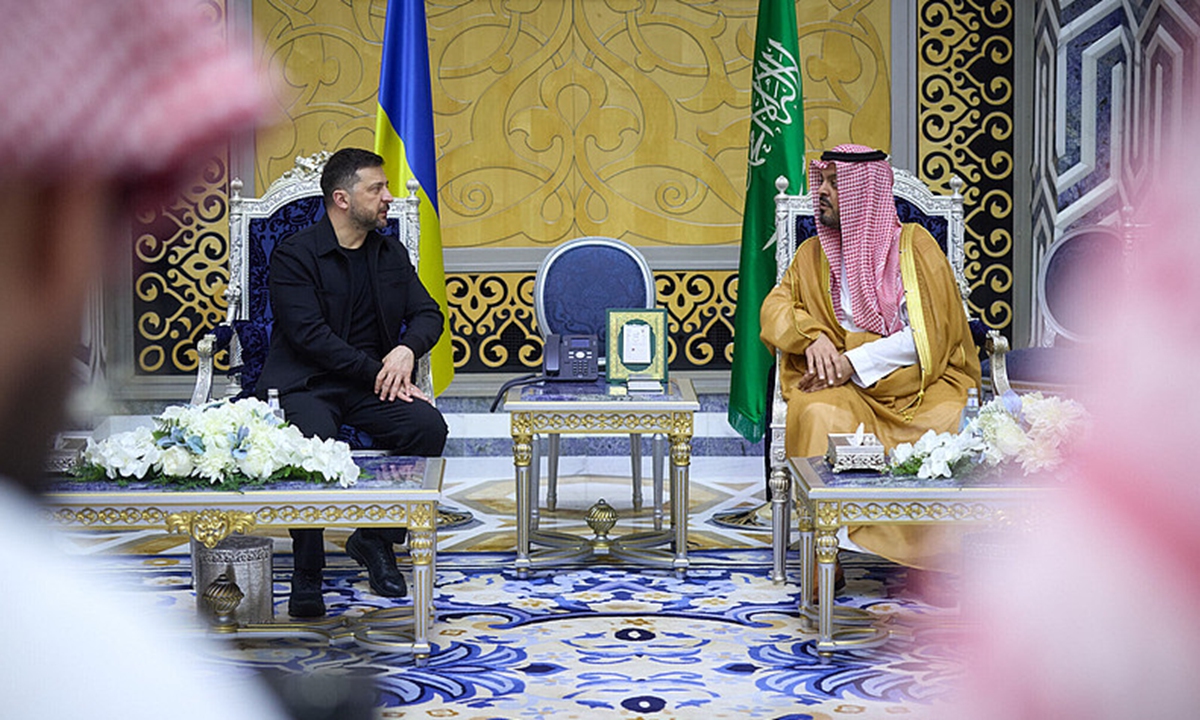
Saudi Crown Prince and Prime Minister Mohammed bin Salman Al Saud meets with Ukrainian President Volodymyr Zelensky in Jeddah on March 27, 2026. Photo: VCG
Ukrainian President Volodymyr Zelensky claimed Saturday that he had negotiated air defense agreements with Saudi Arabia, Qatar and the United Arab Emirates during his Middle East tour promoting anti-drone technologies. Kiev hopes to leverage the move to diversify sources of support rather than relying solely on external security assistance, raising concerns that the two conflicts could increasingly intersect and mutually reinforce one another, a Chinese expert noted.
"Kiev has sought to leverage its expertise in downing Russian drones to help Gulf nations and has deployed anti-drone experts to the three countries Zelensky visited during his diplomatic tour," Al Jazeera reported on Saturday local time.
Qatar's defense ministry said in a statement on Saturday that Doha and Kiev have signed a defense cooperation agreement which includes the exchange of expertise in countering missiles and unmanned aerial systems, according to Reuters.
Zelensky claimed that during his visits, he sought to build strategic relationships with the Gulf region and raise funds to invest in weapons production in Ukraine, adding that the talks focused on weapons co-production, exchanging experiences, and on securing energy and fuel supplies to Ukraine, per the report.
"Zelensky hopes to draw support from the Gulf nations" in its conflict with Russia, which is now in its fifth year, as "Western military aid faces new uncertainty and Kievscrambles for cash to cover its budget deficit and fund domestic weapon production," the report noted.
The report by the Kyiv Post said on Sunday that details of what exactly Ukraine has agreed in the Gulf are slim. "It is unclear what Kiev gets in return, or whether the deals are anything more than simple arms-for-cash," the report said.
In Saturday's report, The New York Times described Ukraine as seeking to shift its image from a recipient of military aid to a supplier. "To some extent, this assessment makes sense, as Ukraine has seen an opportunity to bring the low-cost and practical technologies it developed during the war to the international market," Chinese military affairs expert Song Zhongping told the Global Times.
For Kiev, the more desirable model is to retain a degree of control over key technologies while generating long-term benefit through continued equipment exports or technical services, Song noted
Meanwhile, the Xinhua News Agency reported that Iran's Islamic Revolutionary Guards Corps (IRGC) said on Saturday that it destroyed a Ukrainian anti-drone equipment depot in Dubai, the United Arab Emirates, used to assist US forces.
Ebrahim Zolfaghari, spokesperson for Iran's main military command Khatam al-Anbiya Central Headquarters, said that a warehouse in Dubai containing Ukrainian anti-drone systems and housing 21 Ukrainians had been targeted and destroyed in a joint operation by the IRGC's Air Force and Navy, per Xinhua.
However, Kiev denied the incident. The Kyiv Post cited a spokesperson for Ukraine's Foreign Ministry as dismissing the Iranian side's claims. "The Iranian regime often carries out such disinformation operations," Heorhii Tykhyi was quoted as saying.
This has raised concerns about potential escalation. As Iran has already threatened to regard Ukraine as a legitimate target if Kiev provides support, the two conflicts could increasingly influence each other if the assistance proves decisive, with both potentially feeding into one another, Liu Zhongmin, a professor at the Middle East Studies Institute of Shanghai International Studies University, told the Global Times.
Although the situation does not necessarily mean the two conflicts will escalate into a single large-scale war, signs of "mutual entanglement" are emerging, the expert stressed.
"The interaction remains at a "low-intensity linkage" stage, with the two conflicts influencing each other through the global supply chains, but without direct military confrontation so far," Liu said.
"Gulf states have long maintained a strategy of multilateral hedging in the Russia-Ukraine conflict. However, if Riyadh or Abu Dhabi were to rely on Ukrainian military support to defend against Iran, they might no longer be viewed as credible mediators between Ukraine and Russia," Liu said.
RELATED ARTICLES