US carries out bombing raids on military targets in Iran's Kharg Island; move reflects escalation of confrontation: Chinese expert
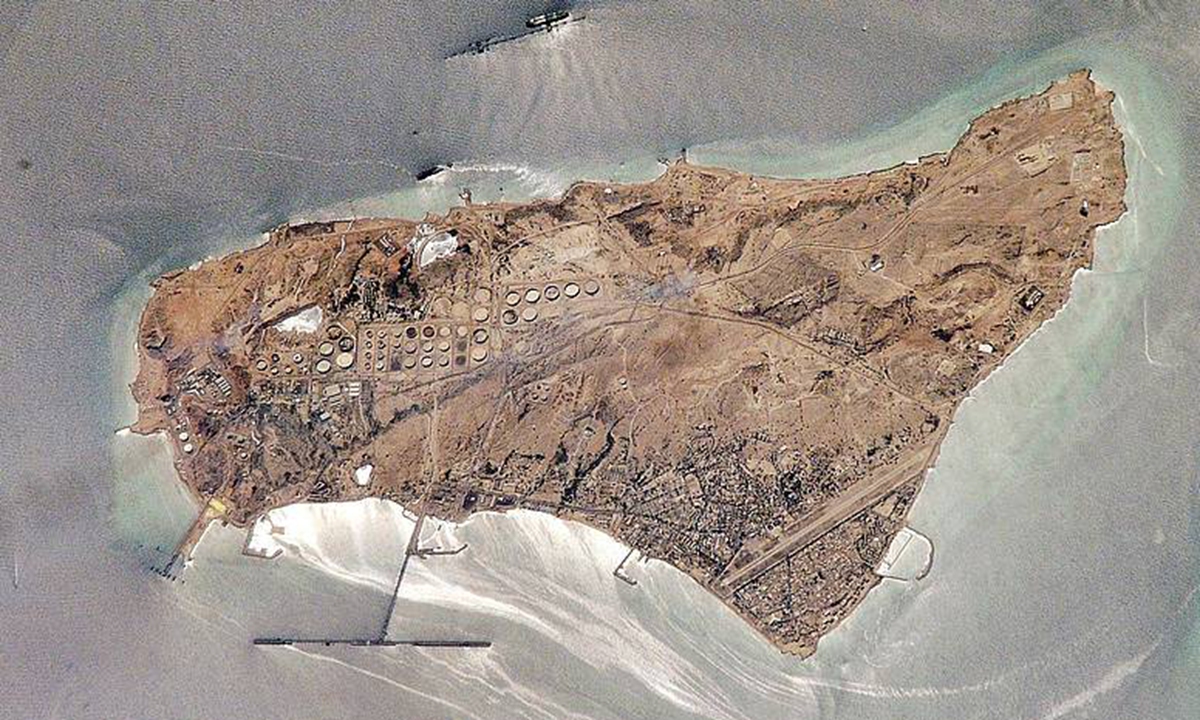
Kharg Island, Iran's primary oil export terminal in the Persian Gulf. Photo: VCG
Nearly two weeks into the US-Israeli war against Iran, the US on Friday reportedly carried out bombing raids against military targets on Kharg Island, a key oil export hub that handles most of Iran's crude shipments. A Chinese expert described the move as reflecting a further escalation of confrontation, warning that should the conflict escalate, it could expand from military targets to civilian infrastructure, signaling both intensifying hostilities and a greater threat to global energy security.
US President Donald Trump announced on Friday local time that the US military carried out bombing raids against military targets on Iran's Kharg Island. Via his Truth Social account, Trump also said he had decided not to strike the island's oil infrastructure, although he would change his mind "should Iran, or anyone else, do anything to interfere with the free and safe passage of ships through the Strait of Hormuz."
While thick smoke has been seen rising from Iran's Kharg Island, Iranian forces continue to operate from there despite Trump's claims, Iran's Fars news agency reported, according to Al Jazeera. Fars also reported that more than 15 explosions were heard on the island during the attacks, citing sources in the field, and no oil infrastructure was damaged in the attacks.
Within hours of Trump's announcement, the Iranian armed forces said any attack on Iran's oil and energy infrastructure will lead to attacks on energy infrastructure owned by oil companies cooperating with the US in the region, The Guardian reported citing Iranian media.
Just a day before, the speaker of the Iranian parliament said such a strike would provoke a new level of retaliation. Mohammad-Bagher Ghalibaf warned in a Thursday social media post that attacks on the islands on Iran's southern maritime frontier would cause Iran to "abandon all restraint", underscoring how central they are to the country's economy and security, the Guardian reported.
Located 15 nautical miles (equivalent to about 28km) from the Iranian mainland, Kharg Island is the undisputed economic backbone of Iran, where 90 percent of the country's vital crude oil exports are processed - approximately 950 million barrels every year, Al Jazeera reported.
The US continues to link Kharg Island to the Strait of Hormuz, using it as a deterrent against Iran not to close the Strait, which essentially reflects an escalation of the confrontation over the Strait, Liu Zhongmin, a professor at the Middle East Studies Institute of Shanghai International Studies University, told the Global Times on Saturday.
If the confrontation expands from military targets to civilian infrastructure, it will signal both an intensification of hostilities and a broader threat to global energy security, Liu said. However, whether the situation actually reaches this stage will depend not only on the extent of Iran's blockade of the Strait of Hormuz but also on how the US responds in the coming days, the expert added.
Citing experts, CNN reported that any attempt to capture Kharg Island would require a substantial number of ground troops, according to the Xinhua News Agency.
Earlier Friday, the Associated Press citing a US official reported that the US military had ordered 2,500 marines and the amphibious assault ship USS Tripoli to the Middle East. The move marks a reinforcement of US military presence in the region, the report added.
Based on the current scale, Liu said that this resembles more of a special operations engagement rather than a full-scale ground war. Overall, however, it indicates that the US-Iran confrontation is escalating in a more dangerous direction, he added.
RELATED ARTICLES