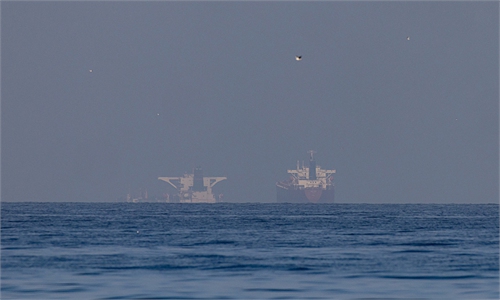
Another strait might be at risk: Will Middle East face a ‘dual chokepoint stranglehold’?
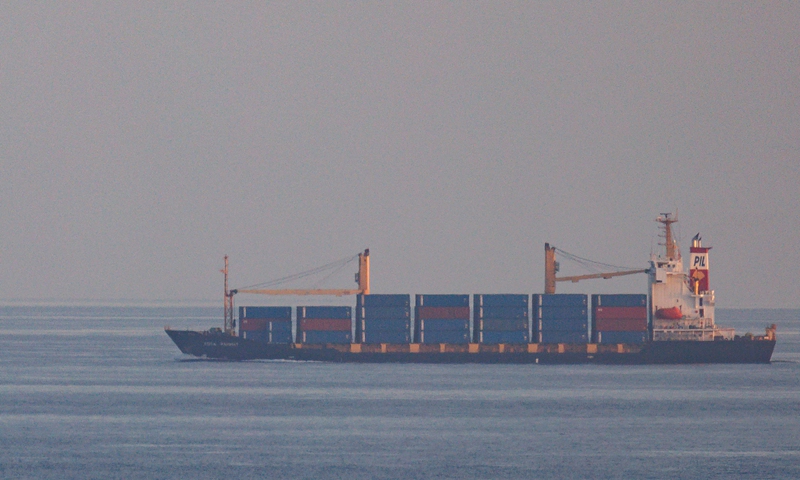
A container ship approaches the Bab-el-Mandeb Strait on January 18, 2024 in Obock, Djibouti. Photo: VCG
As Yemen's Houthi forces signal a potential entry into the Middle East fray, tensions across the region continue to escalate. The Houthis recently indicated they are considering launching military attacks or imposing a blockade in the Bab el-Mandeb Strait in support of Iran, as reported by Xinhua News Agency.
The Bab el-Mandeb Strait is regarded as one of the world's critical maritime chokepoints on par with the Strait of Hormuz. Analysts told the Global Times that while the Houthis are unlikely to fully blockade the Bab el-Mandeb Strait, their capacity to continuously disrupt shipping should not be underestimated. Once the situation escalates, this vital artery of global trade could face severe navigation risks, with far-reaching consequences for international supply chains and global trade security.
How important is Bab el-Mandeb Strait?
Escalating tensions in the Middle East have once again rippled global markets. In early Monday trading, Asia-Pacific markets broadly declined, while Brent crude oil prices opened higher and at one point surged past $116 per barrel. Reuters reported on Sunday that Brent crude has jumped 59 percent in March, marking the biggest monthly rise ever.
Following the near-blockade of the Strait of Hormuz for a month, the potential shipping risk in the Bab el-Mandeb Strait, another critical chokepoint in global maritime trade, is beginning to surface. Linking the Red Sea and the Gulf of Aden, the strait serves as a vital corridor for energy supplies and global trade flows in Middle East. Foreign media noted that navigation through the Bab el-Mandeb is highly challenging, with its narrowest point measuring just 29 kilometers across. Around 10 to 12 percent of global oil and natural gas shipments move through the strait.
Li Zixin, an assistant research fellow at the China Institute of International Studies, told the Global Times on Monday that the Bab el-Mandeb accounts for roughly 12 percent of global seaborne trade, and a comparable share of energy shipments. While a blockade of the Strait of Hormuz would primarily impact the energy sector, disruption in the Bab el-Mandeb would have broader ramifications for global goods trade, delivering a heavier blow to international shipping and insurance industries.
He added that if the Bab el-Mandeb were to be closed, vessels would be forced to reroute around the Cape of Good Hope, "significantly increasing freight costs, insurance premiums, and delivery times."
Wang Xiaoyu, an associate research fellow at the Middle East studies center of Fudan University, said that the Bab el-Mandeb is a key node in the global shipping network, connecting the Gulf of Aden, the Red Sea, and the Suez Canal route, serving as a crucial maritime gateway for Asia-Europe trade. "Any disruption or heightened tensions in this corridor would force ships to detour around the Cape of Good Hope, leading to longer voyages, higher freight rates, increased insurance costs, and supply chain volatility. This makes the strait a highly sensitive point where regional conflicts can quickly translate into global trade risks," she said.
More dangerous than a blockade: the cascading effects of repeated disruptions
Analysts generally agree that a blockade of the Bab el-Mandeb would deal a double blow to global energy supply and logistics chains.
Li noted that if both the Strait of Hormuz and the Bab el-Mandeb were simultaneously blocked, export routes for Gulf oil and gas would be severely constrained. "An energy crisis and a shipping crisis would be highly likely, potentially cascading into broader disruptions across industrial and supply chains," he said. He also noted that Arab countries' attitudes toward Iran may shift more rapidly, becoming increasingly confrontational, which could further escalate regional tensions.
Wang argued that rather than attempting to "blockade the Bab el-Mandeb Strait," the Houthis are effectively disrupting its shipping order amid the ongoing turmoil in the Middle East. "What truly warrants concern is not whether the strait will be completely closed, but that these repeated disruptions are steadily driving up global trade costs and amplifying the spillover effects of regional conflicts on the international economy," she said.
Elisabeth Kendall, a Middle East specialist at the Cambridge University, told Al Jazeera that if this strait is blocked, it would create a "nightmare scenario."
"Because if you have restrictions on the Strait of Hormuz at the same time as restrictions are escalating in the Bab al-Mandeb, then you really will disrupt, if not cripple, trade toward Europe.
How likely is Middle East to face a "dual chokepoint stranglehold"?
According to Xinhua, the US think tank Stimson Center has assessed that potential Houthi targets could include US interests in the Gulf region, and that a blockade of the Bab el-Mandeb is "possible."
BBC reported that the Houthis targeted shipping coming through the Bab al-Mandab Strait at the southern end of the Red Sea, between Yemen and the Horn of Africa. Their action then endangered that key commercial maritime route. Were they to do so again, it would be another big blow to the global economy. Coupled with Iran's near-closure of the Strait of Hormuz, two of the main strategic waterways in the world for trade and energy supplies could potentially be cut off.
"The likelihood of a 'dual chokepoint stranglehold' rises significantly as conflict intensifies in the Persian Gulf," Li told the Global Times. While the Houthis have so far played a limited role, escalating US and Israeli strikes on Iran's key infrastructure—or even potential ground operations—could prompt Tehran to expand its response beyond the Gulf, given its limited options for direct retaliation there.
However, Wang maintained that a full blockade of the Bab el-Mandeb by the Houthis remains unlikely, however, they possess strong capacity to disrupt shipping and drive up global trade and energy transport risks.
Wang noted that while the strait is highly strategic, it is not a waterway that can be easily or sustainably cut off by a single armed group. "Its geographic and navigational conditions make it vulnerable to attacks, but difficult to completely seal off. In other words, it is a highly sensitive node in global shipping, but not a chokepoint that can be readily subjected to total blockade."
Wang further explained that although the Houthis have improved their capabilities in missiles, drones, and maritime attacks in recent years—enough to force some shipping companies to reroute and drive up freight and insurance costs—the leap from "harassment" to "blockade" would require sustained control of the waterway and the ability to withstand external military intervention, which they currently lack.
"More importantly, given the strait's critical role in global energy transport and trade security, any development that significantly disrupts basic navigation would almost inevitably trigger external military intervention. Under such circumstances, the Houthis are more likely to pursue actions that amplify their political and strategic leverage rather than attempt a full shutdown of the route," she said.
Al Jazeera noted that, so far, Yemen's Houthi forces have not officially declared their entry into the conflict. Kendall from Cambridge added that while this was a "sweet spot" for the Houthis, she noted that the Yemeni group might not want to "provoke a Saudi or indeed a broader response."
RELATED ARTICLES