China's manufacturing PMI reaches 50.4 in March, indicating improved economic momentum: NBS
By Published: Mar 31, 2026 11:29 AM

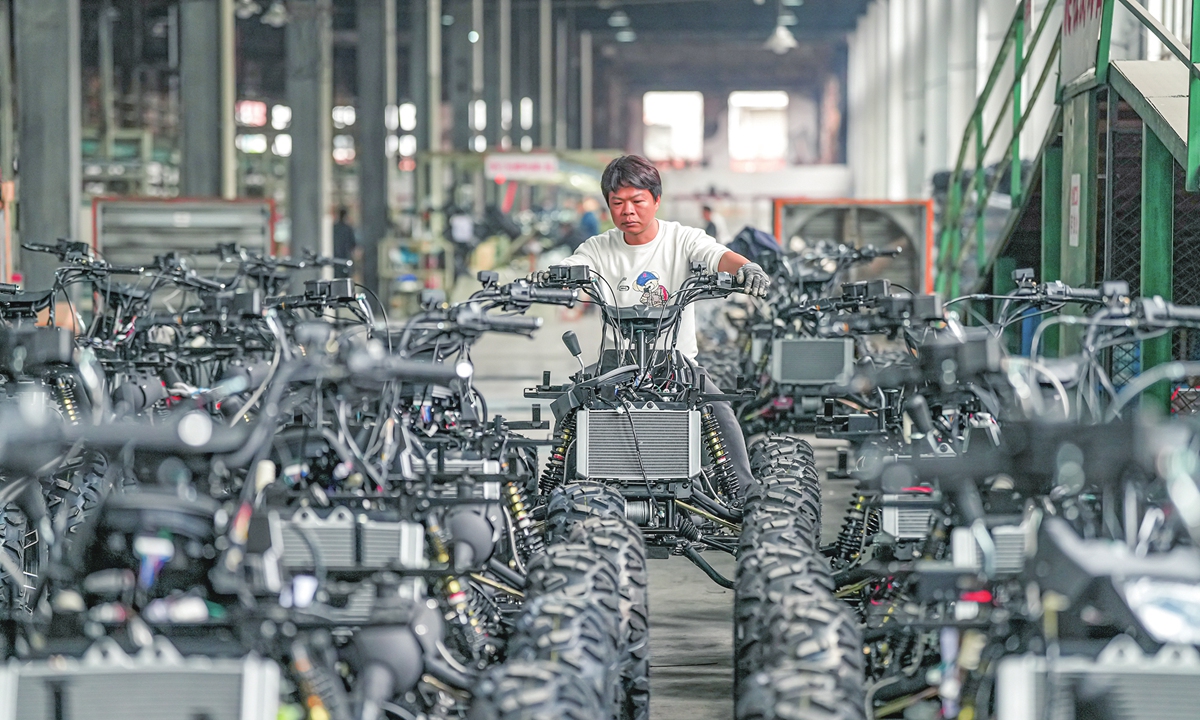
A worker assembles motorcycles on a production line at a manufacturing company in Jinhua, East China's Zhejiang Province, on March 30, 2026. The company is ramping up production to fulfill orders and meet its annual targets. Photo: VCG
China's Manufacturing Purchasing Managers' Index (PMI) rose to 50.4 in March, up 1.4 points from February, after staying below the mark of 50 for two months, according to data released by the National Bureau of Statistics (NBS) on Tuesday. The increase points to the country's recovering economic activity levels.
Analysts said that the March reading is an indicator of the resilience of the Chinese economy, paving the way for steady full-year economic growth, while warning about the impact of rising commodity prices amid the situation in the Middle East.
The PMI stood at 49.3 in January and 49.0 in February. In December 2025, it was 50.1. A reading above 50 signals expansion and one below indicates contraction.
Huo Lihui, chief NBS statistician, said that businesses accelerated the resumption of work and production after the Spring Festival holidays, lifting up market vitality. Specifically, Huo attributed the increase to expansions in both production and demand; a rebound in the PMI reading in enterprises across different sizes, and fast expansion in three key sectors - high-tech manufacturing, equipment manufacturing and consumer goods industries, and energy-intensive industries.
Affected by factors such as the recent continuous rise in prices of some bulk commodities and accelerated corporate procurement, indices tracking raw material input prices and factory gate prices were up significantly from the previous month, indicating a notable rebound in overall manufacturing prices, said Huo.
China's non-manufacturing PMI rose by 0.6 points to 50.1, and the composite PMI climbed to 50.5, up 1 point from February.
With all three gauges returning to expansion territory, this suggests the overall economic activity level is improving, Huo noted.
According to CNBC, which noted that the data is "expanding at its sharpest pace in a year," export orders showed strong momentum in March, as the official gauge for manufacturing activity climbed more than expected.
Reuters reported that the stronger reading in March eases pressure on policymakers, but noted doubts about its durability amid surging energy prices driven by the Middle East conflict.
The recovery in March manufacturing PMI data indicated that the economy was off to a good start in the first quarter, laying a solid foundation for the reminder of the year, Sun Chuanwang, a professor at the School of Economics at Xiamen University, told the Global Times on Tuesday.
The short-term economic recovery has shown resilience, Sun said, while noting that it is still necessary to look for supporting indicators such as those gauging the recovery progress of small and medium-sized enterprises, the transmission of cost pressures and the sustainability of domestic demand in the next phase.
"Tuesday's PMI data indicates that China's first-quarter GDP growth likely surpassed 4.5 percent, the floor for the 2026 growth target. The headline PMIs of both the manufacturing sector and the non-manufacturing sector returned to the expansionary zone" after the longer-than-usual Spring Festival holidays in February, analysts from ANZ Research said in a research note sent to the Global Times on Tuesday.
China's producer price index probably turned positive in March, ANZ analysts said, noting the impact of the rise of raw material prices amid the situation in the Middle East.
Wang Qing, chief macroeconomic analyst at Golden Credit Rating International, told the Global Times on Tuesday that the March data was bolstered by company activity in work and production resumption, strong export growth in the first two months, and the accelerated pace in emerging sectors.
Among the key sub-indices, the production index rose to 51.4, up 1.8 points from the previous month, while the new order index reached 51.6, up 3.0 points from February, indicating markedly improved market demand.
The survey results also showed that, affected by factors such as the current geopolitical conflicts in the Middle East, prices of raw materials such as oil and chemicals have risen sharply, according to the NBS. Coupled with increase in logistics freight rates, the proportion of enterprises reporting high raw material and logistics costs increased compared with the previous month.
By industry, price indices for petroleum, coal and other fuel processing, and chemical raw materials and chemical products have seen notable increases in purchase and selling prices.
The rebound in the manufacturing PMI came after China posted a number of strong industrial data points.
On March 27, NBS data showed that the profits of China's major industrial firms increased 15.2 percent year-on-year in the first two months of 2026, with equipment manufacturing and high-tech manufacturing serving as major growth drivers.
On March 4, according to a survey published by RatingDog, a Chinese consulting firm, China's services activity accelerated in February, with the services PMI hitting 56.7, the highest reading in 33 months.
During the first two months of this year, exports totaled 4.62 trillion yuan ($668.42 billion), up 19.2 percent year-on-year, while imports amounted to 3.11 trillion yuan, up 17.1 percent, the General Administration of Customs said on March 10.
Wang noted that as the advanced economies including the US and the EU begin to feel the impact of the Middle East conflicts in the coming months, China's export sector may be affected.
RELATED ARTICLES