China-Laos-Thailand all-rail cold-chain service launches, sending fresh fruits from ASEAN to China
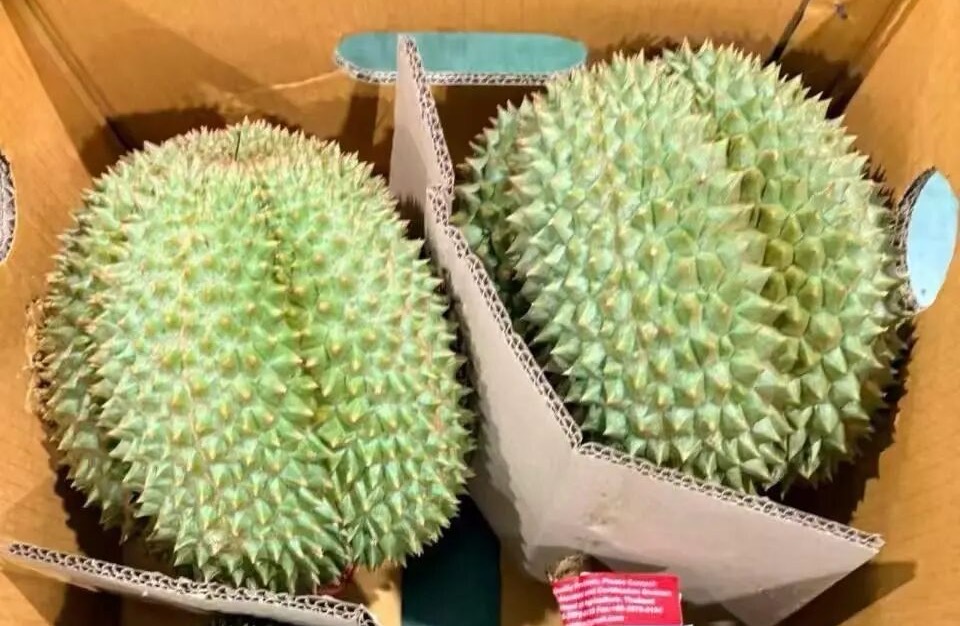
Durains Photo: Chengdu Fabu
A China-Laos-Thailand all-rail cold-chain cargo service carrying fresh Thai durians departed on Monday, marking a new cross-border transport corridor for fruit, Chengdu International Railway Port Investment and Development (Group) Co, the cold-chain operator, told the Global Times in a statement on Tuesday.
It's the latest step forward in opening faster channels for Southeast Asian fruits entering the Chinese market, which will inject fresh momentum into China-Laos-Thailand trade and help drive consumption upgrading in the western part of China, industry analysts said.
The service runs entirely on rail, passing through Nong Khai in Thailand and Vientiane South in Laos, entering China via the Mohan port in Southwest China's Yunnan Province before heading to the Chengdu International Railway Port, the statement said.
The cost structure of imported fruit is complex, with transport, spoilage, and quarantine costs often exceeding the costs of procurement at origin. Shifting to all-rail cold-chain logistics enables direct delivery, shortens transit times, reduces losses, and cuts intermediate costs, enhancing both quality and competitiveness, Bian Yongzu, executive deputy editor-in-chief of Modernization of Management magazine, told the Global Times on Tuesday.
With advantages including direct railway delivery, full-process freshness preservation, and cost efficiency, it is reshaping the transport model for Southeast Asian fruit imports and offering Chinese consumers a new fresh produce experience.
Compared with the existing Vientiane South-Chengdu route, the new route extends the rail starting point from Laos to Laem Chabang in Thailand, directly linking to key durian-producing areas in eastern Thailand.
Fresh fruit is transported from orchards to Laem Chabang within five hours by road before being loaded onto the train for direct shipment to Chengdu, reducing the transfer time and improving efficiency, according to the statement, noting that the closed-loop cold-chain system maintains a constant temperature of 13 C from loading to unloading, ensuring optimal freshness.
To date, the value of imports of Southeast Asian fruits at Chengdu International Railway Port has exceeded 100 million yuan ($13.9 million), said the statement.
Durians, a flagship fruit that's exported in massive quantities from Southeast Asia to China, have seen strong import momentum. The Kunming Daily, citing Kunming Customs, reported that imports of durians through multiple ports, including Tianbao, Mohan, and Hekou, increased in the first two months of this year.
In the first two months of the year, the value of durian imports through Yunnan ports reached 2.05 billion yuan, up 351.6 percent year-on-year, ranking first nationwide, the report said.
Recent imports of fruit overall have also maintained a strong upward trend.
A surge in fruit imports has gathered pace, driven in large part by improved customs clearance efficiency at border ports.
In the first two months of the year, Tianbao Customs handled 14,000 tons of fruit imports from ASEAN members, more than quadrupling year-on-year, including more than 10,000 tons of durians alone, according to Kunming Customs.
With the China-Laos-Thailand all-rail model moving toward regular operations and extending to more inland cities, China's vast consumer market is expected to generate a strong "siphon effect," further driving down transport costs and prompting adjustments in Southeast Asia's production and supply chains, according to Bian. Lower-end prices are likely to stimulate demand, particularly in central and western regions, expanding trade volumes and boosting related sectors such as cold-chain logistics, wholesale, and supporting services, ultimately deepening economic ties between China and ASEAN, he said.
China is one of the world's largest fruit consumption markets. In recent years, rising consumer spending and the development of cross-border logistics have made fresh, high-quality specialty fruits from ASEAN members a popular choice for holiday purchases among Chinese consumers.
RELATED ARTICLES